Paper Review
Learning What Matters: Supervising Global Context Pruning with Causal Evidence Sets
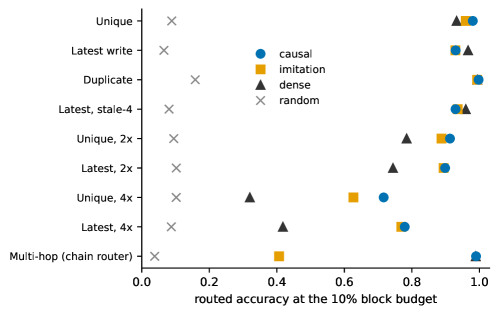
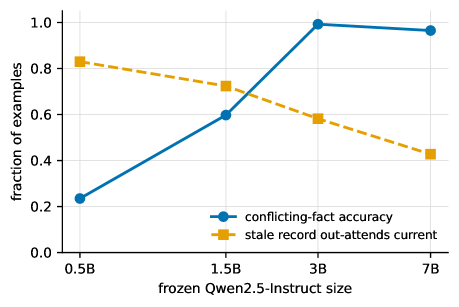
Sparse-attention routers are usually trained to imitate a dense teacher's attention pattern; this paper builds tasks with exactly known causal evidence and shows attention and causal dependence disagree, with a router trained on masking-derived causal labels reaching 0.99 routed accuracy on a 2-hop task versus 0.41 for an attention-distilled router, plus a pretrained-model result where larger models get answers right well before their attention becomes trustworthy.
희소 어텐션(sparse attention) 라우터는 보통 dense 교사 모델의 어텐션 패턴을 모방하도록 학습된다. 이 논문은 인과적 근거가 정확히 알려진 과제를 설계해 어텐션과 인과적 의존성이 실제로는 어긋난다는 것을 보이고, 마스킹 기반 인과 라벨로 학습한 라우터가 2-hop 과제에서 0.99의 라우팅 정확도를 달성하는 반면 어텐션 증류 라우터는 0.41에 그친다는 것, 그리고 사전학습 모델에서는 모델이 커질수록 어텐션이 신뢰할 만해지기 훨씬 전에 정답부터 맞히기 시작한다는 것을 보여준다.
Background Sparse attention lets each query read only a selected part of the context instead of all of it, cutting the cost of long-context inference. The selector (router) making that choice is usually trained by distilling a dense teacher model's attention distribution, resting on the assumption that where a teacher attends reveals what it actually depends on.
배경 희소 어텐션(sparse attention)은 각 쿼리가 문맥 전체가 아니라 선택된 일부만 읽게 해 긴 문맥 처리 비용을 줄이는 기법이다. 이런 선택기(라우터)는 보통 dense 교사 모델의 어텐션 분포를 그대로 모방하도록(distillation) 학습되는데, 이는 "교사가 어디에 주의를 기울이는지 보면 실제로 무엇에 의존하는지 알 수 있다"는 가정에 기대고 있다.
Problem That assumption has never really been tested against ground truth. Whether attention weights are trustworthy explanations has been debated for years, but without knowing exactly what evidence determines an answer, the debate had no way to be settled.
문제 문제는 그 가정 자체가 실증적으로 검증된 적이 없다는 것이다. 어텐션 가중치가 실제로 신뢰할 만한 설명(explanation)인지에 대한 논쟁은 오래됐지만, 정답을 결정하는 근거가 정확히 무엇인지 알 수 있는 정답(ground truth)이 없어 그 논쟁은 결론이 나지 않았다.
Prior limitations Prior sparse-attention work — fixed patterns (Longformer, BigBird), training-free selection methods, and learned routers trained via attention distillation — all used attention as the supervision signal directly, without ever checking that signal against known causal evidence.
기존 한계 기존 희소 어텐션 연구들 — 고정 패턴(Longformer, BigBird), 학습 없는 선택 기법, 어텐션 증류 기반 학습형 라우터 — 은 모두 어텐션을 라우팅의 지도 신호로 그대로 사용했을 뿐, 그 신호를 알려진 인과적 근거와 대조 검증한 적이 없다.
Goal Build synthetic tasks where the evidence for each answer is known exactly, and directly compare a router supervised with causal-masking-derived labels against one supervised with attention distillation.
목표 근거가 정확히 무엇인지 알 수 있는 합성 과제를 만들고, 인과적 마스킹으로 얻은 라벨로 지도한 라우터와 어텐션 증류로 지도한 라우터를 직접 대조하는 것이 목표다.
Method Causal evidence is defined by intervention: add -10^4 to the attention logits of a block's positions at every layer to "erase" it (without moving token positions), then check whether the answer flips. The resulting necessary/sufficient/interchangeable-family block labels become the router's training target directly, compared against a standard KL-distillation-from-teacher-attention router. It is like a blackout test — switching off each light in a room one at a time to see if the room stays lit tells you which light is actually load-bearing far more reliably than eyeballing how bright each one looks.
방법 인과적 근거는 개입(intervention)으로 정의한다 — 특정 블록의 위치에 해당하는 어텐션 로짓에 모든 레이어에서 −10⁴을 더해 그 블록을 "지운" 뒤(토큰 위치 자체는 옮기지 않는다), 답이 바뀌는지를 확인한다. 이렇게 얻은 필요/충분/대체가능(family) 블록 라벨을 라우터의 학습 목표로 직접 사용하고, 이를 표준적인 "교사 어텐션 분포에 대한 KL 증류" 라우터와 비교한다. 마치 정전 실험처럼 — 방 안의 각 조명을 하나씩 꺼보고 방이 계속 밝은지를 보는 것이 조명 하나하나가 "얼마나 밝게 보이는지"를 눈대중으로 재는 것보다 어떤 조명이 실제로 필요한지 더 정확히 알려주는 것과 같다.
Key idea The core move is using a non-differentiable but purely interventional signal — mask and recheck — instead of differentiable attention weights as the supervision target. This is deliberately blunt rather than a refined attribution technique, and that bluntness is the point: it carries no risk of re-inheriting some other model-internal artifact the way a fancier attribution method might.
핵심 아이디어 핵심은 미분 가능한 어텐션 가중치 대신, 미분 불가능하지만 순수한 개입(마스킹→재확인)을 지도 신호로 쓴다는 것이다. 이 방식은 정교한 귀속(attribution) 기법이 아니라 의도적으로 투박하다 — 그 투박함 덕분에 그 라벨이 모델 내부의 다른 아티팩트를 다시 상속받을 위험이 없다.
Validation Tested across five task families — unique retrieval, latest-write, duplicate evidence, multi-hop (up to 3 hops), and aggregation — plus cross-seed stability (Jaccard agreement), robustness under a 4x context-length shift, and a check of whether causal labels recovered without oracle access agree with ground-truth annotations (87-92%). The comparison is further extended to real pretrained models (Qwen2.5 at 0.5B/3B/7B, Gemma-2-9B) on a conflicting-fact task.
검증 단일 검색, 최신 갱신값 검색, 중복 근거, 최대 3-hop 멀티홉, 집계(count) 등 다섯 개 과제 계열에서 검증했고, 학습 시드 간 안정성(자카드 유사도), 4배 문맥 길이 이동에 대한 강건성, 그리고 정답 주석 없이 복원한 인과 라벨이 실제 정답 주석과 얼마나 일치하는지(87–92%)까지 확인했다. 또한 Qwen2.5(0.5B/3B/7B)와 Gemma-2-9B 같은 실제 사전학습 모델의 상충 사실 과제로 결과를 확장했다.
Results On a 2-hop chain task, the causally-supervised router reaches 0.99 routed accuracy (100/100/100% recall at each hop) versus 0.41 for the attention-distilled router — recall at the intermediate hop collapses to 0% because attention skips a step already "consumed" earlier in the computation. Causal labels are far more stable across training seeds (Jaccard 0.79-0.90 vs. 0.25-0.46 for attention-based selection) and hold up better under a 4x length shift (0.72-0.78 vs. 0.32-0.42). In the pretrained-model experiments, Qwen2.5-7B reaches 96% accuracy while still attending more to a stale record than the current one on 43% of examples.
결과 2-hop 체인 과제에서 인과 지도 라우터는 0.99의 라우팅 정확도(각 단계 재현율 100/100/100%)를 보인 반면, 어텐션 증류 라우터는 0.41에 그쳤다 — 이미 앞선 계산 단계에서 소비되어 "다 읽은" 중간 단계를 어텐션이 건너뛰기 때문에 그 단계의 재현율이 0%로 떨어진다. 인과 라벨은 시드 간 자카드 일치도가 0.79–0.90으로 어텐션 기반 선택(0.25–0.46)보다 훨씬 안정적이며, 4배 길이 이동에서도 더 잘 버틴다(0.72–0.78 대 0.32–0.42). 사전학습 모델 실험에서는 Qwen2.5-7B가 96%의 정답률을 보이면서도 여전히 43%의 사례에서 오래된 기록에 더 주의를 기울였다.
Comparison Against both attention distillation and an "adaptive attention" baseline (smallest block set covering 90% of attention mass), the three supervisions tie on simple single-record retrieval, but the causally-supervised router's advantage grows sharply as context lengthens or tasks require multi-hop chains.
비교 어텐션 증류 및 상위 90% 어텐션 질량을 덮는 "적응형 어텐션" 기준선 모두와 비교했을 때, 단일 레코드 검색처럼 단순한 과제에서는 세 방식이 비슷하지만 문맥이 길어지거나 멀티홉으로 복잡해질수록 인과 지도 라우터의 우위가 뚜렷해진다.
Significance From an efficient-AI standpoint, this reopens the question of what the correct training signal for a sparse-attention router should be — not imitating attention, but labels derived from causal intervention. It also shows that accuracy improves with scale faster than attention faithfulness does, which is a caution against treating raw attention weights as an interpretability signal more generally.
의의 효율적 AI 관점에서 이 논문은 희소 어텐션 라우터의 "정답 학습 신호"가 무엇이어야 하는지를 다시 묻는다 — 어텐션을 모방하는 것이 아니라 인과적 개입으로 얻은 라벨을 써야 한다는 것이다. 동시에 모델 규모가 커질수록 정답률은 개선되지만 어텐션의 신뢰도는 그보다 느리게(혹은 다르게) 개선된다는 점을 보여, 어텐션을 해석 가능성의 신호로 쓰는 관행 전반에 의문을 던진다.
Limitations Stated directly by the authors: the tasks are synthetic and the teacher models used in the main router experiments are small (10.7M parameters). Cost is measured as accuracy at a fixed block budget, not wall-clock time. Router transfer is checked across seeds and training length, not across tokenizers or architectures. The efficient label estimator handles redundancy and multi-hop chains separately but not combined in one example — only a costlier greedy search covers that mixed regime. The pretrained-model experiments cover only two tasks with forced-choice scoring at short (dozens-of-record) contexts, leaving free-form generation and document-scale context untested.
한계 저자들이 직접 밝힌 한계다: 과제는 합성이며 라우터 실험에 쓰인 교사 모델은 1,070만 파라미터로 작다. 비용은 블록 예산 대비 정확도로만 측정했고 실제 벽시계 시간(wall-clock)은 다루지 않는다. 라우터의 전이는 시드와 학습 길이에 대해서만 확인했고 토크나이저나 아키텍처 전이는 다루지 않는다. 중복(redundancy)과 체인이 한 예제 안에 함께 나타나는 혼합 상황은 효율적인 추정기가 처리하지 못하고, 더 비용이 큰 그리디 탐색만이 이를 다룬다. 사전학습 모델 실험은 두 과제, 강제 선택형 채점, 수십 개 레코드 수준의 문맥만 다뤄 자유형 생성이나 문서 규모 문맥은 열려 있다.
Future work No separate future-work section is given, but the limitations section names what remains open: extending to free-form generation and document-scale context, transferring the router across tokenizers and architectures, and finding a more efficient estimator for the combined redundancy-plus-chain regime.
향후 과제 논문은 별도의 향후 연구 절을 두지 않지만, 한계 절에서 다음이 미해결로 명시된다: 자유형 생성과 문서 규모 문맥으로의 확장, 토크나이저·아키텍처 간 라우터 전이, 그리고 중복과 체인이 함께 나타나는 혼합 상황을 다루는 더 효율적인 추정기.
Released resources No public code repository was found — no public release verified.
자원 공개 공개 코드 저장소는 확인되지 않았다 — 공개 링크 확인 안 됨.
The research thread
Where this paper sits 연구의 흐름
Efficient long-context attention research has moved from fixed-pattern sparsification (Longformer, BigBird) through training-free block selection to learned routers trained by distilling a dense teacher's attention. That whole line shares an implicit premise: wherever the teacher attends is where the real evidence is. Separately, the interpretability literature has long debated whether attention weights are trustworthy explanations at all, but without a ground-truth evidence set, that debate had no way to resolve.
This paper's shift is fusing those two lines into one testable question. By building synthetic tasks where the evidence is known exactly, it shows attention-distilled routing inherits precisely the flaw the interpretability debate worried about — and that flaw now has a concrete, measurable cost: a router that drops an entire intermediate step on a 2-hop chain task. A second twist follows: on real pretrained models, scaling up to get the right answer and getting attention to point at the right evidence turn out to be separable — growing capability does not automatically buy growing attention faithfulness.
The open question this paper leaves is whether the result holds at real serving-scale sparse attention. By the authors' own account, the validation stays within small teacher models, synthetic tasks, and contexts of dozens of records — whether the causal-supervision advantage persists, grows, or requires an entirely different labeling recipe under document-scale free-form generation and across tokenizers and architectures is left for follow-up work.
긴 문맥을 다루는 효율적 어텐션 연구는 Longformer, BigBird 같은 고정 패턴 희소화에서 시작해, 최근에는 학습 없이 블록을 고르는 방법과, dense 교사의 어텐션을 증류해 학습하는 라우터로 이어져 왔다. 이 흐름 전체가 공유하는 암묵적 전제는 "교사가 주의를 기울이는 곳이 실제로 중요한 곳"이라는 것이었다. 한편 해석가능성 연구 쪽에서는 어텐션 가중치가 정말 신뢰할 만한 설명인지를 놓고 오래 논쟁해왔지만, 정답의 근거가 정확히 무엇인지 아는 정답 세트가 없어 논쟁은 미해결로 남아 있었다.
이 논문의 전환은 그 두 흐름을 하나의 질문으로 합친 데 있다. 정답 근거가 정확히 알려진 합성 과제를 만들어 어텐션 증류 기반 라우팅이 해석가능성 논쟁이 우려하던 바로 그 결함을 그대로 물려받는다는 것을, 그리고 그 결함에 구체적인 비용이 따른다는 것을(2-hop 체인 과제에서 중간 단계를 통째로 놓치는 라우터) 보여준다. 여기에 더해 두 번째 반전이 있다 — 실제 사전학습 모델에서는 모델을 키워 정답률을 올리는 것과 어텐션이 올바른 근거를 향하게 만드는 것이 서로 분리된다는 것이다. 즉 능력이 커진다고 해서 어텐션의 신뢰도가 저절로 따라오지 않는다.
이 논문이 남기는 질문은 이 결과가 실제 서빙 규모의 희소 어텐션에서도 성립하는가이다. 논문 스스로 인정하듯 검증은 작은 교사 모델, 합성 과제, 수십 개 레코드 수준의 문맥에 머물러 있다 — 문서 규모의 자유형 생성 문맥에서, 그리고 서로 다른 토크나이저·아키텍처 사이에서 인과 지도의 우위가 그대로 유지될지, 커질지, 아니면 전혀 다른 라벨링 방식이 필요해질지는 후속 연구의 몫으로 남아 있다.
Sparks — where one could take this 아이디어의 씨앗
-
As the paper itself notes as a limitation, would the gap between attention-distilled and causally-supervised routers widen or narrow under free-form generation and document-scale context? 논문이 명시한 한계대로, 자유형 생성과 문서 규모의 문맥에서도 어텐션-증류 라우터와 인과 지도 라우터의 격차가 이 논문에서 본 것처럼 벌어질까, 아니면 좁혀질까?
-
Router transfer was only checked across seeds and training length — would the same causal-supervision recipe hold up when transferred across different tokenizers or architectures? 라우터의 전이는 시드와 학습 길이에서만 확인됐다 — 같은 인과 지도 방식이 서로 다른 토크나이저나 아키텍처 사이에서도 비슷한 우위를 유지할까?
-
The mixed regime where redundant evidence and multi-hop chains co-occur in one example is currently only handled by a costlier greedy search — could a more efficient estimator be designed for it? 중복 근거와 멀티홉 체인이 한 예제 안에 함께 나타나는 혼합 상황은 지금은 비용이 큰 그리디 탐색으로만 다뤄진다 — 이를 감당할 더 효율적인 추정기를 설계할 수 있을까?
Seeds grounded in the paper's own stated limitations and open questions. 논문이 스스로 밝힌 limitations와 open questions에 뿌리를 둔 씨앗입니다.
Notes
Notes
Linked reviews
DuoAttention: Efficient Long-Context Inference with Retrieval and Streaming Heads
Learns which attention heads actually retrieve from long context and gives only those a full KV cache, cutting long-context memory up to 2.55x with retrieval accuracy intact.
kv-cacheH2O: Heavy-Hitter Oracle for Efficient Generative Inference of LLMs
A small set of "heavy-hitter" tokens dominates attention mass, so greedily evicting low-accumulated-attention entries keeps only ~20% of the KV cache while matching full-cache accuracy and raising serving throughput up to 29x.
kv-cacheError Certificates for KV-Cache Eviction via Randomized Design
This paper proves that deterministic top-k KV-cache eviction cannot certify its own damage -- evicted values can be altered so everything the serving system retains is unchanged while the true attention-output error grows unboundedly -- and shows that a cheap randomized retention scheme (Poisson sampling plus one logit correction) restores enough statistical structure to build a real per-step error certificate, though pre-registered testing finds that certificate is worth its 2x overhead only for attributing and scheduling recovery from failures, not predicting them.
video-diffusionPartition the Support, Reconstruct the Residual: Training-Free Sparse Attention for Video Generation and World Models (SparsePR)
SparsePR makes training-free block-sparse attention for video diffusion transformers actually executable, by routing queries with key/value response geometry and correcting the sparse output with a few exact probe rows -- beating four prior sparse-attention methods on fidelity at similar or lower compute across four video/world models.