Paper Review
Context-Matched Distillation: Teacher Causality for Autoregressive Video Distillation
Context-Matched Distillation (CMD) fixes a causal information-set mismatch in distilling few-step autoregressive video generators: prior pipelines score a causal student's rollout with a bidirectional teacher that can see future frames, so CMD instead trains a causal teacher, queries it under exactly the same history the student had, and reuses it to initialize the student too, improving both short- and long-video quality and camera-control accuracy.
Context-Matched Distillation(CMD)은 few-step 자기회귀 비디오 생성기 증류에서 발생하는 causal 정보-집합 불일치를 고친다 -- 기존 파이프라인은 causal 학생의 롤아웃을 미래 프레임까지 보는 bidirectional teacher로 채점했는데, CMD는 대신 causal teacher를 학습시켜 학생이 실제로 가졌던 것과 정확히 같은 history 아래에서 채점하고, 같은 teacher를 학생 초기화에도 재사용해 짧은/긴 비디오 품질과 카메라-제어 정확도를 함께 개선한다.
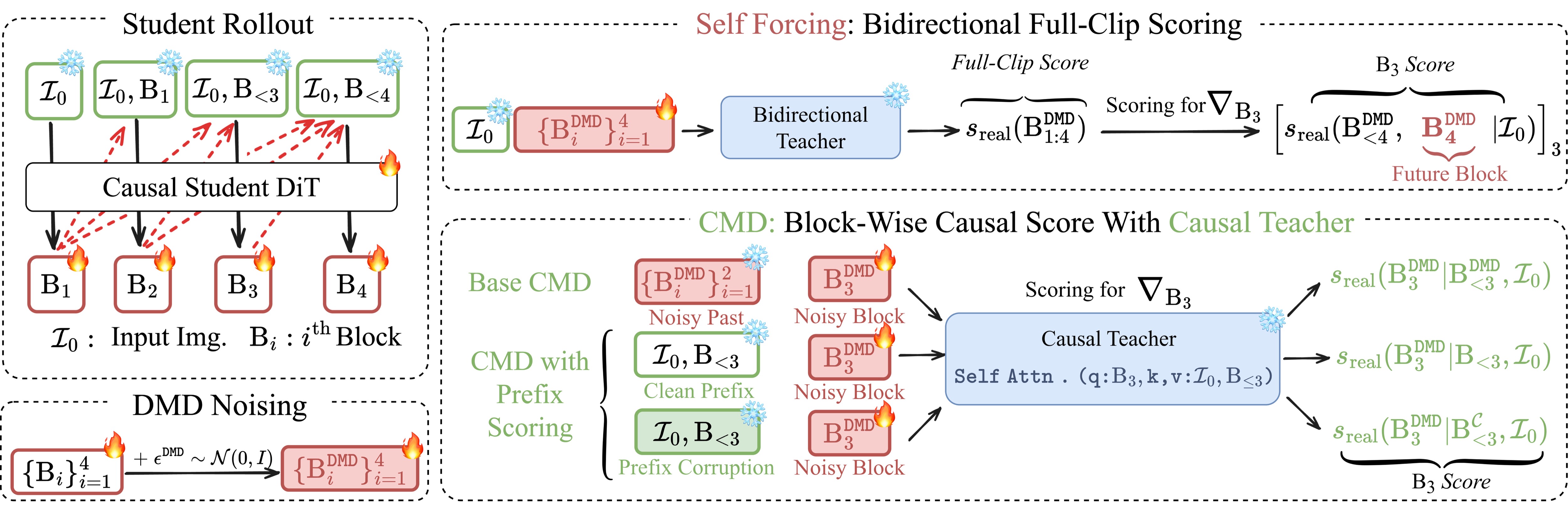
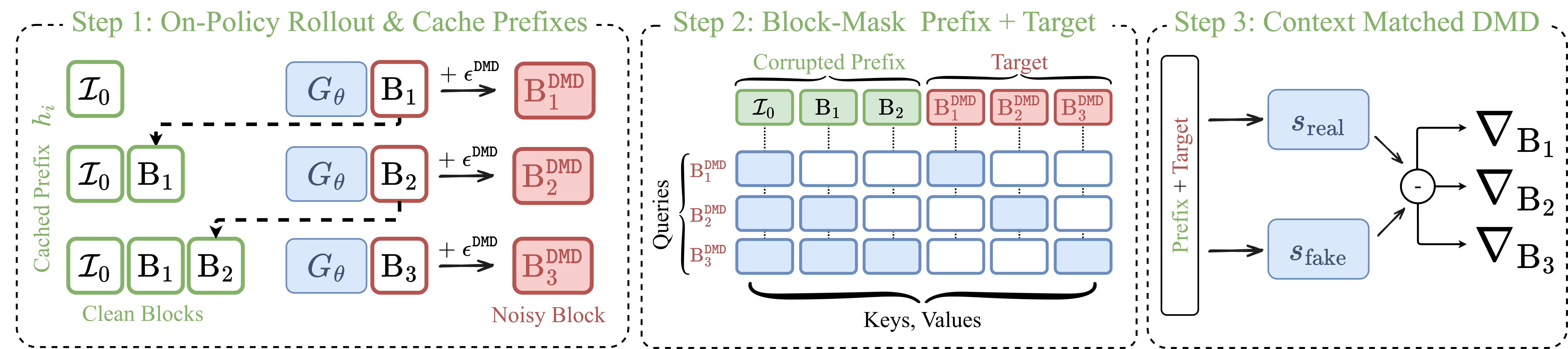
Background Autoregressive (AR) video diffusion models fit real-time, interactive generation well because they generate frames sequentially and reuse cached history. To keep latency low, these models are usually obtained by distilling a pretrained bidirectional model into a few-step causal student via distribution matching distillation (DMD) under a causal attention mask.
배경 자기회귀(AR) 비디오 확산 모델은 실시간·인터랙티브 생성에 잘 맞는데, 프레임을 순차적으로 생성하고 캐시된 과거를 재사용하기 때문이다. 저지연을 위해 이런 모델들은 대개 사전학습된 bidirectional 모델을 causal attention mask로 few-step 학생에 distribution matching distillation(DMD)으로 증류해서 얻는다.
Problem The problem is that DMD pipelines training a causal student still often score it with a bidirectional teacher that sees the full clip at once. The teacher score for block t can then depend on future frames and controls the student never had when it generated that block, misaligning teacher supervision with the student's actual causal information set.
문제 causal 학생을 학습시키는 DMD 파이프라인이 여전히 전체 클립을 한꺼번에 보는 bidirectional teacher로 점수를 매기는 경우가 많다는 것이 문제다. 블록 t에 대한 teacher 점수가 학생이 그 블록을 생성할 때는 존재하지 않았던 미래 프레임·컨트롤에 의존할 수 있어, teacher 감독과 학생의 실제 causal 정보 집합이 어긋난다.
Prior limitations Some recent work reduces the teacher-student mismatch by using a causal teacher only for student initialization (via ODE matching or consistency distillation), or by fine-tuning a student for long-video generation. These approaches still either keep a separate task-specific bidirectional teacher or do not apply one consistent causal formulation across teacher training, student initialization, and distillation (per the paper's own §2 Related Work).
기존 한계 일부 최근 연구는 causal teacher를 ODE 매칭이나 consistency distillation으로 학생 초기화에만 쓰거나, 장기 비디오용으로 학습된 학생을 파인튜닝하는 식으로 teacher-학생 불일치를 줄이려 했다. 이 방식들은 여전히 별도의 task-specific bidirectional teacher를 두거나, teacher 학습·학생 초기화·증류 전체에 걸쳐 하나의 일관된 causal 정식화를 쓰지는 않는다(논문 §2 Related Work 서술 기준).
Goal The goal is to make teacher scoring match exactly the information set the student actually had when generating each target frame, with one causal formulation that covers short video, long video, and camera-controlled generation.
목표 목표는 teacher 채점을 학생이 각 타겟 프레임을 생성할 때 실제로 가졌던 정보 집합과 정확히 일치시켜, 짧은 비디오·긴 비디오·카메라 제어 비디오 생성 전반에 하나의 causal 정식화로 대응하는 것이다.
Method CMD replaces the bidirectional teacher with a causal teacher and reuses that same teacher for both student initialization and distillation. Two mechanisms do the work: Prefix Scoring evaluates each target under the actual cached student-generated prefix that produced it (not a teacher-regenerated prefix), and Prefix Corruption deliberately perturbs unreliable early-training prefixes to stabilize training while preserving prefix-context alignment.
방법 CMD는 bidirectional teacher를 causal teacher로 바꾸고, 그 teacher를 학생 초기화와 증류 모두에 재사용한다. 핵심 장치는 두 가지 — Prefix Scoring은 각 타겟을 실제로 그 타겟을 만들어낸 캐시된 학생-생성 prefix(다시 teacher로 재생성한 prefix가 아니라)에 대해 채점하고, Prefix Corruption은 학습 초반의 불안정한 prefix를 의도적으로 손상시켜 prefix-컨텍스트 정합을 유지한 채 학습을 안정화한다.
Key idea The key idea is simple: never let supervision exceed what the student could have known at that moment. It is like an exam grader who never expects a student to use material from a later chapter to answer an earlier question -- clipping the teacher's information boundary to match the student's actual rollout point is enough to fix the mismatch.
핵심 아이디어 핵심 아이디어는 단순하다 — supervision이 "학생이 그 순간 알 수 있었던 것"을 절대 넘어서지 않게 만드는 것. 마치 시험 채점자가 학생이 그 문제를 풀 때 아직 배우지 않은 뒤 단원의 지식을 요구하지 않는 것과 같다: teacher의 정보 경계를 학생의 실제 롤아웃 시점에 맞춰 자르는 것만으로 정합이 이루어진다.
Validation Quantitative evaluation used VBench-I2V for short-horizon generation (five fixed seeds per image-prompt pair) and the SANA-WM benchmark for long-horizon generation (80 images, 501 frames / ~30s at 16fps, 480x832), with camera-controlled evaluation on SANA-WM's Simple/Hard splits measuring rotation, translation, and Camera Matrix Consistency error. Ablations progress from a bidirectional teacher through Base CMD to Full CMD (Prefix Scoring + Prefix Corruption).
검증 VBench-I2V 단기 벤치마크(이미지-프롬프트 쌍마다 5개 고정 시드)와 SANA-WM 롱-호라이즌 벤치마크(80개 이미지, 501프레임/약 30초, 16fps, 480×832)에서 정량 평가했고, 카메라 조건 생성은 SANA-WM Simple/Hard 스플릿에서 회전·이동·Camera Matrix Consistency 오차로 평가했다. Bidirectional teacher → Base CMD → Full CMD(Prefix Scoring + Prefix Corruption) 순서로 소거 실험도 수행했다.
Results On short-horizon VBench-I2V, the chunk-4 model achieves the best Total (88.47), I2V (96.54), and Camera Motion (76.12) scores, improving over the strongest baseline by +0.84/+1.18/+33.58 points respectively. On long-horizon SANA-WM, the chunk-1 model leads every aggregate metric (+0.77 Total over Context Forcing) with Dynamic Degree 0.7750, far above temporally-consistent baselines LongLive (0.0875) and Rolling Forcing (0.0375) -- quality that is not bought by degenerating into near-static video. Ablations show switching from bidirectional to base CMD alone raises Total by +5.68 points, with prefix scoring and corruption adding a further +0.13 (Total), +2.98 (Camera Motion), and +5.85 (Dynamic Degree).
결과 VBench-I2V 단기 평가에서 chunk-4 모델이 Total 88.47, I2V 96.54, Camera Motion 76.12로 최고 점수를 기록해 최강 baseline 대비 각각 +0.84/+1.18/+33.58점 개선했다. SANA-WM 장기 평가에서는 chunk-1 모델이 모든 집계 지표에서 1위였고(Context Forcing 대비 Total +0.77점), Dynamic Degree 0.7750을 기록해 LongLive(0.0875)·Rolling Forcing(0.0375) 같은 시간-일관성 강한 baseline보다 훨씬 動的이면서도 밀리지 않는 품질을 보였다. 소거 실험에서는 bidirectional→base CMD 전환만으로 Total이 +5.68점 뛰었고, prefix 채점·오염 추가로 추가 +0.13(Total), +2.98(Camera Motion), +5.85(Dynamic Degree) 개선됐다.
Comparison CMD is compared directly against recent causal/streaming AR video generators -- Context Forcing, LingBot-World, LongLive, Rolling Forcing -- on the SANA-WM benchmark. The paper explicitly notes that LongLive and Rolling Forcing score higher on temporal-consistency metrics but at far lower Dynamic Degree (0.09/0.04 vs. CMD's 0.78), distinguishing CMD's stability from stability-by-staying-static.
비교 Context Forcing, LingBot-World, LongLive, Rolling Forcing 등 최근 causal/streaming AR 비디오 생성기와 SANA-WM 벤치마크상에서 직접 비교했다. LongLive·Rolling Forcing이 시간적 일관성 지표는 더 높지만 Dynamic Degree가 극히 낮다는 점(0.09/0.04 vs CMD의 0.78)을 지적해, "정적으로 수렴해 얻은 안정성"이 아니라는 차별점을 명시했다.
Significance Through an efficient-AI lens, this paper is less about KV-cache or quantization itself and more about fixing a structural bug in the training signal that few-step distillation relies on (a teacher seeing a future the student cannot) -- raising distillation quality ceiling without changing the inference-time cost structure at all. That makes it a useful training-side companion to the Self-Forcing/CausVid line of few-step video-diffusion work this site tracks on the inference-efficiency side.
의의 효율적 AI 렌즈에서 보면 이 논문은 KV-cache나 양자화 자체보다, few-step distillation의 학습 신호 자체에 있던 구조적 버그(teacher가 학생이 못 보는 미래를 봄)를 고쳐서 같은 파라미터·같은 단계 수로 품질을 끌어올린 사례다. 인퍼런스 비용 구조를 바꾸지 않고도 distillation 품질 상한을 올린다는 점에서, 이 워크스페이스가 추적하는 few-step video-diffusion 계열(Self-Forcing/CausVid 라인)의 훈련 측 개선 사례로 유용하다.
Limitations The paper does not include an explicit "Limitations" section (not stated in the paper). Whether the shift to a causal teacher costs frame fidelity relative to the original bidirectional teacher in an offline, non-interactive setting is not discussed by the authors (reviewer judgment).
한계 논문에 명시적 "Limitations" 절은 없다(논문 내 명시 없음). causal teacher로의 전환이 오프라인·비-인터랙티브 세팅에서 원래의 bidirectional teacher보다 프레임 충실도가 떨어질 가능성은 저자들이 직접 논하지 않았다(리뷰어 판단).
Future work There is no explicit "Future Work" section (not stated in the paper). The conclusion states the causal formulation extends naturally to frame-wise and chunk-wise generation, long-video distillation, and camera-conditioned distillation -- but these are demonstrated extensions within the paper itself, not items left for later.
향후 과제 명시적 "Future Work" 절은 없다(논문 내 명시 없음). 저자들은 결론에서 이 causal 정식화가 프레임 단위·청크 단위 생성, 장기 비디오 증류, 카메라 조건 증류로 자연스럽게 확장된다고 서술하는데, 이는 이미 본 논문에서 실증된 확장이지 향후 과제로 남겨둔 것은 아니다.
Released resources No code or checkpoint release is stated in the paper. The project page (hmrishavbandy.github.io/cmd-site) hosts video results but no public repository link was verified.
자원 공개 코드/체크포인트 공개는 논문 내 명시 없음 -- 프로젝트 페이지(hmrishavbandy.github.io/cmd-site)에는 비디오 결과가 게시돼 있으나 공개 저장소 링크는 확인되지 않았다.
The research thread
Where this paper sits 연구의 흐름
This paper continues the Self-Forcing/CausVid line of causal video-diffusion distillation, which made few-step interactive video generation possible by distilling a bidirectional teacher into a causal student via distribution matching distillation (DMD) under a causal attention mask, and which subsequent work like LongLive and Rolling Forcing extended toward longer streaming with rolling windows and attention sinks.
The conceptual shift this paper makes is about who does the scoring. The prior line handled "causal-ization" by masking only the student while keeping a bidirectional teacher for quality; CMD argues that choice is itself an information leak -- if the teacher scores using a future the student cannot see, that score is a signal the student can never reproduce at deployment time. So CMD makes the teacher causal too, unifying student initialization, distillation, and inference under one consistent formulation.
A question this opens is how general this "training-inference information-boundary mismatch" bug pattern is across other causal generative distillation settings. Whether few-step distillation of causal language models or diffusion LLMs has an analogous leak -- a teacher scoring against future tokens the student cannot see -- is an adjacent question this paper does not address.
이 논문은 Self-Forcing/CausVid 계열 causal 비디오 확산 증류 흐름을 잇는다. 이 흐름은 bidirectional teacher를 causal attention mask로 학생에 distillation matching distillation(DMD)으로 증류해 few-step 인터랙티브 비디오 생성을 가능하게 했고, 이후 LongLive·Rolling Forcing 같은 후속 연구들이 롤링 윈도우·attention sink로 스트리밍 길이를 늘려왔다.
이 논문이 만드는 개념적 전환은 "누가 채점하느냐"에 있다. 기존 흐름은 품질을 위해 bidirectional teacher를 유지한 채 causal mask만 학생에 씌우는 식으로 causal화를 다뤘는데, CMD는 그 자체가 정보-누출이라고 지적한다 -- teacher가 학생은 못 보는 미래를 보고 채점하면, 그 채점은 애초에 학생이 배포 시점에 재현할 수 없는 신호다. 그래서 teacher까지 causal하게 만들고 학생 초기화·증류·추론 전체를 하나의 정식화로 통일한다.
이 흐름이 다음에 열 수 있는 질문은 이 "학습-추론 정보 경계 불일치"라는 버그 패턴이 다른 causal 생성 모델 증류에도 얼마나 일반적인가이다. 예컨대 causal 언어모델이나 diffusion LLM을 few-step으로 증류할 때도 teacher가 학생이 못 보는 미래 토큰을 보고 채점하는 유사한 정보-누출이 있는지는 이 논문이 다루지 않은 인접 질문이다.
Sparks — where one could take this 아이디어의 씨앗
-
The paper doesn't directly address whether a causal teacher matches the original bidirectional teacher's frame fidelity in an offline, non-interactive setting -- would the causal-teacher fix still help when real-time constraints are removed? 논문은 offline·비-인터랙티브 세팅에서 causal teacher가 원래의 bidirectional teacher만큼 프레임 충실도를 낼 수 있는지 직접 다루지 않는다 -- 실시간성이 필요 없는 상황에서도 causal teacher가 여전히 이득인지 측정해보면 어떨까?
-
The optimal Prefix Corruption noise level (t_prefix=256) is found empirically at this paper's data and model scale -- whether this sweet spot holds across other scales or domains is an open question. Prefix Corruption의 최적 노이즈 강도(t_prefix=256)는 이 논문의 데이터·모델 스케일에서 경험적으로 찾은 값이다 -- 다른 스케일이나 다른 도메인에서도 이 지점이 안정적으로 유지되는지는 열린 질문이다.
Seeds grounded in the paper's own stated limitations and open questions. 논문이 스스로 밝힌 limitations와 open questions에 뿌리를 둔 씨앗입니다.
Notes
Notes
Internal thread: adjacent to Thread 5 (video-diffusion / AR-video inference acceleration) in this workspace’s literature tracking — a training-side fix to teacher-student information mismatch in DMD-style few-step distillation, not an inference-time KV-cache or quantization intervention.
Linked reviews
Parallel Decoding Distillation (PDD) for Fast Image and Video Generation
PDD trains a parallel decoder that predicts the mean velocity of several consecutive denoising intervals in a single network evaluation instead of one interval at a time, giving a trajectory-based distillation method that reaches SOTA 4-8 NFE generation on LTX-2.3, Wan2.1-14B and Qwen-Image while avoiding the mode collapse that variational-score-distillation and adversarial methods suffer from.
kv-cacheSelf Gradient Forcing: Native Long Video Extrapolation
Self Gradient Forcing names the historical context-gradient gap in Self-Forcing-style autoregressive video diffusion training — the historical KV cache is written once and then frozen, so future losses can never supervise how it should have been written — and fixes it with a two-pass training scheme that lets models trained on 5-second clips extrapolate natively to 240-second video.
kv-cacheLiveAnimate: Stable Long-Form Streaming Human Animation in Real-Time
A block-causal video diffusion model with a retrieval-augmented sink-attention KV-cache policy sustains real-time, constant-memory streaming human animation for minutes, not seconds.
video-diffusionSQuad: Sub-Quadratic Attention Distillation for Efficient Video Generation
SQuad distills a pretrained video diffusion transformer's full-softmax attention into a fixed, sub-quadratic O(n*sqrt(n)) factorization -- a local pass within sqrt(n)-sized windows plus a global cross-window pass, still true softmax throughout -- and pairs it with step distillation, matching the original's quality at 6 sampling steps instead of 100 while cutting attention compute by roughly 67x.