Paper Review
D-Cut: Adaptive Verification Depth Pruning for Batched Speculative Decoding
Prunes speculative-decoding draft tokens jointly across a whole serving batch so verification compute isn't wasted on rejected suffixes as concurrency scales up.
배치 서빙 전체에서 초안 토큰을 공동으로 가지치기해, 동시 요청이 늘어나도 검증 연산이 거부될 접미사 토큰에 낭비되지 않게 하는 스펙큘레이티브 디코딩 기법.
Background Speculative decoding (SD) accelerates LLM inference by having a cheap drafter propose multiple tokens that the target model verifies in parallel. DFlash-style parallel-drafting variants decouple drafting latency from draft length, letting a single request draft longer sequences and raise the mean accepted tokens (MAT) per verification round.
배경 스펙큘레이티브 디코딩(SD)은 값싼 드래프터가 여러 토큰을 미리 제안하고 타깃 모델이 이를 병렬 검증해 추론을 가속하는 기법이다. DFlash류의 병렬 드래프팅 방식은 드래프팅 지연을 디코딩 길이에서 분리해, 한 요청이 더 긴 초안을 만들어 검증 라운드당 평균 수락 토큰 수(MAT)를 높일 수 있게 한다.
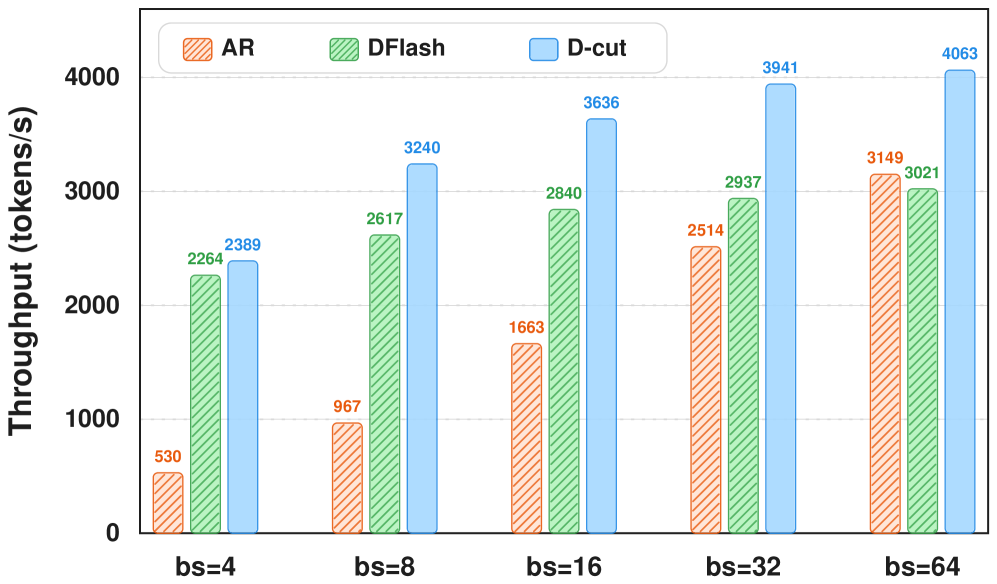
Problem The problem is batched serving with many concurrent requests: giving every request an equally long draft wastes verification compute on the rejected suffix tokens across the whole batch at once. The authors show that once concurrency crosses a threshold, SD's average throughput can fall below plain autoregressive decoding.
문제 문제는 여러 요청이 동시에 몰리는 배치 서빙 환경이다. 모든 요청에 동일하게 긴 초안을 주면, 배치 전체에서 거부되는 접미사 토큰들에 검증 연산이 낭비된다. 저자들은 동시성이 임계치를 넘으면 SD의 평균 처리량이 오히려 일반 자기회귀 디코딩보다 낮아질 수 있음을 보인다.
Prior limitations Existing draft-pruning/depth-selection methods size or prune each request's draft independently — none of them model the shared GPU verification budget that every concurrent request in a batch must now split.
기존 한계 기존의 드래프트 가지치기·깊이 선택 기법들은 각 요청을 독립적으로 다룬다 — 즉 배치 내 모든 동시 요청이 나눠 써야 하는 공유 GPU 검증 예산이라는 개념 자체가 없다.
Goal Restore, and extend, speculative decoding's speedup at the high concurrency levels real production serving needs, without sacrificing per-request MAT at low concurrency (batch size 1).
목표 저비용동시성(배치=1)에서의 요청당 MAT을 희생하지 않으면서도, 실제 프로덕션 서빙이 요구하는 높은 동시성 구간에서도 SD의 속도 향상을 되살리고 확장하는 것이 목표다.
Method D-Cut ranks every draft token in the batch by acceptance confidence and prunes globally against one shared verification budget, so the batch's fixed compute goes to the highest-confidence tokens across all requests rather than a fixed depth per request. A runtime cost model additionally adapts pruning depth to the deployment's GPU architecture and parallelism strategy.
방법 D-Cut은 배치 내 모든 드래프트 토큰을 수락 신뢰도(confidence) 기준으로 순위를 매기고, 하나의 공유 검증 예산에 맞춰 전역적으로 가지치기한다 — 요청마다 고정 깊이를 주는 대신, 배치의 고정된 연산량이 전체 요청 중 신뢰도가 가장 높은 토큰들에 쓰이도록 한다. 여기에 GPU 아키텍처와 병렬화 전략에 맞춰 가지치기 깊이를 조정하는 런타임 비용 모델이 더해진다.
Key idea Treat "how deep to verify" as a cross-request resource-allocation problem instead of a per-request hyperparameter — like scheduling jobs on one shared server by priority instead of handing every job an identical fixed time-slice.
핵심 아이디어 "검증을 어디까지 할지"를 요청별 하이퍼파라미터가 아니라 요청 간 자원 배분 문제로 재정의한 것이 핵심이다. 비유하자면, 모든 작업에 동일한 고정 시간 슬롯을 주는 대신 하나의 공유 서버에서 작업들의 우선순위에 따라 스케줄링하는 것과 같다.
Validation Evaluated on both dense and Mixture-of-Experts (MoE) target models under batched serving, sweeping batch size on Math500 with Qwen3-8B on a single H20 GPU, directly measuring the throughput-vs-concurrency curve where naive long-draft speculative decoding degrades.
검증 고밀도(dense) 모델과 MoE 타깃 모델 모두, 배치 서빙 환경에서 평가했다. Qwen3-8B·Math500으로 H20 GPU 한 대에서 배치 크기를 스윕하며, 초안 길이가 그대로일 때 처리량-동시성 곡선이 어떻게 무너지는지, 그리고 D-Cut이 이를 얼마나 회복하는지를 직접 측정했다.
Results Average speedup over plain autoregressive decoding rises from 1.26× to 1.65× for dense models at high concurrency, and up to 3.0× on MoE models. The paper's Figure 1 shows uncorrected DFlash throughput actually dropping below AR decoding at batch size 64 — the exact gap D-Cut's pruning closes.
결과 고밀도 모델 기준 평균 속도 향상이 일반 자기회귀 디코딩 대비 1.26배 → 1.65배로 개선되었고, MoE 모델에서는 최대 3.0배에 달했다. 논문의 Figure 1은 보정 없는 DFlash가 배치 64에서 자기회귀 디코딩보다도 느려지는 지점을 직접 보여주며, D-Cut의 가지치기가 이를 바로잡는다.
Comparison The direct baseline is uncorrected long-draft parallel speculative decoding (DFlash-style), shown degrading with batch size. D-Cut is positioned as a serving-time correction layer rather than a new drafter architecture.
비교 직접 비교 대상은 보정되지 않은 긴 초안 병렬 스펙큘레이티브 디코딩(DFlash류)이며, 논문은 이 방식이 배치 크기 증가에 따라 성능이 악화됨을 보인다. D-Cut은 새로운 드래프터 아키텍처가 아니라 서빙 단계에서 적용하는 보정 레이어로 자리매김한다.
Significance This adds a concurrency/batch-size axis to speculative decoding that acceptance-rate-vs-context-length research typically doesn't model — a speedup measured at batch size 1 can silently invert once real multi-tenant serving load is applied.
의의 이 논문은 스펙큘레이티브 디코딩에 동시성/배치 크기라는 축을 추가한다 — 배치=1에서 측정된 속도 향상이 실제 다중 테넌트 서빙 부하 하에서는 조용히 역전될 수 있음을 보여준다는 점에서, 문맥 길이 대비 수락률만 보는 기존 관점을 보완한다.
Limitations Not stated in the paper (this review is based on the abstract and the Figure 1 region of the arXiv HTML; a full-text read would be needed to confirm further caveats) (reviewer judgment).
한계 논문 내 명시 없음 (본 리뷰는 초록과 arXiv HTML의 Figure 1 영역을 근거로 작성되었으며, 전체 본문을 읽어야 추가적인 한계를 확인할 수 있다) (리뷰어 판단).
Future work Not stated in the paper.
향후 과제 논문 내 명시 없음.
Released resources The arXiv preprint is the only verified public resource; no project page or code repository was found linked from the paper (reviewer judgment).
자원 공개 arXiv 프리프린트가 유일하게 확인된 공개 자료이며, 논문에서 연결된 프로젝트 페이지나 코드 저장소는 확인되지 않았다 (리뷰어 판단).
The research thread
Where this paper sits 연구의 흐름
Speculative-decoding research started from "how do we build a better drafter" (tree drafting, learned drafters, confidence scheduling) and has recently been shifting toward "how do we allocate that draft inside a real serving system." D-Cut is an instance of this second thread: it shows that a parallel-drafting method like DFlash, excellent per single request, can have its own strength (long drafts) flip into a weakness (wasted verification) once real batched serving is applied.
The conceptual shift is redefining "verification depth" from a per-request tuning knob into a finite resource the whole batch shares. This implies that evaluating speculative decoding purely on single-request metrics (acceptance rate, MAT) can be misleading once production batch serving is the real deployment target.
The open question this framing raises is whether other axes of improvement — tree-based drafters, or learned confidence schedulers like DSpark — still pay off once they compete for the same batch-level shared budget, or whether gains along different axes cancel each other out under real batched serving.
스펙큘레이티브 디코딩 연구는 "드래프터를 어떻게 더 잘 만들까"(트리 드래프팅, 학습된 드래프터, 신뢰도 스케줄링)에서 출발해 최근에는 "서빙 시스템 안에서 그 드래프트를 어떻게 배분할까"로 무게중심이 옮겨가고 있다. D-Cut은 이 두 번째 흐름의 한 예로, DFlash 같은 병렬 드래프팅 기법이 단일 요청 기준으로는 뛰어나지만 배치 서빙이라는 현실적 제약 아래서는 스스로의 강점(긴 초안)이 약점(검증 낭비)으로 뒤집힐 수 있음을 보여준다.
개념적 전환은 "검증 깊이"를 요청별 튜닝 값이 아니라 배치 전체가 공유하는 유한 자원으로 재정의한 것이다. 이는 단일 요청 성능 지표(수락률, MAT)만으로 스펙큘레이티브 디코딩을 평가하는 관행이 프로덕션 배치 서빙 환경에서는 오도될 수 있음을 시사한다.
이 관점이 열어주는 다음 질문은, 트리 기반 드래프터나 학습된 신뢰도 스케줄러(DSpark류) 같은 다른 축의 개선들이 배치 수준의 공유 예산 경쟁 아래서도 여전히 이득을 유지하는지, 아니면 서로 다른 축의 최적화들이 배치 서빙 환경에서 상쇄되는지이다.
Sparks — where one could take this 아이디어의 씨앗
-
When multiple drafting strategies (tree-based, parallel) coexist in one serving stack, could a higher-level scheduler allocate the shared verification budget across strategies, not just across requests? 여러 드래프팅 전략(트리형, 병렬형)이 하나의 서빙 스택에 공존할 때, 공유 검증 예산을 전략 간에도 배분하는 상위 스케줄러가 가능한가?
-
Does confidence-based global ranking risk structurally starving requests that consistently draft low-confidence tokens — an open SLA/fairness question the paper doesn't address. 신뢰도 기반 전역 순위가 지속적으로 낮은 신뢰도를 받는 일부 요청을 구조적으로 굶길 위험은 없는가 — SLA·공정성 관점의 열린 질문.
-
Whether the runtime cost model that adapts pruning depth to GPU architecture/parallelism generalizes to heterogeneous GPU clusters (mixed generations) is left untested. GPU 아키텍처·병렬화 전략에 따라 가지치기 깊이를 조정하는 런타임 비용 모델이 이종 GPU 클러스터(예: 서로 다른 세대의 GPU 혼재)에서도 일반화되는지는 미확인이다.
Seeds grounded in the paper's own stated limitations and open questions. 논문이 스스로 밝힌 limitations와 open questions에 뿌리를 둔 씨앗입니다.
Notes
Notes
Linked reviews
DSpark: Confidence-Scheduled Speculative Decoding with Semi-Autoregressive Generation
A semi-autoregressive drafter combined with confidence-scheduled verification fixes the intra-block acceptance decay of parallel speculative-decoding drafters, delivering 51-85% throughput and latency gains in DeepSeek-V4 production serving.
speculative-decodingLess Experts, Faster Decoding: Cost-Aware Speculative Decoding for Mixture-of-Experts (EcoSpec)
Speculative decoding for Mixture-of-Experts models optimizes for token-acceptance likelihood alone, ignoring that each draft token also determines which experts get loaded from HBM during verification; EcoSpec adds a lightweight expert-activation predictor and a dynamic expert buffer to draft-tree selection, cutting the number of distinct experts touched per verification step and reaching up to 1.62x speedup on DeepSeek-V3.1, Qwen3-235B-A22B, and GPT-OSS-120B without touching the verification rule itself.
speculative-decodingAgentSpec: Speculative Decoding for Batch Inference of LLM Agents
A structure-isolated speculative decoding scheme for LLM agents that fixes the batch-size collapse where existing methods become slower than plain autoregressive decoding, delivering up to 2.02x speedup by tracking semantic block boundaries and allocating draft budget by historical redundancy.
speculative-decodingAngelSpec: Towards Real-World High Performance Inference with Speculative Decoding
AngelSpec unifies two rival speculative-decoding drafter families -- lightweight autoregressive Multi-Token-Prediction heads and block-parallel diffusion drafters -- by co-specializing each one's training data to the workload it is actually good at, upgrading the diffusion drafter's architecture (DFly), and letting a batch-level scheduler (D-cut) reallocate verification budget online; on Tencent's own Hy3 MoE model family this reaches a 1.98-2.40x speedup over autoregressive decoding, validated against live production traffic rather than a static benchmark.
speculative-decodingTreeWY: Speculative Verification for Gated DeltaNet Hybrids
TreeWY removes the per-draft-position recurrent-state snapshot that makes wide speculative-decoding draft trees memory-infeasible for hybrid softmax+Gated-DeltaNet models, by rewriting the gated delta rule as a tree-structured WY transform that verifies every draft node with one triangular solve and reconstructs only the accepted state on commit.
kv-cacheWindowed-MTP: Removing the Full-Context Draft-KV Tax at Million-Token Context
Windowed-MTP names the long-context draft-attention tax in built-in Multi-Token-Prediction speculative-decoding heads -- the draft re-reads the entire KV cache every step, so at million-token context it can flip speculation net-negative -- and fixes it losslessly with a training-free sink+window applied only to the draft's attention, cutting per-decode-step cost 28-44% across three architecture families at 1M tokens.