Paper Review
FlashDrive: Algorithm-System Co-Design for Real-Time VLA Autonomous-Driving Inference
Algorithm-system co-design cuts real-time reasoning-VLA latency 4.7x by matching a distinct lightweight fix to each of four structurally different inference bottlenecks.
서로 다른 원인을 가진 네 가지 추론 병목에 각각 다른 경량 해법을 매칭하는 알고리즘-시스템 공동설계로, 실시간 추론형 VLA의 지연시간을 4.7배 줄인다.
Background Vision-Language-Action (VLA) models fuse visual perception, language-style reasoning, and continuous trajectory prediction into one network, replacing hand-crafted modular self-driving pipelines with a single end-to-end model. This generality is built by stacking a vision encoder, an LLM-style reasoning backbone, and a flow-matching trajectory head, and each of those components is individually expensive at inference time.
배경 VLA(Vision-Language-Action) 모델은 시각 인지, 언어 스타일 추론, 연속 궤적 예측을 하나의 네트워크로 통합해 손으로 짠 모듈형 자율주행 파이프라인을 대체한다. 이 범용성은 시각 인코더, LLM 스타일 추론 백본, 플로우매칭 궤적 헤드를 쌓아서 만들어지며, 각 구성요소는 추론 시점에 개별적으로 비용이 크다.
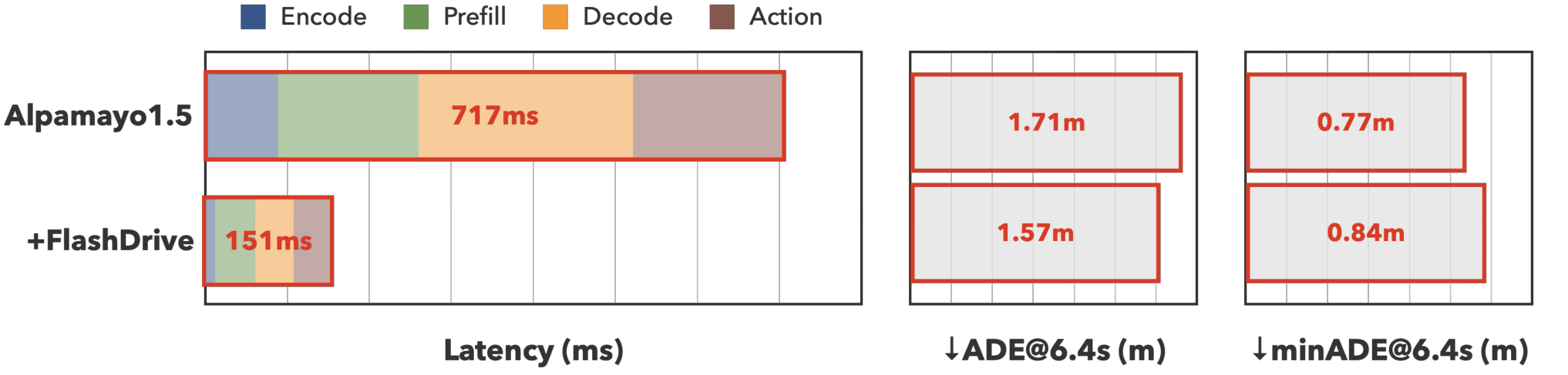
Problem Reasoning VLAs are far too slow for real-time vehicle control: the paper's reference model, the open-source Alpamayo 1.5-10B, takes 717ms per frame on an RTX PRO 6000, a control frequency of only 1.4Hz. The paper argues this is not one bug but a structural cascade of four distinct bottlenecks — visual encoding, language-model prefill, serial reasoning-token generation, and flow-matching denoising — each slow for a different underlying reason.
문제 추론형 VLA는 실시간 차량 제어에 턱없이 느리다 — 논문이 기준으로 삼은 오픈소스 Alpamayo 1.5-10B는 RTX PRO 6000에서 프레임당 717ms가 걸리며, 이는 1.4Hz의 제어 주파수에 불과하다. 논문은 이것이 하나의 버그가 아니라 시각 인코딩·언어모델 프리필·순차적 추론-토큰 생성·플로우매칭 디노이징이라는 구조적으로 서로 다른 네 가지 병목의 연쇄라고 주장하며, 각 단계는 서로 다른 근본 이유로 느리다.
Prior limitations Existing efficiency work typically targets a single stage of a VLA pipeline at a time: compress the vision encoder, speed up the language decoder, or accelerate the diffusion/flow sampler in isolation. Because the four stages are each other's bottleneck in sequence, fixing only one just moves the ceiling to whichever stage is left untouched, which the paper reports is why single-stage approaches never reach real-time control frequencies for a 10B-parameter reasoning VLA.
기존 한계 기존 효율화 연구는 대개 VLA 파이프라인의 한 단계만을 겨냥한다 — 시각 인코더만 압축하거나, 언어 디코더만 가속하거나, 디퓨전/플로우 샘플러만 단독으로 최적화하는 식이다. 네 단계가 순차적으로 서로의 병목이 되기 때문에, 한 단계만 고치면 손대지 않은 단계로 천장이 옮겨갈 뿐이며, 논문은 이것이 단일 단계 접근이 100억 파라미터급 추론형 VLA에서 결코 실시간 제어 주파수에 도달하지 못하는 이유라고 보고한다.
Goal Reach real-time control frequencies for a full-sized reasoning VLA on a single GPU, without materially changing driving behavior — trajectory accuracy and closed-loop safety metrics should hold steady, not just wall-clock latency.
목표 단일 GPU에서 대형 추론형 VLA가 실시간 제어 주파수에 도달하되, 주행 행동을 실질적으로 바꾸지 않는 것 — 즉 단순히 벽시계 지연시간뿐 아니라 궤적 정확도와 폐루프 안전 지표도 그대로 유지되어야 한다.
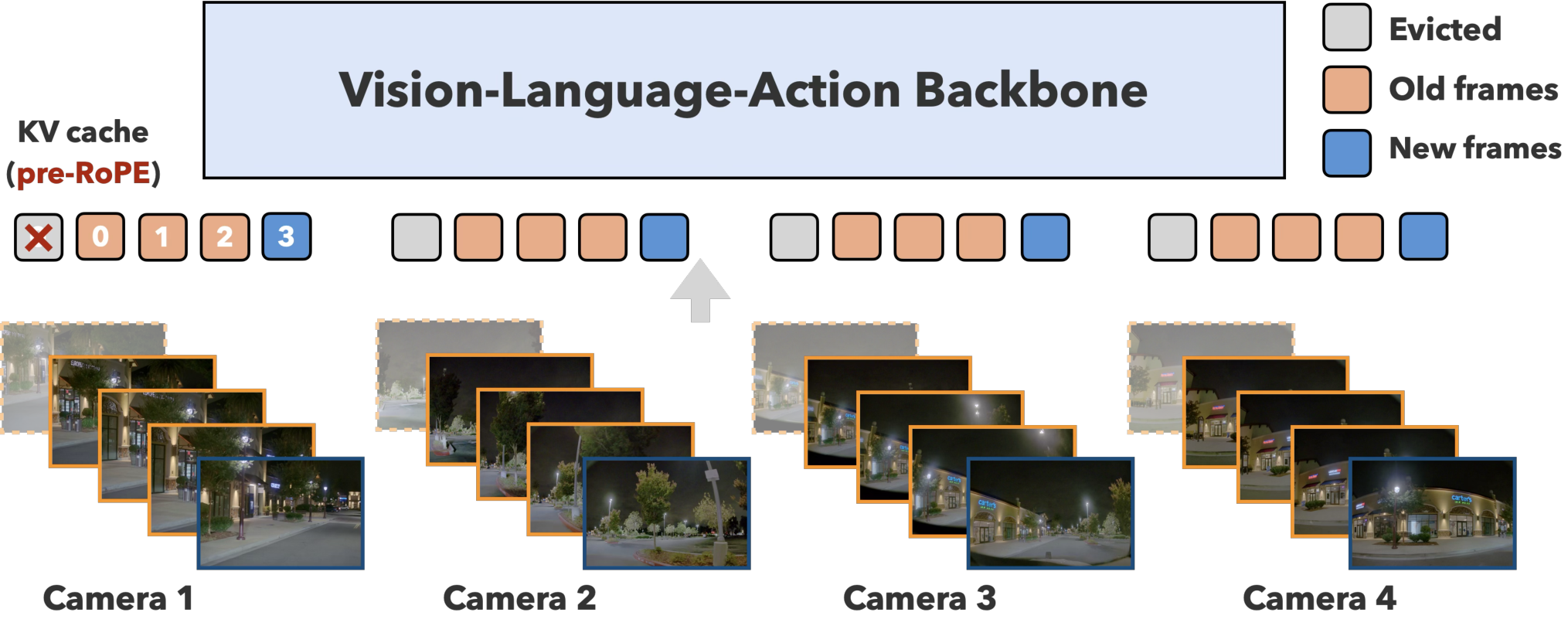
Method FlashDrive profiles the VLA pipeline into four stages and pairs each with a distinct, lightweight fix: streaming KV-cache reuse across overlapping camera frames for visual encoding (storing keys pre-RoPE so cached tokens can be re-positioned as the window shifts); prefill-state carryover between timesteps; a non-autoregressive diffusion drafter for speculative decoding of reasoning tokens, exploiting their low per-token entropy and strong intra-block correlation; and adaptive step-caching that concentrates flow-matching compute where the trajectory's velocity field changes fastest (the endpoints) and skips redundant computation where it is flat (the middle). All four sit on top of CUDA Graph compilation, kernel fusion, and W4A8 quantization.
방법 FlashDrive는 VLA 파이프라인을 네 단계로 프로파일링한 뒤 각각에 서로 다른 경량 해법을 매칭한다: 겹치는 카메라 프레임 간 스트리밍 KV 캐시 재사용(윈도우가 이동해도 캐시된 토큰을 재배치할 수 있도록 키를 RoPE 적용 전 상태로 저장), 타임스텝 간 프리필 상태 이월, 추론 토큰의 낮은 토큰당 엔트로피와 강한 블록 내 상관관계를 활용하는 비자기회귀 디퓨전 드래프터 기반 스펙큘레이티브 디코딩, 그리고 궤적의 속도장이 가장 빠르게 변하는 지점(양 끝단)에 디노이징 연산을 집중하고 평탄한 구간(중간)에서는 중복 연산을 건너뛰는 적응적 스텝 캐싱. 이 네 가지는 모두 CUDA Graph 컴파일, 커널 퓨전, W4A8 양자화 위에 얹힌다.
Key idea Each bottleneck has a different root cause, so the paper gives each one a matched cheap fix instead of reaching for one generic acceleration trick and applying it everywhere. It is closer to sending four different specialists to fix four different machines than to hoping one universal wrench loosens every bolt — caching answers redundant vision, carryover answers redundant prefill, drafting answers low-entropy serial decoding, and adaptive stepping answers a non-uniform velocity field.
핵심 아이디어 각 병목은 근본 원인이 다르므로, 논문은 하나의 범용 가속 트릭을 모든 곳에 적용하는 대신 각 병목에 맞춤 해법을 준다. 이는 하나의 만능 렌치로 모든 볼트를 풀기를 바라기보다, 네 대의 서로 다른 기계에 네 명의 서로 다른 전문가를 보내는 것에 가깝다 — 캐싱은 중복된 시각 정보에, 이월은 중복된 프리필에, 드래프팅은 낮은 엔트로피의 순차 디코딩에, 적응적 스텝은 불균일한 속도장에 각각 대응한다.
Validation Evaluated end-to-end on the open Alpamayo 1.5-10B reasoning VLA: wall-clock latency and control frequency, trajectory-quality metrics (minADE1, minADE6@6.4s), and closed-loop simulation metrics (collision rate, off-road rate) in the AlpaSim simulator. Ablations separately test whether fine-tuning the VLM recovers streaming-induced KV-cache approximation error, and whether a larger speculative-decoding draft block size helps.
검증 오픈소스 Alpamayo 1.5-10B 추론형 VLA에서 end-to-end로 평가한다: 벽시계 지연시간과 제어 주파수, 궤적 품질 지표(minADE1, minADE6@6.4s), 그리고 AlpaSim 시뮬레이터에서의 폐루프 지표(충돌률, 이탈률). Ablation은 VLM을 파인튜닝하면 스트리밍으로 인한 KV 캐시 근사 오차가 회복되는지, 그리고 더 큰 스펙큘레이티브 디코딩 드래프트 블록이 도움이 되는지를 별도로 검증한다.
Results FlashDrive cuts end-to-end latency from 717ms to 151ms, a 4.7x reduction, raising control frequency from 1.4Hz to 6.6Hz on a single GPU. Trajectory quality is essentially preserved — minADE6@6.4s shifts by only 0.08m and minADE1 improves — and closed-loop collision and off-road rates improve rather than degrade in simulation, so the speedup is not bought with a safety trade-off. The ablations show fine-tuning the VLM to compensate for streaming-cache approximation error actually makes accuracy worse, and that a larger draft block (16 vs 8 tokens) accepts more tokens per block but does not reduce latency, since draft/verification cost grows to offset the gain.
결과 FlashDrive는 end-to-end 지연시간을 717ms에서 151ms로, 즉 4.7배 줄이며 단일 GPU에서 제어 주파수를 1.4Hz에서 6.6Hz로 끌어올린다. 궤적 품질은 사실상 보존된다 — minADE6@6.4s는 0.08m만 변하고 minADE1은 오히려 개선되며, 시뮬레이션에서 폐루프 충돌률과 이탈률도 악화가 아니라 개선되어, 이 속도 향상이 안전성과 맞바꾼 것이 아님을 보인다. Ablation에서는 스트리밍 캐시 근사 오차를 보정하려고 VLM을 파인튜닝하면 오히려 정확도가 나빠지고, 더 큰 드래프트 블록(8 대신 16토큰)은 블록당 더 많은 토큰을 수용하지만 드래프트·검증 비용이 커져 이득을 상쇄해 지연시간이 줄지 않는다.
Comparison The paper positions itself against every single-stage optimization it names (encoder-only compression, decoder-only speedup, sampler-only acceleration), arguing none of them alone reaches real-time because whichever stage stays unoptimized becomes the new ceiling. Through an efficient-AI lens, this generalizes the same argument this site has covered for single-axis KV-cache or quantization fixes to LLM inference — FlashDrive applies it across a full four-stage heterogeneous pipeline rather than one cache or one weight tensor.
비교 논문은 자신이 언급하는 모든 단일 단계 최적화(인코더 전용 압축, 디코더 전용 가속, 샘플러 전용 가속)와 스스로를 대비시키며, 손대지 않은 단계가 새로운 천장이 되기 때문에 그 어느 것도 단독으로는 실시간에 도달하지 못한다고 주장한다. 효율적 AI의 관점에서 이는 이 사이트가 다뤄온 LLM 추론의 단일 축 KV 캐시·양자화 개선과 같은 논리를 일반화한 것이며, FlashDrive는 그것을 하나의 캐시나 하나의 가중치 텐서가 아니라 이질적인 4단계 파이프라인 전체에 적용한다.
Significance FlashDrive is a clean case study in composing four already-known acceleration techniques — caching, carryover, speculative decoding, and adaptive-step diffusion sampling — and showing the combination compounds rather than fights itself. The diffusion-drafter-for-speculative-decoding piece is the most transferable idea here: it repurposes the propose-many-tokens-in-parallel-then-verify-sequentially pattern from language-model speculative decoding for driving-reasoning tokens, a reusable recipe for any domain with low-entropy, block-structured generation.
의의 FlashDrive는 캐싱, 이월, 스펙큘레이티브 디코딩, 적응적 스텝 디퓨전 샘플링이라는 이미 알려진 네 기법을 조합해, 그 조합이 서로 상쇄되지 않고 곱해짐(compound)을 보여주는 깔끔한 사례 연구다. 가장 전이 가능성이 높은 아이디어는 디퓨전 드래프터 기반 스펙큘레이티브 디코딩으로, 언어모델 스펙큘레이티브 디코딩의 '디퓨전 모델로 여러 토큰을 병렬 제안하고 순차적으로 검증한다'는 패턴을 주행-추론 토큰에 재활용한 것이며, 낮은 엔트로피의 블록 구조 생성이 있는 어떤 도메인에도 재사용 가능한 레시피다.
Limitations The paper reports ablations for individual design choices (streaming fine-tuning, draft block size), but the sections available here do not decompose the overall 4.7x speedup into each of the four algorithmic fixes' individual contribution versus the systems-level compounding from CUDA Graphs and kernel fusion (reviewer judgment). Results are reported on one model family, Alpamayo 1.5-10B; transfer to other reasoning-VLA architectures is not shown in the sections read.
한계 논문은 개별 설계 선택(스트리밍 파인튜닝, 드래프트 블록 크기)에 대한 ablation은 보고하지만, 이번 리뷰에서 읽은 범위에서는 전체 4.7배 향상을 네 가지 알고리즘 해법 각각의 기여와 CUDA Graph·커널 퓨전에 의한 시스템 수준 상승효과로 분해하지 않는다(리뷰어 판단). 결과는 Alpamayo 1.5-10B라는 단일 모델 계열에서만 보고되며, 다른 추론형 VLA 아키텍처로의 전이는 읽은 범위에서 제시되지 않는다.
Future work The paper does not list discrete next steps, but its conclusion states a belief that the underlying profile-then-match-a-lightweight-shortcut-to-each-bottleneck methodology generalizes beyond driving to any inference pipeline with structurally heterogeneous bottlenecks.
향후 과제 논문은 구체적인 다음 단계 목록을 제시하지 않지만, 결론에서 '프로파일링한 뒤 각 병목에 경량 지름길을 매칭한다'는 방법론이 자율주행을 넘어 구조적으로 이질적인 병목을 가진 모든 추론 파이프라인에 일반화될 것이라는 믿음을 밝힌다.
Released resources No public release verified. The paper acknowledges Yotta Labs for compute support but does not mention a code or checkpoint release in the sections read for this review.
자원 공개 공개 링크 확인 안 됨. 논문은 컴퓨팅 자원을 지원한 Yotta Labs에 감사를 표하지만, 이번 리뷰에서 읽은 범위에서는 코드나 체크포인트 공개에 대한 언급은 없다.
The research thread
Where this paper sits 연구의 흐름
Speculative decoding for autoregressive language models established the cheap-drafter-proposes, expensive-model-verifies pattern; block-diffusion (dFlash-style) diffusion drafters, which this site has covered under names like DSpark and DominoTree, then showed a diffusion model can propose a whole block of tokens at once instead of one at a time. Separately, KV-cache reuse across overlapping context (as in KIVI- and KVQuant-style caching work) and low-bit weight/activation quantization became the default toolkit for shrinking the memory and compute cost of a single forward pass.
FlashDrive's shift is to stop treating a large reasoning model's inference cost as one bottleneck attacked with one technique, and instead treat a Vision-Language-Action pipeline as four structurally different bottlenecks that each want a different member of that existing toolkit — KV-cache reuse for the vision encoder, prefill carryover for context, a diffusion drafter for the reasoning tokens, and adaptive step allocation for the trajectory denoiser. None of the four ideas is new in isolation; the contribution is diagnosing which bottleneck needs which fix and showing the combination compounds instead of interfering.
The paper's own closing claim is that this profile-the-pipeline-then-match-a-lightweight-shortcut-to-each-stage recipe should generalize past autonomous driving to any inference pipeline built from structurally different stages — for instance, other embodied-AI or robotics models that similarly chain a vision encoder, a language-style reasoning stage, and an action/trajectory decoder.
첫 문단 — lineage: 자기회귀 언어모델을 위한 스펙큘레이티브 디코딩은 "값싼 드래프터가 제안하고, 값비싼 모델이 검증한다"는 패턴을 확립했고, 이 사이트가 DSpark·DominoTree 등으로 다룬 블록-디퓨전(dFlash류) 디퓨전 드래프터는 한 번에 토큰 하나가 아니라 블록 전체를 제안할 수 있음을 보였다. 한편 겹치는 컨텍스트 구간의 KV 캐시 재사용(KIVI·KVQuant류 캐싱 연구)과 저비트 가중치·활성값 양자화는 한 번의 forward pass에 드는 메모리·연산 비용을 줄이는 기본 도구상자가 되었다.
둘째 문단 — shift: FlashDrive의 전환은, 대형 추론 모델의 추론 비용을 "하나의 병목 → 하나의 기법"으로 다루기를 멈추고, VLA(Vision-Language-Action) 파이프라인을 구조적으로 서로 다른 네 가지 병목으로 보고 각각에 기존 도구상자의 다른 구성원을 매칭하는 데 있다 — 시각 인코더에는 KV 캐시 재사용, 컨텍스트에는 prefill 이월, 추론 토큰에는 디퓨전 드래프터, 궤적 디노이저에는 적응적 스텝 배분. 네 아이디어 각각은 개별적으로 새롭지 않으며, 기여는 어느 병목에 어느 해법이 맞는지 진단하고 그 조합이 서로 상쇄되지 않고 곱해짐을 보인 데 있다.
셋째 문단 — what it opens: 논문 스스로의 결론은, "파이프라인을 프로파일링한 뒤 각 단계의 구체적 중복성에 경량 지름길을 매칭한다"는 이 레시피가 자율주행을 넘어 구조적으로 서로 다른 단계들로 이루어진 어떤 추론 파이프라인에도 일반화될 것이라는 주장이다 — 예컨대 시각 인코더·언어 스타일 추론 단계·행동/궤적 디코더를 마찬가지로 연쇄시키는 다른 임바디드 AI·로보틱스 모델들.
Sparks — where one could take this 아이디어의 씨앗
-
The authors argue their profile-then-exploit recipe should generalize beyond driving to any pipeline with structurally heterogeneous bottlenecks — what would the four-bottleneck breakdown look like for a different embodied-AI task, like robotic manipulation, where the stages are not encode-prefill-reason-denoise but something else entirely? 저자들은 프로파일 후 최적화 레시피가 자율주행을 넘어 구조적으로 이질적인 병목을 가진 어떤 파이프라인에도 일반화될 것이라 주장한다 — 로봇 조작처럼 인코딩-프리필-추론-디노이징이 아닌 전혀 다른 단계로 구성된 임바디드 AI 과제라면, 네 가지 병목 분해는 어떤 모습일까?
-
Their own ablation shows a larger speculative-decoding draft block (16 tokens) accepts more tokens per block but does not lower latency, because draft and verification cost grow to offset the gain — is there a principled way to pick the draft block size from a domain's reasoning-token entropy profile, rather than sweeping it empirically? 저자들의 자체 ablation에 따르면 더 큰 드래프트 블록(16토큰)은 블록당 더 많은 토큰을 수용하지만, 드래프트·검증 비용이 커져 이득을 상쇄하기 때문에 지연시간은 줄지 않는다 — 도메인의 추론-토큰 엔트로피 프로파일로부터 드래프트 블록 크기를 경험적 스윕 없이 원칙적으로 정할 방법이 있을까?
Seeds grounded in the paper's own stated limitations and open questions. 논문이 스스로 밝힌 limitations와 open questions에 뿌리를 둔 씨앗입니다.
Notes
Notes
Linked reviews
KIVI: A Tuning-Free Asymmetric 2-bit Quantization for KV Cache
Asymmetric KV quantization derived from element-distribution analysis — per-channel keys, per-token values — pushes the KV cache to tuning-free 2 bits, cutting peak memory 2.6x and lifting serving throughput up to 3.47x.
kv-cacheKVQuant: Towards 10 Million Context Length LLM Inference with KV Cache Quantization
Pre-RoPE per-channel key and per-token value quantization with sensitivity-weighted non-uniform datatypes plus ~1% fp16 outliers pushes the KV cache to 3 bits at under 0.1 perplexity cost, reaching million-token contexts on a single A100.
speculative-decodingDSpark: Confidence-Scheduled Speculative Decoding with Semi-Autoregressive Generation
A semi-autoregressive drafter combined with confidence-scheduled verification fixes the intra-block acceptance decay of parallel speculative-decoding drafters, delivering 51-85% throughput and latency gains in DeepSeek-V4 production serving.
quantizationTurboQuant: Online Vector Quantization with Near-optimal Distortion Rate
A random rotation forces every coordinate into a known Beta distribution, so one precomputed Lloyd-Max codebook quantizes any vector stream online with zero calibration — plus a 1-bit QJL residual stage for unbiased inner products — provably within ≈2.7× of the information-theoretic distortion floor, yielding quality-neutral 3.5-bit KV caches and vector-search indexing in near-zero time.
vlaFlashVLA: Streaming Action Decoding for Fast and Asynchronous VLA Inference
Brings streaming chunk-wise diffusion from long-video generation to robot action decoding, cutting per-step latency up to 20x and reaching real-time control on a single GPU.
servingFreeToken: Efficient Edge-Native MoE Serving with Bandwidth-Adaptive Execution
An edge-native MoE serving system that continuously repartitions GPU memory between KV cache and resident experts at runtime, letting consumer GPUs serve up to 753B-parameter models with 1.3-2.3x higher decode throughput than prior edge engines.