Paper Review
HeadCast: Casting Attention Heads for Efficient Autoregressive Video Generation
HeadCast is a training-free KV-cache acceleration framework for autoregressive video diffusion that classifies each attention head into one of four stable behavioral archetypes (Sink, Dummy, Spatial, Global) and routes each to a disjoint storage/compute pathway, keeping the long-range Global heads at full attention to avoid the flickering that coarser eviction baselines cause.
HeadCast는 자기회귀 비디오 확산을 위한 학습-불필요 KV 캐시 가속 프레임워크로, 각 어텐션 헤드를 Sink·Dummy·Spatial·Global 네 가지 안정적 행동 유형으로 분류해 서로 다른 저장/연산 경로로 라우팅하며, 장거리 의존성을 지닌 Global 헤드는 전체 어텐션으로 남겨 두어 거친 제거 기법이 유발하는 플리커링을 피한다.
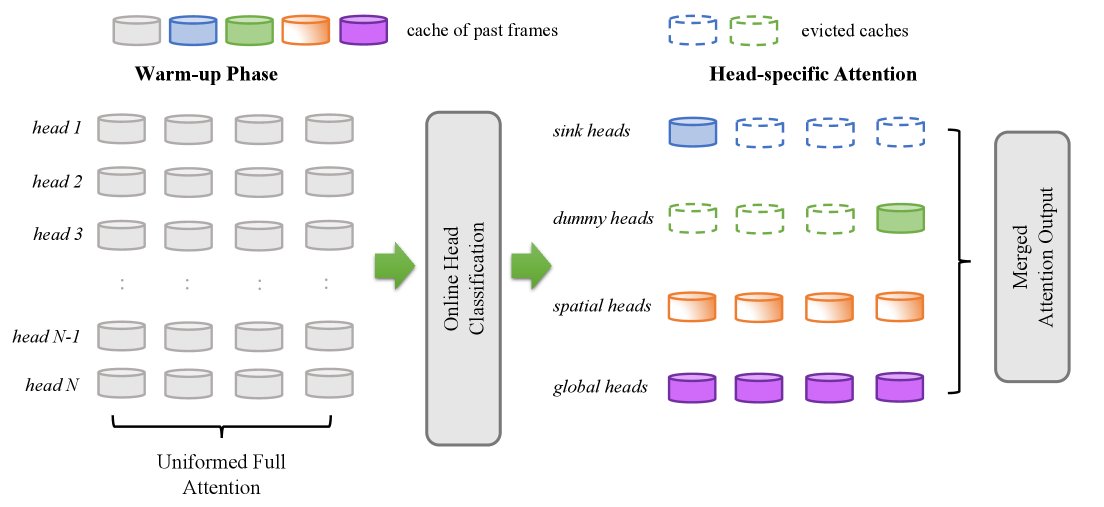
Background Autoregressive (AR) video diffusion models generate video block-by-block, reusing past frame state via a KV cache. As generation proceeds the cache grows without bound and attention cost scales quadratically with cache length, eventually dominating inference -- especially at high resolution, where each frame contributes many tokens.
배경 자기회귀(AR) 비디오 확산 모델은 긴 영상을 블록 단위로 생성하며 KV 캐시로 과거 프레임 상태를 재사용한다. 하지만 캐시는 생성이 진행될수록 계속 커지고, 어텐션 비용은 캐시 길이에 대해 이차적으로 증가해 결국 추론의 병목이 된다 — 특히 프레임당 토큰 수가 많은 고해상도에서 두드러진다.
Problem Existing cache-reduction methods either evict old context with coarse heuristics (causing inter-frame flickering) or require retraining. The authors pinpoint that the existing eviction baseline (Dummy Forcing) effectively treats nearly every head as a local-window-only Dummy type -- evicting long-range context that some heads actually depend on, breaking structure those heads were carrying.
문제 캐시를 줄이는 기존 방법들은 거친 휴리스틱으로 오래된 컨텍스트를 제거하거나(프레임 간 플리커링 유발), 재학습이 필요하다. 저자들은 기존 제거 베이스라인(Dummy Forcing)이 사실상 모든 헤드를 지역 윈도우만 보는 Dummy 유형으로 취급한다는 점을 지목한다 — 일부 헤드가 실제로는 장거리 컨텍스트에 의존하는데 이를 함께 제거해버려 구조가 깨진다는 것이다.
Prior limitations Prior eviction strategies apply a uniform policy across heads, or rely on retraining-based sparse attention with high deployment cost. What was missing was a cheap diagnostic for which heads actually need long-range information and which don't.
기존 한계 기존 제거 전략은 헤드를 구분하지 않는 균일한 정책을 적용하거나, 재학습 기반 희소 어텐션처럼 배포 비용이 큰 방식에 의존해왔다. 어떤 헤드가 실제로 장거리 정보를 필요로 하는지 구분하는 저비용 진단이 빠져 있었다.
Goal Without any retraining, cheaply diagnose what context each attention head of a pretrained AR model actually needs, and give each head a different storage/compute pathway accordingly.
목표 재학습 없이, 사전학습된 AR 모델의 각 어텐션 헤드가 실제로 어떤 컨텍스트를 필요로 하는지 값싸게 진단해, 헤드별로 서로 다른 저장/연산 경로를 부여하는 것이 목표다.
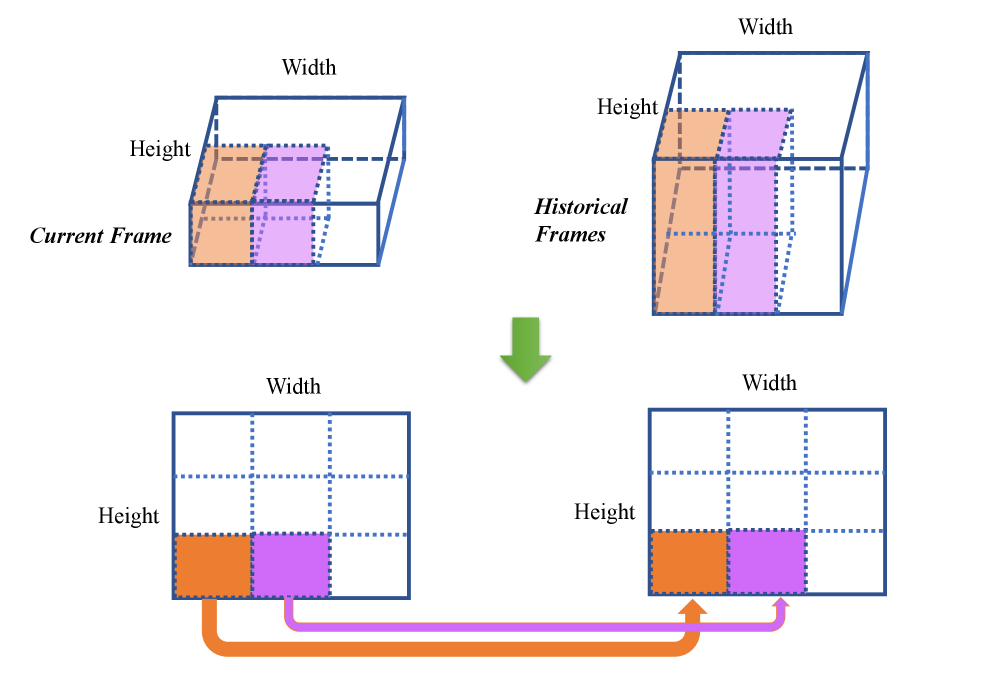
Method HeadCast performs a single one-time classification after warm-up, at the maximum-noise denoising step. Each head's attention output is compared to a full-history reference output via cosine similarity, sorting it into one of four archetypes: Sink (attends only to the first temporal block), Dummy (only the current local block), Spatial (all history, but confined to a local grid around each query token), or Global (fits none of the above -- the heads carrying long-range temporal consistency). The Spatial decision uses a conservative score (5th-percentile cosine similarity minus an MSE penalty) rather than a plain average, since average similarity can stay high even when a head fails at a few boundary tokens. It is a bit like profiling each meeting participant's usual speaking pattern in advance, then applying a different note-taking shorthand to each person when compressing the minutes.
방법 HeadCast는 워밍업 후 최대-노이즈 스텝에서 단 한 번 분류를 수행한다. 각 헤드의 어텐션 출력을 전체-히스토리 참조 출력과 코사인 유사도로 비교해, Sink(첫 시간 블록에만 주의), Dummy(현재 지역 블록만), Spatial(전체 히스토리이지만 쿼리 주변 그리드로 국한), Global(위 어디에도 맞지 않음 — 장거리 시간 일관성을 담당) 네 유형 중 하나로 배정한다. Spatial 판정에는 평균 코사인 유사도가 일부 경계 토큰의 실패를 가려버릴 수 있다는 점을 감안해, 5백분위수 코사인 유사도에서 MSE 페널티를 뺀 보수적 점수를 쓴다. 마치 회의 참석자 각각의 평소 발언 패턴을 미리 파악해 두었다가, 회의록을 압축할 때 각자에게 맞는 요약 방식을 다르게 적용하는 것과 비슷하다.
Key idea The core move is treating cache reduction as a four-way routing decision per head rather than a binary keep/evict choice -- explicitly protecting the Global heads that carry long-range consistency avoids the flickering that uniform eviction causes. A useful side effect of the design is that the Spatial pathway's savings automatically grow with resolution.
핵심 아이디어 핵심은 제거를 이진(유지/삭제) 결정이 아니라 헤드별로 네 갈래의 서로 다른 경로로 다루는 것이다 — 특히 장거리 일관성을 담당하는 Global 헤드를 명시적으로 보호함으로써, 균일 제거가 만드는 플리커링을 원천적으로 피한다. 해상도가 커질수록 Spatial 경로의 절감폭이 자동으로 커진다는 점도 설계상의 장점이다.
Validation Evaluated on four state-of-the-art AR video backbones at 480P/720P/1080P, using VBench (Quality, Semantic, Total, Dynamic Degree), PSNR/LPIPS against full-attention output, a block-boundary discontinuity metric, a user study, and ablations over classification thresholds and the classification timestep.
검증 4개의 최신 AR 비디오 백본에서 480P·720P·1080P 해상도, VBench(품질·의미·전체·역동성), 전체 어텐션 대비 PSNR/LPIPS, 블록 경계 불연속성 지표, 사용자 연구, 분류 임계값·시점 소거 실험으로 평가한다.
Results At 480P the cache is still small so speedups are modest for both methods (HeadCast 1.02-1.08x), but the gap widens at high resolution -- on the LongLive (30s) backbone, HeadCast reaches 1.62x/1.95x at 720P/1080P, with steady-state KV-cache size roughly 33% smaller than full attention. On frame fidelity, HeadCast reaches 22-26 dB PSNR (vs. Dummy Forcing's 16-19 dB) and 0.045-0.068 LPIPS (vs. 0.15-0.22, a 3-4x gap) against each model's full-attention output; a block-boundary discontinuity metric shows Dummy Forcing degrading by up to 36% while HeadCast matches full attention.
결과 480P에서는 캐시가 아직 작아 두 방법 모두 속도 향상이 크지 않지만(HeadCast 1.02–1.08배), 고해상도에서 격차가 벌어진다 — LongLive(30초) 백본에서 720P/1080P 각각 1.62배/1.95배 속도 향상, 정상상태 KV 캐시는 전체 어텐션 대비 약 33% 축소. 프레임 충실도에서 HeadCast는 전체-어텐션 대비 22–26dB PSNR(Dummy Forcing 16–19dB)·LPIPS 0.045–0.068(Dummy Forcing 0.15–0.22, 3–4배 격차)을 기록하며, 블록 경계 불연속성 지표에서 Dummy Forcing이 최대 36% 악화되는 반면 HeadCast는 전체 어텐션과 동등하다.
Comparison Compared against both full attention (the ceiling) and the existing coarse eviction baseline (Dummy Forcing) across the same four backbones. HeadCast stays within 0.15 VBench-Total points of full attention while Dummy Forcing loses up to 0.7 points -- the fidelity/consistency gap between the two methods is far sharper than their speed gap.
비교 동일한 4개 백본에서 전체 어텐션(상한)과 기존 거친 제거 베이스라인(Dummy Forcing)을 함께 비교한다. VBench 총점은 HeadCast가 전체 어텐션과 0.15점 이내로 근접하는 반면 Dummy Forcing은 최대 0.7점까지 벌어진다 — 두 방법의 속도 차이보다 화질·일관성 격차가 더 뚜렷하게 갈린다.
Significance From an efficient-video-generation standpoint, this paper questions the uniform-policy assumption that every head needs to see the same amount of history -- if heads are already stably heterogeneous, a cheap one-time diagnostic is enough to exploit that heterogeneity without any retraining.
의의 효율적 비디오 생성 관점에서, 이 논문은 헤드가 모두 똑같이 히스토리 전체를 봐야 한다는 균일-정책 전제에 의문을 던진다 — 헤드가 이미 안정적으로 이질적(heterogeneous)이라면, 값싼 일회성 진단만으로 재학습 없이 그 이질성을 활용할 수 있다는 것이다.
Limitations How narrow the good-operating-range is for the four archetype thresholds -- i.e. the effective hidden tuning cost -- is shown in the paper's threshold ablation (Fig. 5), but this review's read doesn't pin down specific sensitivity numbers (reviewer judgment). Whether the one-shot max-noise-step classification assumption holds at much longer rollouts or under content-distribution shift than tested here is not stated in the paper.
한계 네 아키타입의 결정 임계값이 얼마나 좁은 범위에서만 잘 작동하는지, 즉 사실상의 튜닝 비용이 어느 정도인지는 논문의 임계값 소거 실험(Fig. 5)에 나타나지만 이 리뷰가 읽은 범위에서 구체적 민감도 수치까지 확정하지는 않는다(리뷰어 판단). 분류가 최대-노이즈 스텝 한 번으로 고정된다는 가정이 이 논문에서 시험한 것보다 훨씬 긴 롤아웃이나 콘텐츠 분포 변화에서도 유지되는지는 논문 내 명시 없음.
Future work No explicit future-work items are identifiable within the scope this review draws from (abstract, method, and main-results sections) -- not stated in the paper.
향후 과제 이 리뷰가 읽은 범위(초록·서론·방법·주요 결과 섹션)에서 저자들이 명시한 future-work 항목은 확인되지 않는다 — 논문 내 명시 없음.
Released resources A public GitHub repository (https://github.com/sjlgaga/HeadCast) is stated in the paper's abstract and was confirmed reachable.
자원 공개 공개 GitHub 저장소(https://github.com/sjlgaga/HeadCast)가 논문 초록에 명시되어 있고 접속이 확인되었다.
The research thread
Where this paper sits 연구의 흐름
KV-cache reduction for AR video diffusion has mostly split into two lineages: temporal/relevance-based eviction (sliding-window style), and, more recently, surprise-gated re-admission that partially reverses eviction (Surprise Forcing, [[surprise-forcing]]). Both lineages share a common unit of decision: what to keep is decided per token/frame.
This paper changes the unit itself -- the decision is made per head, not per frame. Instead of one eviction policy applied uniformly across every frame, it first diagnoses that heads have stably different behavior patterns (Sink/Dummy/Spatial/Global), then assigns a different storage strategy per pattern. That reframes evict-or-keep into acknowledging a fact that was already true: some heads are inherently local and some are inherently global.
This opens two questions. One is whether head-level routing and frame/token-level re-admission (Surprise-Forcing-style) can be combined in the same system, since they look like orthogonal axes. The other is whether this head heterogeneity is specific to video diffusion, or a more general structure that could be diagnosed and exploited the same way in text or other-modality autoregressive generation.
AR 비디오 확산의 KV 캐시 절감 계열은 대체로 두 축으로 갈라져 왔다: 시간/관련성 기반 제거(슬라이딩 윈도우류)와, 최근에는 서프라이즈 신호로 제거를 되돌리는 재수용 방식(Surprise Forcing, [[surprise-forcing]]). 두 계열 모두 무엇을 저장할 것인가를 토큰/프레임 단위로 결정한다는 공통점이 있다.
이 논문은 단위 자체를 바꾼다 — 결정을 프레임이 아니라 헤드 단위로 내린다. 모든 프레임에 걸쳐 균일하게 적용되는 하나의 제거 정책 대신, 헤드마다 안정적으로 다른 행동 패턴(Sink/Dummy/Spatial/Global)이 있다는 것을 먼저 진단하고, 그 진단에 따라 서로 다른 저장 전략을 부여한다. 이는 제거냐 보존이냐의 질문을, 이미 어떤 헤드는 지역적이고 어떤 헤드는 전역적이라는 사실을 인정하는 쪽으로 재구성한 것이다.
이 흐름이 여는 질문은 두 가지다. 하나는 헤드 단위 라우팅과 프레임/토큰 단위 재수용(Surprise Forcing류)을 같은 시스템에서 결합할 수 있는가 — 서로 직교하는 축처럼 보이기 때문이다. 다른 하나는 이 헤드 이질성이 비디오 확산에 국한된 현상인지, 아니면 텍스트나 다른 모달리티의 자기회귀 생성에서도 같은 방식으로 진단하고 활용할 수 있는 더 일반적인 구조인지다.
Sparks — where one could take this 아이디어의 씨앗
-
The paper assumes head classification stays fixed after a single max-noise-step pass -- directly testing whether head archetypes actually remain stable over much longer rollouts or under large scene/content shifts would probe the limits of that assumption. 논문은 헤드 분류가 최대-노이즈 스텝 한 번으로 고정된다고 가정한다 — 훨씬 긴 롤아웃이나 장면이 크게 바뀌는 콘텐츠에서 헤드 아키타입이 실제로 안정적으로 유지되는지 직접 시험해보면 이 가정의 한계를 드러낼 수 있을 것이다.
-
There's a threshold-sensitivity ablation across the four archetypes, but whether a coarser classification recovers most of the benefit isn't separately addressed -- sweeping the number of archetypes itself to map the performance-complexity trade-off is a natural follow-up. 네 아키타입 사이의 임계값 민감도 소거 실험은 있지만, 더 거친 분류로도 대부분의 이득을 회수할 수 있는지는 별도로 다뤄지지 않는다 — 아키타입 수 자체를 바꿔가며 성능-복잡도 트레이드오프를 그려보는 것은 자연스러운 후속 질문이다.
Seeds grounded in the paper's own stated limitations and open questions. 논문이 스스로 밝힌 limitations와 open questions에 뿌리를 둔 씨앗입니다.
Notes
Notes
Linked reviews
Self Gradient Forcing: Native Long Video Extrapolation
Self Gradient Forcing names the historical context-gradient gap in Self-Forcing-style autoregressive video diffusion training — the historical KV cache is written once and then frozen, so future losses can never supervise how it should have been written — and fixes it with a two-pass training scheme that lets models trained on 5-second clips extrapolate natively to 240-second video.
video-diffusionSurprise Forcing: What to Remember, When to Skip in Long Video Generation
Surprise Forcing is a training-free framework for streaming autoregressive video diffusion that re-admits evicted frames into a rolling KV cache under a feedback-controlled surprise budget, and separately skips denoising steps for chunks judged easy, improving long-horizon consistency without sacrificing real-time streaming.
hybrid-architectureSANA-Video 2.0: Hybrid Linear Attention with Attention Residuals for Efficient Video Generation
SANA-Video 2.0 combines 75% gated linear attention with 25% periodic softmax anchors -- measured as the quality-efficiency Pareto knee via from-scratch proxy sweeps, not assumed from language-model literature -- plus Block Attention Residuals routing completed-block summaries into later linear layers, reaching VBench 84.30 in 13.2s at 480p on one H100 and a 3.2x DiT-forward speedup over full-softmax at 720p/60s that widens with duration.