Paper Review
Jet-Long: Efficient Long-Context Extension with Dynamic Bifocal RoPE
A tuning-free method extends an LLM's context window beyond its pretrained length by combining a local RoPE-faithful attention window with a long-range window whose rescaling factor adapts dynamically to the current sequence length, fused into a single GPU kernel.
로컬 RoPE-충실 attention 윈도우와, 현재 시퀀스 길이에 맞춰 rescaling 계수가 동적으로 조정되는 장거리 윈도우를 결합해, 추가 학습 없이 LLM의 context window를 사전학습 길이 이상으로 확장하고 이를 단일 GPU 커널로 융합한 방법이다.
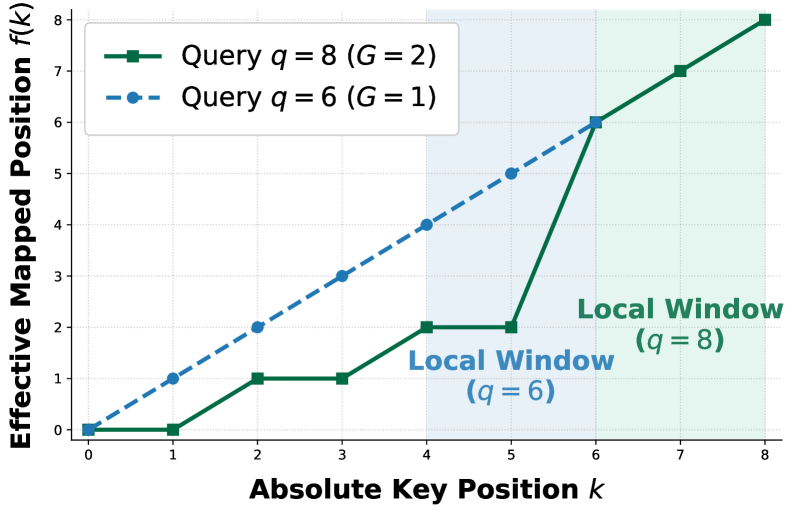
Background LLMs are increasingly deployed on RAG, repository-level coding, and agentic workflows whose inputs routinely exceed the pretraining window (typically 4K–32K) by an order of magnitude, making zero-shot context extension the dominant deployment path for open-weight checkpoints. RoPE-based models fail beyond the window through two mechanisms: low-frequency RoPE components produce out-of-distribution rotation angles at unseen positions, and the softmax distribution flattens as the key set grows (attention diffusion). A zero-shot RoPE-rescaling family — PI, NTK/Dynamic NTK, YaRN, Self-Extend, DCA, ReRoPE, LM-Infinite, GALI — attacks the former.
배경 RAG, repository-level coding, agentic workflow처럼 입력이 사전학습 window(보통 4K–32K)를 한 자릿수 배 이상 넘는 long-context 응용이 늘면서, open-weight 체크포인트에는 zero-shot context 확장이 지배적인 배포 경로가 됐다. RoPE 기반 모델이 window 밖에서 무너지는 원인은 두 가지로 정리된다: 학습에서 본 적 없는 위치에서 저주파 RoPE 성분이 out-of-distribution 회전각을 만드는 것, 그리고 key 집합이 커질수록 softmax 분포가 평평해지는 attention diffusion. PI, NTK/Dynamic NTK, YaRN, Self-Extend, DCA, ReRoPE, LM-Infinite, GALI 등 zero-shot RoPE 재조정 계열이 전자를 공략해 왔다.
Problem Most existing zero-shot methods fix one rescaling factor (or grouping size) before deployment: an aggressive factor sacrifices short-context fidelity while a conservative one breaks down at long contexts. The root issue is that the optimal factor is a function of the current sequence length, yet it gets pinned to a constant. It is like trying to serve both street-level navigation and cross-continent travel with a single map scale — whichever you pick, you lose resolution on the other end.
문제 기존 zero-shot 기법 대부분은 rescaling factor(또는 grouping size) 하나를 배포 전에 고정하는데, 공격적인 factor는 짧은 context의 fidelity를 희생하고 보수적인 factor는 긴 context에서 무너진다. 최적 factor 자체가 현재 시퀀스 길이의 함수인데 이를 상수로 못 박는 것이 근본 문제다. 골목길 안내와 대륙 횡단을 지도 한 장의 단일 축척으로 해결하려는 것과 같다 — 어느 쪽을 골라도 반대쪽 해상도를 잃는다.
Prior limitations The paper explicitly notes that YaRN, Self-Extend, and DCA fix a single grouping size or factor up front. Concretely, Qwen3-4B-Base explodes from ~9.7 to 104.66 PG-19 perplexity at the longest length past its 32K window, and the fixed-factor baselines mitigate this but still trail by 2–4.8pp on aggregate RULER (strongest baseline: DNTK at 1.7B, Self-Extend at 4B/8B). Dynamic NTK does adapt its factor to length, but rescales all positions uniformly with no protected window preserving local RoPE faithfulness (reviewer judgment on the mechanism contrast).
기존 한계 논문은 YaRN, Self-Extend, DCA가 grouping size나 factor 하나를 사전에 고정한다는 점을 명시적으로 지적한다. 실제로 Qwen3-4B-Base는 32K window를 넘으면 PG-19 perplexity가 ~9.7에서 최장 길이 기준 104.66까지 폭발하며, 고정-factor baseline들은 이를 완화하지만 RULER 집계에서 여전히 2–4.8pp 뒤진다(최강 baseline: 1.7B는 DNTK, 4B/8B는 Self-Extend). Dynamic NTK는 factor를 길이에 맞춰 조정하긴 하나 모든 위치를 일괄 재조정해, 근거리 RoPE-충실성을 지키는 보호 구간이 없다(메커니즘 대비는 리뷰어 판단).
Goal Build a tuning-free zero-shot extension that recovers the base model exactly inside the pretrained window and extrapolates cleanly beyond it at any current length. Simultaneously, the added attention work must be essentially free at serving time, and even the single hyperparameter (local window size) should need no per-deployment tuning.
목표 추가 학습 없이(tuning-free), 사전학습 window 안에서는 base 모델을 정확히 재현하고 그 밖에서는 현재 길이에 맞게 깔끔하게 extrapolate하는 zero-shot 확장을 만드는 것. 동시에 추가된 attention 연산이 서빙 시점에 사실상 공짜여야 하고, 유일한 hyperparameter(local window 크기)조차 배포별 튜닝이 필요 없어야 한다.
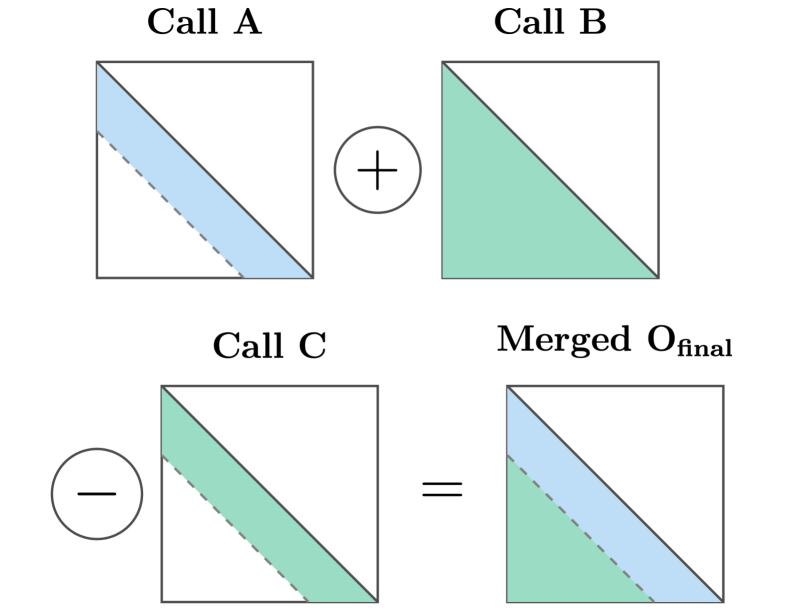
Method Dynamic Bifocal RoPE — (q,k) pairs within relative distance w₀=2048 keep the original RoPE score, while farther pairs have positions remapped by f(x)=⌊x/G⌋, with the group size G=max(1, ⌈L/W_pretrain⌉) growing with the current length L. Prefill merges three FlashAttention calls — (A) sliding-window with base RoPE, (B) full-causal with remote RoPE, (C) sliding-window with remote RoPE — by inclusion-exclusion, O=(W_A·O_A + W_B·O_B − W_C·O_C)/(W_A+W_B−W_C), stabilized via LogSumExp. Like computing the area of A∪B in a Venn diagram by subtracting the overlap once, call C removes exactly the local region that B double-counts. At decode, the KV cache stores uncompressed keys at absolute positions and applies on-the-fly correction rotations (Δq, Δk) by RoPE composition instead of recomputing, and the whole construction is fused into a single CuTe kernel.
방법 Dynamic Bifocal RoPE — 상대 거리 w₀=2048 이내의 (q,k) 쌍은 원래 RoPE score를 그대로 쓰고, 그 밖은 위치를 f(x)=⌊x/G⌋로 재매핑하되 group 크기 G=max(1, ⌈L/W_pretrain⌉)가 현재 길이 L에 따라 커진다. Prefill은 세 번의 FlashAttention 호출 — (A) base RoPE sliding-window, (B) remote RoPE full-causal, (C) remote RoPE sliding-window — 을 포함-배제(inclusion-exclusion) 원리로 O=(W_A·O_A + W_B·O_B − W_C·O_C)/(W_A+W_B−W_C)처럼 병합한다(LogSumExp로 수치 안정화). 벤 다이어그램에서 A∪B의 넓이를 구할 때 겹친 부분을 한 번 빼 주듯, B가 이중 계산한 local 구간을 C가 정확히 걷어내는 구조다. Decode에서는 KV cache에 절대 위치의 비압축 key를 저장하고 즉석(on-the-fly) 보정 회전(Δq, Δk)을 RoPE 합성으로 적용해 재계산을 피하며, 전체를 단일 CuTe 커널로 융합했다.
Key idea Make the rescaling factor a function of the current length rather than a constant chosen for the target maximum: when L is within the pretrained window, G=1 and the method reduces exactly to the base model; beyond it, remote positions are compressed only as much as that length requires. It goes one step past bifocal glasses — the near lens stays prescription-free, while the far lens adjusts its power automatically to how far you are looking, like a varifocal lens.
핵심 아이디어 rescaling factor를 목표 최대 길이에 대한 상수가 아니라 현재 길이의 함수로 만든 것. L이 사전학습 window 이하면 G=1이 되어 base 모델로 정확히 환원되고, 길어지면 그 길이가 요구하는 만큼만 원거리를 압축한다. 이중초점(bifocal) 안경에서 한 걸음 더 나아간 셈으로 — 근거리 렌즈는 도수 없이 두고, 원거리 렌즈의 도수가 보는 거리에 맞춰 자동으로 바뀌는 가변초점 렌즈에 해당한다.
Validation Qwen3 1.7B/4B/8B Base (native 32K window) extended to 128K, evaluated on RULER (13 tasks × 7 lengths, 4K–128K), HELMET-RAG (4 sub-tasks), and PG-19 perplexity over 100 books. Baselines are Dynamic NTK, YaRN, DCA, and Self-Extend, with per-baseline hyperparameters listed in the appendix. Efficiency is measured against FlashAttention-2 on H100 for both prefill and generation throughput, and the single hyperparameter w₀ is ablated separately.
검증 Qwen3 1.7B/4B/8B Base(native 32K window)를 128K까지 확장해 RULER(13개 태스크 × 4K–128K 7개 길이), HELMET-RAG(4개 하위 태스크), PG-19(책 100권 perplexity)로 평가했다. Baseline은 Dynamic NTK, YaRN, DCA, Self-Extend 4종이며 각 baseline의 hyperparameter는 부록에 명시돼 있다. 효율은 H100에서 FlashAttention-2 대비 prefill/generation 처리량으로 측정하고, 유일한 hyperparameter w₀는 별도로 ablation했다.
Results On RULER aggregated over 4K–128K, +4.79/+2.18/+2.03pp over the strongest baseline at 1.7B/4B/8B; best HELMET-RAG at 4B/8B (only 0.73pp behind Self-Extend at 1.7B); lowest PG-19 perplexity on all three models. On efficiency, H100 prefill reaches up to 1.39× FlashAttention-2 at 128K (approaching the Hopper-only FA4), single-batch generation stays at ≥0.96× FA2 (≤4% overhead) at every length, and within 32K it matches FA2 to ±1%. Kernel fusion is the make-or-break piece: the unfused three-pass implementation drops to 0.29×.
결과 4K–128K 집계 RULER에서 최강 baseline 대비 +4.79/+2.18/+2.03pp(1.7B/4B/8B), HELMET-RAG는 4B/8B에서 최고(1.7B만 Self-Extend에 0.73pp 뒤짐), PG-19 perplexity는 세 모델 모두 최저다. 효율 면에서는 H100 prefill이 128K에서 FlashAttention-2의 최대 1.39배(Hopper 전용 FA4에 근접), 단일 배치 generation은 모든 길이에서 0.96× 이상(≤4% 오버헤드), 32K 이내에서는 FA2와 ±1% 일치. 커널 융합이 관건으로, 융합하지 않은 3-pass 구현은 0.29×까지 떨어진다.
Comparison Against all four baselines (Dynamic NTK, YaRN, DCA, Self-Extend) it leads on all three accuracy benchmarks, and the structural difference from fixed-factor methods is exact reduction to base attention within 32K. The hybrid-architecture generalization is experimentally supported rather than merely claimed: applied to Jet-Nemotron 2B/4B (interleaved softmax + linear attention), it lifts seven-length-average RULER from 42.93→52.94 (+10.01pp) and 42.16→53.47 (+11.31pp) respectively.
비교 Baseline 4종(Dynamic NTK, YaRN, DCA, Self-Extend)과의 비교에서 정확도 3개 벤치 모두 우위이며, 32K 이내에서 base attention으로 정확히 환원된다는 점이 고정-factor 기법들과의 구조적 차이다. Hybrid 아키텍처 일반화도 주장이 아니라 실험으로 뒷받침된다: softmax와 linear attention을 interleave하는 Jet-Nemotron 2B/4B에 적용해 7개 길이 평균 RULER를 각각 42.93→52.94(+10.01pp), 42.16→53.47(+11.31pp) 끌어올렸다.
Significance Zero training, zero calibration, one kernel swap — extending an open-weight model's context 4× while actually gaining prefill throughput makes this unusually close to drop-in for serving. Methodologically, the recipe of position remapping + inclusion-exclusion merging + cache correction rotations demonstrates a general way to layer an attention variant losslessly on top of the existing fused-kernel ecosystem. It connects directly to the long-context serving and KV-cache efficiency themes this site tracks (reviewer judgment).
의의 학습 0, 캘리브레이션 0, 커널 교체 하나로 open-weight 모델의 context를 4배 확장하면서 prefill 처리량은 오히려 이득 — 서빙 관점에서 드물게 drop-in에 가까운 조합이다. 방법론적으로는 위치 재매핑 + 포함-배제 병합 + 캐시 보정 회전이라는 레시피가, attention 변형을 기존 fused-kernel 생태계 위에 무손실로 얹는 일반적인 방법을 보여준다. 이 사이트가 다루는 long-context serving/KV-cache 효율화 논의와 직접 맞닿는 결과다(리뷰어 판단).
Limitations The method fixes only the position out-of-distribution failure mode; the paper itself draws the line at attention diffusion (softmax flattening with length), which it leaves to architectural alternatives such as sparse/linear attention. It also presupposes a softmax-attention-with-RoPE base, so models without RoPE or without softmax attention are out of scope. Evaluation is confined to the Qwen3 dense family plus Jet-Nemotron hybrids, so generality to other model families is unverified (reviewer judgment). The w₀ ablation shows RULER collapsing to near zero at w₀=0 and dropping 1.4–2.1pp at w₀=8192, marking that the protected window is essential but must not consume too large a share of context.
한계 이 방법이 고치는 것은 두 실패 모드 중 position out-of-distribution 쪽뿐이며, attention diffusion(길이가 늘수록 softmax가 평평해지는 문제)은 sparse/linear attention 같은 아키텍처 대안의 몫으로 남는다고 논문 스스로 선을 긋는다. 또한 softmax attention + RoPE 조합을 전제하므로 RoPE가 없거나 non-softmax인 모델에는 그대로 적용되지 않는다. 평가가 Qwen3 dense 계열과 Jet-Nemotron hybrid에 국한되어 다른 모델 계열에서의 일반성은 미확인이다(리뷰어 판단). w₀ ablation에서는 w₀=0이면 RULER가 거의 0으로 붕괴하고 w₀=8192로 키우면 1.4–2.1pp 하락해, 보호 구간이 필수이되 context를 잠식해서는 안 된다는 경계를 보여준다.
Future work The paper names natural extensions to other softmax-with-RoPE variants — Multi-head Latent Attention (MLA) and sparse attention — and to architectures interleaving softmax with sparse or linear-attention sub-layers. The attention-diffusion axis remains a complementary problem handled by those architectural families rather than by position remapping.
향후 과제 논문은 softmax-with-RoPE를 쓰는 다른 변형들 — Multi-head Latent Attention(MLA)과 sparse attention — 그리고 softmax와 sparse/linear attention sub-layer를 interleave하는 아키텍처로의 확장을 자연스러운 다음 단계로 명시한다. attention diffusion 축은 위치 재매핑이 아닌 그런 아키텍처 계열이 다루는 상보적 문제로 남는다.
Released resources Code is public at github.com/jet-ai-projects/jet-long, linked on the front page of the paper (correcting the earlier note that no release was verified). The arXiv HTML full text is available, including the fused CuTe kernel description and baseline configurations in the appendices.
자원 공개 코드가 github.com/jet-ai-projects/jet-long 에 공개되어 있으며 논문 첫 페이지에 링크가 명시돼 있다(이전 리뷰의 '공개 링크 확인 안 됨'을 정정). arXiv HTML 전문이 공개되어 있고, fused CuTe 커널 설명과 baseline 설정이 부록에 포함돼 있다.
The research thread
Where this paper sits 연구의 흐름
Jet-Long is the newest link in the zero-shot RoPE-extension chain that began when Position Interpolation (Chen et al., 2023) showed a pretrained context window could simply be stretched, was made frequency-aware by the community-born NTK scaling and its length-adaptive sibling Dynamic NTK, and was consolidated by YaRN's per-band interpolation. A second branch of the same family — ReRoPE (from Jianlin Su, RoPE's own author), LM-Infinite, Self-Extend, and DCA — shared a different protective instinct: keep a local neighborhood under the original RoPE and remap only the remote positions. Self-Extend is the closest ancestor, flooring remote positions into groups in exactly the shape of Jet-Long's f(x)=⌊x/G⌋; and the author lineup (Song Han, Han Cai) ties it to the same group's Jet-Nemotron hybrid line, where the local/global split of attention is already an efficiency primitive rather than an accuracy trick.
The conceptual move is small to state and large in consequence: the rescaling factor stops being a deployment-time constant and becomes a runtime function of the current sequence length. Every predecessor answered "how much do we compress distance?" once, for the worst case; Jet-Long answers it per sequence, so that within the pretrained window the model is not approximately but exactly the base model — a zero-risk property no fixed factor can offer. The quieter second shift is treating a positional scheme as algebra over existing kernels: three standard FlashAttention calls merged by inclusion-exclusion, then fused into one. The unfused variant running at 0.29× says plainly that this second shift is what makes the first one deployable.
Where the line goes next is already written into the paper's future-work section: the remap–merge–correct recipe is a protocol rather than a one-off, and MLA and sparse attention are named as the next softmax-with-RoPE hosts. The Jet-Nemotron experiments (+10–11pp RULER) sketch the likely equilibrium — hybrid stacks in which the few full-attention layers carry dynamic remapping while linear layers absorb length natively — moving zero-shot extension from a patch on dense transformers to a standard component of hybrid design.
The tension the paper leaves open is the axis it explicitly declines to fix: attention diffusion. No position remapping can stop softmax from flattening as the key set grows, so the residual long-context gap now carries a cleaner attribution question — how much of what remains is diffusion rather than position OOD? Expect answers in the same tuning-free register, such as logit temperatures that grow with length. And one constant still stands in a method whose thesis is that constants should be functions of length: the protected window w₀ itself, fixed at 2048, whose ablation (collapse at 0, slow dilution at 8192) hints that it too wants to become adaptive.
Jet-Long은 zero-shot RoPE 확장 계보의 최신 고리다. Position Interpolation(Chen et al., 2023)이 사전학습 context window를 그냥 잡아 늘일 수 있음을 보였고, 커뮤니티에서 태어난 NTK scaling과 그 길이 적응형 형제 Dynamic NTK가 이를 주파수-인지형으로 만들었으며, YaRN이 대역별 보간으로 정리했다. 같은 가족의 두 번째 갈래 — RoPE 원저자 Jianlin Su의 ReRoPE, LM-Infinite, Self-Extend, DCA — 는 다른 보호 본능을 공유했다: 가까운 이웃은 원본 RoPE로 두고 먼 위치만 재매핑하는 것. 그중 Self-Extend가 가장 가까운 조상으로, 먼 위치를 group 단위로 내림(floor)하는 방식이 Jet-Long의 f(x)=⌊x/G⌋와 정확히 같은 형태다. 저자 라인업(Song Han, Han Cai)은 같은 그룹의 Jet-Nemotron hybrid 계보와도 이어진다 — attention의 local/global 분할이 정확도 트릭이 아니라 이미 효율의 primitive가 된 자리에서 나온 논문이다.
개념적 전환은 말로는 작지만 귀결은 크다: rescaling factor가 배포 시점의 상수이기를 멈추고 현재 시퀀스 길이의 runtime 함수가 된다. 모든 선행 기법은 "거리를 얼마나 압축할 것인가"를 최악의 경우 기준으로 한 번만 답했다; Jet-Long은 시퀀스마다 답하고, 그 결과 사전학습 window 안에서는 base 모델과 근사적으로가 아니라 정확히 일치한다 — 고정 factor로는 불가능한 zero-risk 속성이다. 더 조용한 두 번째 전환은 positional scheme을 기존 커널 위의 대수(algebra)로 취급한 것이다: 표준 FlashAttention 호출 세 번을 inclusion-exclusion으로 병합한 뒤 하나로 융합한다. 융합하지 않은 구현이 0.29×로 떨어진다는 수치는, 첫 번째 전환을 배포 가능하게 만드는 것이 바로 이 두 번째 전환임을 그대로 말해준다.
이 계보가 다음으로 갈 곳은 논문의 future-work에 이미 적혀 있다: remap–merge–correct 레시피는 일회성이 아니라 프로토콜이고, MLA와 sparse attention이 다음 softmax-with-RoPE 숙주로 지명된다. Jet-Nemotron 실험(+10–11pp RULER)은 유력한 평형점을 스케치한다 — 소수의 full-attention layer가 dynamic remapping을 담당하고 linear layer가 길이를 원생적으로 흡수하는 hybrid 스택 — zero-shot 확장이 dense transformer에 붙이는 패치에서 hybrid 설계의 표준 부품으로 이동하는 그림이다.
논문이 열어둔 긴장은 스스로 고치지 않겠다고 선을 그은 축, attention diffusion이다. key 집합이 커질수록 softmax가 평평해지는 것은 어떤 위치 재매핑으로도 막을 수 없으므로, 이제 남은 long-context 격차에는 더 깨끗한 귀속(attribution) 질문이 생긴다 — 남은 것 중 얼마가 position OOD가 아니라 diffusion인가? 같은 tuning-free 문법의 답, 예컨대 길이에 따라 커지는 logit temperature 같은 시도가 이어질 것이다. 그리고 "상수는 길이의 함수여야 한다"가 논지인 방법에 아직 상수가 하나 서 있다: 2048로 고정된 보호 window w₀ 자체다. ablation(0에서 붕괴, 8192에서 완만한 희석)은 이것 역시 적응형이 되고 싶어 함을 암시한다.
Sparks — where one could take this 아이디어의 씨앗
-
One could port the remap–merge–correct recipe to Multi-head Latent Attention, testing whether the on-the-fly correction rotations survive when keys live in a shared compressed latent space rather than per head. remap–merge–correct 레시피를 Multi-head Latent Attention으로 이식해, key가 head별이 아니라 공유 latent space에 압축된 상태에서도 on-the-fly 보정 회전이 성립하는지 확인해볼 수 있다.
-
One could pair dynamic position remapping with a tuning-free logit-temperature correction that grows with log context length, measuring how much of the remaining long-context gap is attention diffusion rather than position OOD. dynamic position remapping에 log context length에 비례해 커지는 tuning-free logit-temperature 보정을 결합해, 남은 long-context 격차 중 얼마가 position OOD가 아닌 attention diffusion인지 측정해볼 수 있다.
-
One could make the protected window w₀ adaptive per model or per layer — derived from measured attention-span statistics — since the ablation shows the fixed 2048 sits on a ridge between collapse at zero and dilution at 8192. 보호 window w₀를 모델·layer별 attention-span 통계에서 유도해 적응형으로 만들어볼 수 있다 — ablation이 보여주듯 고정값 2048은 0에서의 붕괴와 8192에서의 희석 사이 능선에 놓여 있다.
Seeds grounded in the paper's own stated limitations and open questions. 논문이 스스로 밝힌 limitations와 open questions에 뿌리를 둔 씨앗입니다.
Notes
Notes
The core move is making the RoPE rescaling factor a function of the current sequence length rather than a global constant chosen once for the target maximum length — a small but meaningful reframing of the usual “one NTK/YaRN factor for the whole context” approach, with the bifocal split (protected local window + dynamically grouped remote window) buying exact base-model recovery within the pretrained window. The full-text read resolved the open question from the initial sweep: the hybrid-architecture claim IS experimentally supported (Jet-Nemotron 2B/4B, +10.01/+11.31pp average RULER), not just a design intention.
Corrections against the initial autosweep entry (verified from the arXiv HTML full text): (1) the paper’s stated affiliation is NVIDIA, not MIT HAN Lab (lab fixed); (2) code is publicly released at github.com/jet-ai-projects/jet-long, contra the earlier “no public release verified”; (3) the +4.79/+2.18/+2.03pp RULER gains are aggregates over seven lengths up to 128K (Table 1), not results “at 128K” as previously phrased.
Linked reviews
DuoAttention: Efficient Long-Context Inference with Retrieval and Streaming Heads
Learns which attention heads actually retrieve from long context and gives only those a full KV cache, cutting long-context memory up to 2.55x with retrieval accuracy intact.
linear-attentionGated Delta Networks: Improving Mamba2 with Delta Rule
Unifies Mamba2-style gated decay with the delta-rule targeted memory update into a single hardware-efficient linear-attention layer that beats both parents and anchors strong hybrid stacks with sliding-window attention.