Paper Review
LiftQuant: Continuous Bit-Width LLM via Dimensional Lifting and Projection
A lift-then-project weight-quantization scheme that stores each weight block as a linear projection of a 1-bit lattice living in a higher-dimensional space, so the effective bit-width becomes a quasi-continuous dial (lifted dim / block dim) — e.g. Llama-3-70B at 2.4 bits exactly fills a 24GB GPU and clearly beats every 2-bit method forced onto the same card, with a lookup-table-free INT1-GEMM decode path.
고차원 lifted 공간의 1-bit lattice를 선형 projection해 weight block을 표현하는 lift-then-project 양자화 — 유효 bit-width가 차원비(D/d)로 준연속 조절되어, 예컨대 Llama-3-70B를 2.4-bit로 24GB GPU에 정확히 채우고 같은 카드에 들어가는 모든 2-bit 방법을 능가하며, decode는 lookup table 없는 INT1-GEMM 경로를 유지한다.
Background Weight-only quantization has become standard practice for fitting large LLMs onto commodity GPUs, and the authors point to the memory wall, not compute, as the deployment bottleneck. The state of the art has split into hardware-friendly uniform quantization (GPTQ, QuaRot, EfficientQAT) and vector quantization (QuIP#, AQLM, VPTQ, QTIP), which buys 2–3-bit accuracy at the cost of codebook lookups. Both families share one structural assumption: the bit-width is an integer.
배경 LLM weight-only 양자화는 commodity GPU에 대형 모델을 올리기 위한 표준 관행이 됐고, 저자들이 지목하는 병목은 연산이 아니라 memory wall이다. 최신 기법은 hardware-friendly한 uniform quantization(GPTQ·QuaRot·EfficientQAT) 계열과, codebook lookup 비용을 치르고 2–3-bit 정확도를 사는 vector quantization(QuIP#·AQLM·VPTQ·QTIP) 계열로 갈라져 있다. 두 계열 모두 "bit-width는 정수"라는 구조적 가정을 공유한다.
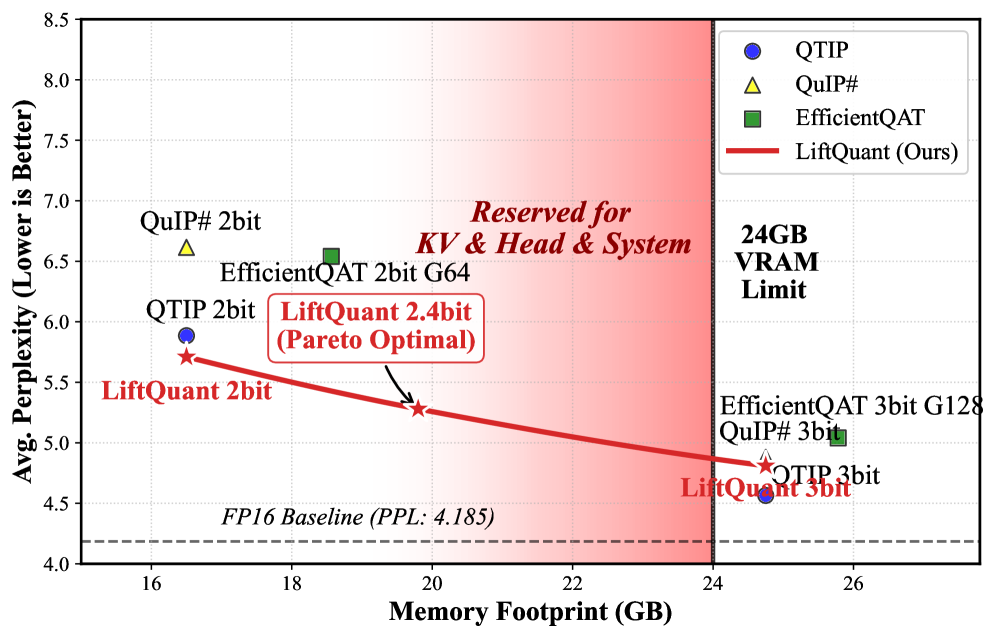
Problem Integer bit-widths create a "deployment gap" — a given memory budget almost never coincides with an integer-bit model size, so one either leaves VRAM idle or gives up the next precision step. It is like shoes sold only in whole sizes: a size-9.5 foot must cram into a 9 or swim in a 10. On a 24GB GPU a 2-bit 70B model wastes memory while the 3-bit one overflows, and no existing method can dial in the "2.4 bits" in between.
문제 정수 bit-width는 "deployment gap"을 만든다 — 주어진 memory budget이 정수-bit 모델 크기와 정확히 맞아떨어지는 일은 거의 없어서, VRAM을 놀리거나 한 단계 큰 정밀도를 포기해야 한다. 신발이 정수 사이즈로만 나오는 것과 같다: 9.5 발은 9에 구겨 넣거나 10에서 헐렁거리는 수밖에 없다. 24GB GPU에서 2-bit 70B는 메모리를 남기고 3-bit 70B는 넘치는데, 기존 방법으로는 그 사이의 "2.4-bit"를 다이얼할 수 없다.
Prior limitations UQ methods are locked to integer bit-widths by their datatype itself, while VQ methods could in principle vary the rate but tie bit-width to codebook size, with lookup-table decode cost growing alongside the codebook. Assembling layers at different integer bits is a coarse approximation rather than a continuous knob, and even QTIP's trellis coding operates only at fixed integer rates.
기존 한계 UQ는 datatype 자체가 정수 bit-width에 묶여 있고, VQ는 원리상 rate를 바꿀 수 있지만 bit-width가 codebook 크기에 결박돼 있으며 codebook이 커질수록 lookup-table decode 비용이 자란다. layer별로 서로 다른 정수 bit를 섞는 조립은 연속 knob이 아니라 성긴 근사에 그치고, QTIP의 trellis coding조차 고정된 정수 rate에서만 동작한다.
Goal Make the effective bit-width a quasi-continuous structural parameter so a model can be fit exactly to a memory budget — e.g. a 70B model at 2.4 bits on a 24GB GPU, or a 32B model at 2.5 bits on a 12GB GPU. At the same time, retain VQ-grade accuracy and a lookup-table-free, hardware-friendly decode path.
목표 유효 bit-width를 준연속(quasi-continuous) 구조 파라미터로 만들어 모델을 memory budget에 정확히 맞추는 것 — 예컨대 70B를 2.4-bit로 24GB GPU에, 32B를 2.5-bit로 12GB GPU에 배치한다. 동시에 VQ급 정확도와 lookup table 없는 hardware-friendly decode 경로를 유지하는 것이 목표다.
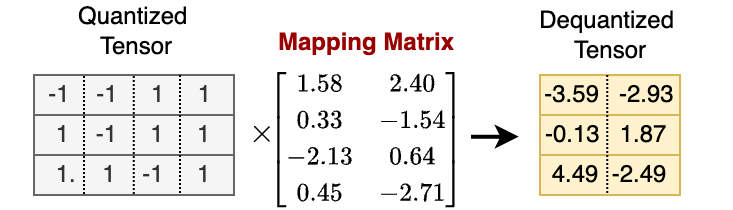
Method Each length-d weight block is represented as w ≈ M·w_q with w_q ∈ {±1}^D, i.e. as the projection of a 1-bit lattice living in a higher-dimensional lifted space, and the effective bit-width is the dimension ratio D/d (e.g. 24/10 = 2.4 bits). The projection matrix M is optimized offline against a standard Gaussian; a layer-wise whitening transform T (Hadamard-initialized orthogonal mixing plus scalings, in the QuIP# lineage) reshapes real weights toward that i.i.d. Gaussian; encoding is a nearest-neighbor search in the lifted space, accelerated from 2^D to 2^(D−d) by pseudo-inverse initialization. An intra-block correction fine-tunes W_q and the fused transform on RedPajama calibration data (4,096 segments of 2,048 tokens) with optional end-to-end fine-tuning, and decode is just diag(s)·W_q·(T*·aᵀ) — an INT1×FP GEMM plus small linear maps, with no lookup tables.
방법 길이 d의 weight block을 w ≈ M·w_q (w_q ∈ {±1}^D)로, 즉 고차원 lifted 공간에 있는 1-bit lattice의 projection으로 표현하며 유효 bit-width는 차원비 D/d다(예: 24/10 = 2.4-bit). Projection matrix M은 표준 Gaussian에 대해 offline으로 최적화하고, layer별 whitening transform T(Hadamard 초기화 orthogonal mixing + 스케일링, QuIP# 계보)로 실제 weight를 i.i.d. Gaussian에 가깝게 만든 뒤, lifted 공간 nearest-neighbor 탐색(pseudo-inverse 초기화로 복잡도 2^D → 2^(D−d))으로 encode한다. RedPajama calibration 데이터(2,048-token 세그먼트 4,096개)로 W_q와 fused transform을 intra-block 보정하고 선택적으로 end-to-end fine-tune하며, decode는 diag(s)·W_q·(T*·aᵀ) — INT1×FP GEMM과 작은 선형변환뿐, lookup table이 없다.
Key idea Do not design a codebook — cast a shadow. By a corollary of the CLT (Diaconis–Freedman), projecting the corners of a high-dimensional ±1 hypercube onto a lower-dimensional subspace yields a point cloud that converges to a Gaussian — the same shape as whitened LLM weights. So the simplest possible 1-bit lattice, viewed through the right projection, behaves like an expressive non-uniform vector codebook, and the "resolution of the shadow" is tuned continuously via the dimension ratio D/d.
핵심 아이디어 Codebook을 설계하지 말고 그림자를 드리워라. CLT의 따름정리(Diaconis–Freedman)에 의해 고차원 ±1 hypercube의 꼭짓점들을 저차원 부분공간으로 projection하면 그 점구름은 Gaussian으로 수렴하는데, 이는 whitening된 LLM weight의 분포와 같은 모양이다. 즉 가장 단순한 1-bit lattice도 알맞은 projection을 통해 보면 표현력 있는 non-uniform vector codebook처럼 행동하고, 그 "그림자의 해상도"는 차원비 D/d로 연속 조절된다.
Validation Evaluated on the Llama-2 (7B/13B/70B), Llama-3 (8B/70B), Qwen-2.5, and Qwen-3 families using WikiText-2 and C4 perplexity plus zero-shot suites (ARC-c/e, HellaSwag, PIQA, WinoGrande) and MMLU. Appendices check robustness of calibration to data size, sequence length, and domain shift, and end-to-end decoding throughput is measured on an RTX 4090D.
검증 Llama-2(7B/13B/70B)·Llama-3(8B/70B)·Qwen-2.5·Qwen-3 계열에서 WikiText-2·C4 perplexity와 zero-shot(ARC-c/e·HellaSwag·PIQA·WinoGrande)·MMLU로 평가했다. 부록에서 calibration 데이터 크기·sequence 길이·domain shift에 대한 강건성을 점검하고, RTX 4090D에서 end-to-end decoding throughput을 측정했다.
Results On Llama-3-70B, 2-bit LQ-32/16 reaches 4.69 WikiText-2 perplexity (QTIP 4.97, QuIP# 5.77), the fractional LQ-24/10 (2.4-bit) drops to 4.10, and LQ-24/8 (3-bit) reaches 3.45 (QuIP# 3.59). The headline is the deployment result: a 2.4-bit 70B model exactly fills a 24GB GPU while clearly beating the strongest 2-bit models forced onto the same card. Decoding is practical too — Llama-2-70B runs at 31.3 tok/s at 2 bits on an RTX 4090D-48G, faster than QTIP at the same bit-width (24.5 tok/s).
결과 Llama-3-70B 기준 2-bit LQ-32/16이 WikiText-2 4.69(QTIP 4.97, QuIP# 5.77), 분수-bit LQ-24/10(2.4-bit)은 4.10, LQ-24/8(3-bit)은 3.45(QuIP# 3.59)를 기록했다. 헤드라인은 배치 결과다: 2.4-bit 70B가 24GB GPU를 정확히 채우면서, 같은 카드에 들어가도록 강제된 최강 2-bit 모델들을 크게 앞선다. Decode도 실용적이어서 Llama-2-70B가 RTX 4090D-48G에서 2-bit 31.3 tok/s로 같은 bit-width의 QTIP(24.5 tok/s)보다 빠르다.
Comparison Against the full UQ (GPTQ, QuaRot, EfficientQAT) and VQ (AQLM, VPTQ, QuIP#, QTIP) baseline sets, it trades blows with QTIP at exactly 2.0 bits (winning on Llama-3-70B, trailing slightly on the smaller Llama-2 models) but has no competitors at all at the fractional points in between. Versus VQ it swaps the phrasebook for a grammar: instead of storing and looking up a learned codebook, every codeword is generated on the fly by a linear map, so decode stays BitBLAS-friendly INT1×FP16 GEMM.
비교 UQ(GPTQ·QuaRot·EfficientQAT)와 VQ(AQLM·VPTQ·QuIP#·QTIP) 전부와 비교해, 정확히 2.0-bit에서는 QTIP과 모델별로 엎치락뒤치락하지만(Llama-3-70B는 이기고 소형 Llama-2에서는 소폭 뒤진다) 그 사이 분수-bit 지점에는 경쟁자 자체가 없다. VQ 대비로는 phrasebook을 문법으로 바꾼 셈이다: 학습된 codebook을 저장·조회하는 대신 모든 codeword를 선형변환으로 즉석 생성하므로, decode가 BitBLAS 친화적 INT1×FP16 GEMM으로 유지된다.
Significance It turns bit-width from a discrete menu into a continuous dial, making quantization memory-budget-first ("what fits in this 24GB?") rather than bit-width-first — made-to-measure instead of off-the-rack. It is also a clean case of theory directly shipping an algorithm (the CLT geometry of high-dimensional projections), and was accepted as an ICML 2026 Spotlight.
의의 Bit-width를 이산 메뉴에서 연속 다이얼로 바꿔, "몇 bit로 줄일까"가 아니라 "이 24GB에 무엇이 들어가나"라는 memory-budget-first 양자화를 실용화했다 — 기성복이 아니라 맞춤복이다. 고차원 기하의 CLT라는 이론이 알고리즘을 직접 낳은 깔끔한 사례이며, ICML 2026 Spotlight로 채택됐다.
Limitations The authors state that in the ~4-bit regime, keeping the search feasible forces small block dimensions (d ≤ 6), limiting how much inter-channel correlation can be exploited; that exact nearest-neighbor encoding is exponential and practically capped at D−d ≤ 20; and that at exactly 2.0 bits, QTIP's trellis coding with dimension-64 codes retains a theoretical efficiency edge. (reviewer judgment) Decode is also slower than plain uniform-quant kernels (AWQ at 36.1 tok/s in their table), so the continuous-bit-width flexibility is not free at the kernel level.
한계 저자들이 명시한 한계로, ~4-bit 고비트 영역에서는 탐색을 감당하려면 block 차원을 d ≤ 6으로 줄여야 해 채널 간 상관 활용이 제한되고, 정확한 nearest-neighbor encode는 지수 복잡도라 실질적으로 D−d ≤ 20에 묶이며, 정확히 2.0-bit에서는 64차원 code를 쓰는 QTIP의 trellis coding이 이론 효율상 우위다. (리뷰어 판단) decode 속도도 단순 uniform-quant kernel(표의 AWQ 36.1 tok/s)보다는 느려, 연속 bit-width의 유연성이 kernel 수준에서 공짜는 아니다.
Future work No explicit future-work section is stated; the paper suggests the framework can be used to construct a dense deployment continuum. (reviewer judgment) Natural next steps are approximate or learned encoders to lift the D−d cap, extending coverage into the 4-bit regime, and serving-stack integration.
향후 과제 명시적 future-work 절은 없고, 본문에서 이 프레임워크가 조밀한 deployment continuum을 구성하는 데 쓰일 수 있음을 시사하는 정도다. (리뷰어 판단) D−d 상한을 푸는 근사/학습 기반 encoder, 4-bit 영역으로의 커버리지 확장, serving 스택 통합이 자연스러운 다음 단계다.
Released resources Code and checkpoints are public on GitHub (Heliulu/LiftQuant; verified reachable). The inference kernels are built on torch.compile and BitBLAS UINT1-FP16 GEMV.
자원 공개 코드와 checkpoint가 GitHub(Heliulu/LiftQuant)에 공개돼 있다(접속 확인됨). 추론 kernel은 torch.compile과 BitBLAS의 UINT1-FP16 GEMV로 구현됐다.
The research thread
Where this paper sits 연구의 흐름
LiftQuant is the latest move in the extreme low-bit weight-quantization line that has spent the past few years climbing down below 4 bits. GPTQ made one-shot post-training quantization routine; QuIP and QuIP# added incoherence processing — the Hadamard-flavored whitening this paper openly inherits — plus E8 lattice codebooks; AQLM and VPTQ pushed learned additive and vector codebooks; and QTIP swapped lookup tables for trellis-coded quantization to reach high-dimensional codes cheaply. On the uniform side, GPTQ, QuaRot, and EfficientQAT kept the datatype hardware-friendly but integer-locked. A quieter sibling motivation runs through Any-Precision LLM and Matryoshka Quantization, which attacked deployment flexibility by nesting several integer widths inside one model — more shoe sizes on the shelf, but still whole sizes.
The conceptual shift is where the rate lives. Every predecessor treated bit-width as a property of the datatype or the codebook — you design one quantizer at 2 bits, another at 3, and the menu stays discrete. LiftQuant relocates rate into geometry: a weight block is the shadow of a ±1 hypercube living in a higher dimension, and the bit-width is simply the dimension ratio of that projection. The codebook is no longer designed, learned, or even stored — it exists by theorem, since projected hypercube corners converge to exactly the Gaussian that whitened weights already resemble. That inversion flips the practical question too: not "how good is k bits?" but "what exactly fills this 24GB card?" — quantization becomes memory-budget-first.
What it opens is a genuinely dense deployment continuum, and with it, a likely change in how the field keeps score: once the bits axis is continuous, integer-bit leaderboard tables start to look like a sampling artifact, and accuracy-per-byte curves become the natural report. The tensions it leaves are honest ones. Exact encoding in the lifted space is exponential, capping D−d at 20; at exactly 2.0 bits QTIP's trellis codes keep a theoretical edge; and decode, while lookup-free, is still slower than a plain uniform kernel — the continuous dial is not free at the kernel level.
The next moves will follow those seams. Structured or learned search in the lifted space could break the exponential cap — a natural marriage with the very trellis machinery it currently competes against, and a hint that the two lines may converge on rotation-plus-whitening as a shared frontend with rate implemented as geometry rather than datatype. Coverage should stretch into the ~4-bit regime, where small block dimensions currently forfeit inter-channel correlation, and serving stacks will have to decide how far to meet fractional formats halfway — if they do, choosing a model precision becomes a solver job rather than a menu choice.
LiftQuant는 지난 몇 년간 4-bit 아래로 내려온 extreme low-bit weight quantization 계보의 최신 수다. GPTQ가 one-shot post-training quantization을 일상화했고, QuIP·QuIP#가 incoherence processing — 이 논문이 공공연히 물려받은 Hadamard 계열 whitening — 과 E8 lattice codebook을 더했으며, AQLM·VPTQ는 학습된 additive/vector codebook을 밀어붙였고, QTIP은 lookup table을 trellis-coded quantization으로 바꿔 고차원 code를 싸게 손에 넣었다. Uniform 진영에서는 GPTQ·QuaRot·EfficientQAT가 datatype을 hardware-friendly하게 유지했지만 정수 bit에 결박돼 있었다. 더 조용한 동기의 형제 계보로 Any-Precision LLM과 Matryoshka Quantization이 있다 — 한 모델 안에 여러 정수 bit-width를 중첩시켜 배치 유연성을 공략했지만, 선반에 신발 사이즈가 늘었을 뿐 여전히 정수 사이즈다.
이 논문의 개념적 이동은 rate가 사는 곳이다. 모든 선행 연구는 bit-width를 datatype이나 codebook의 속성으로 취급했다 — 2-bit용 quantizer를 하나 설계하고 3-bit용을 또 설계하는, 이산적인 메뉴다. LiftQuant는 rate를 기하로 옮긴다: weight block은 더 높은 차원에 사는 ±1 hypercube의 그림자이고, bit-width는 그 projection의 차원비일 뿐이다. Codebook은 설계되지도, 학습되지도, 심지어 저장되지도 않는다 — projection된 hypercube 꼭짓점들이, whitening된 weight가 이미 닮아 있는 바로 그 Gaussian으로 수렴한다는 정리에 의해 존재한다. 이 반전은 실용적 질문도 뒤집는다: "k bit가 얼마나 좋은가"가 아니라 "이 24GB 카드를 정확히 채우는 것은 무엇인가" — 양자화가 memory-budget-first가 된다.
이 논문이 여는 것은 진짜로 조밀한 deployment continuum이고, 그와 함께 분야의 채점 방식이 바뀔 공산이 크다: bits 축이 연속이 되는 순간 정수-bit leaderboard 표는 sampling artifact처럼 보이기 시작하고, accuracy-per-byte 곡선이 자연스러운 보고 형식이 된다. 남는 긴장은 정직하다. lifted 공간의 정확한 encoding은 지수 복잡도라 D−d가 20에 묶이고, 정확히 2.0-bit에서는 QTIP의 trellis code가 이론적 우위를 유지하며, decode는 lookup-free지만 단순 uniform kernel보다는 느리다 — 연속 다이얼은 kernel 수준에서 공짜가 아니다.
다음 수는 그 이음새들을 따라갈 것이다. lifted 공간의 구조적 혹은 학습 기반 탐색이 지수 상한을 깰 수 있다 — 지금은 경쟁 상대인 trellis 기계와의 자연스러운 결합이고, 두 계보가 rotation+whitening을 공유 frontend로 삼고 rate를 datatype이 아닌 기하로 구현하는 지점에서 수렴할 수 있다는 암시다. 커버리지는 작은 block 차원이 채널 간 상관을 포기하게 만드는 ~4-bit 영역으로 확장돼야 하고, serving 스택은 fractional format을 어디까지 받아줄지 결정해야 한다 — 받아준다면, 모델 정밀도 선택은 메뉴 고르기가 아니라 solver의 일이 된다.
Sparks — where one could take this 아이디어의 씨앗
-
Since exact nearest-neighbor encoding is exponential and capped at D−d ≤ 20, one could try replacing it with a learned or trellis-style structured search over the lifted hypercube and measure how far the fractional dial stretches before accuracy gives way. 정확한 nearest-neighbor encoding이 지수 복잡도로 D−d ≤ 20에 묶여 있으니, lifted hypercube 위의 학습 기반 encoder나 trellis식 구조적 탐색으로 바꿔 정확도가 무너지기 전까지 fractional dial이 어디까지 늘어나는지 측정해볼 수 있다.
-
Because the ~4-bit regime forces the block dimension down to d ≤ 6 and forfeits inter-channel correlation, one could try a hierarchical or multi-stage lifting scheme that recovers high-bit coverage without the exponential search. ~4-bit 영역에서는 탐색 비용 때문에 block 차원이 d ≤ 6으로 강제되어 채널 간 상관을 포기하게 되므로, 지수적 탐색 없이 고비트 커버리지를 되찾는 계층적 또는 다단(multi-stage) lifting을 시도해볼 수 있다.
-
With the bit-width axis now quasi-continuous, one could try charting perplexity as a dense function of fractional bits across model families — a quantization scaling-law study that locates the accuracy knee at a resolution integer-bit tables never allowed. bit-width 축이 준연속이 된 만큼, 여러 모델 계열에서 fractional bit에 대한 perplexity를 조밀하게 그려 정수-bit 표로는 불가능했던 해상도로 정확도 knee를 찾아내는 quantization scaling-law 연구를 시도해볼 수 있다.
Seeds grounded in the paper's own stated limitations and open questions. 논문이 스스로 밝힌 limitations와 open questions에 뿌리를 둔 씨앗입니다.
Notes
Notes
The rotation/whitening machinery is openly inherited from the QuIP# lineage; the genuinely new object is the rate knob. Where QuIP#/QTIP learn or code an expressive codebook at a fixed integer rate, LiftQuant gets the Gaussian-shaped codebook by construction — as the CLT shadow of a ±1 hypercube — and the bit-width falls out as a dimension ratio anyone can tune. That makes the fractional points (2.4, 2.5, 2.67 bits…) a competition of one: the honest reading of the tables is that at exactly 2.0 bits QTIP is still roughly its equal, and the paper concedes trellis codes keep a theoretical edge there, but nobody else can even bid on “fill this 24GB card exactly.”
정수 bit 지점의 싸움이 아니라 그 사이 공백을 여는 논문이다 — 비교 표에서 정확히 2.0-bit는 QTIP과 호각이지만, 2.4-bit 열에는 애초에 다른 방법이 존재하지 않는다는 점이 핵심이다.
Linked reviews
KVQuant: Towards 10 Million Context Length LLM Inference with KV Cache Quantization
Pre-RoPE per-channel key and per-token value quantization with sensitivity-weighted non-uniform datatypes plus ~1% fp16 outliers pushes the KV cache to 3 bits at under 0.1 perplexity cost, reaching million-token contexts on a single A100.
quantizationKIVI: A Tuning-Free Asymmetric 2-bit Quantization for KV Cache
Asymmetric KV quantization derived from element-distribution analysis — per-channel keys, per-token values — pushes the KV cache to tuning-free 2 bits, cutting peak memory 2.6x and lifting serving throughput up to 3.47x.
on-deviceMobileLLM: Optimizing Sub-billion Parameter Language Models for On-Device Use Cases
A systematic sub-billion design-space study showing that at 125M-350M scale deep-thin layouts, embedding sharing, GQA, and block-wise layer sharing buy accuracy per byte, yielding state-of-the-art on-device LMs.
quantizationExTernD: Expanded-Rank Ternary Decomposition — Ternary LLM PTQ with Accuracy Approaching Any Quantization Level
ExTernD factors each LLM weight matrix into two ternary (-1/0/+1) matrices plus a real scale vector, deliberately expanding the inner rank past full rank so later components provably, monotonically correct the residual error of earlier ones, turning ternary quantization''s usual fixed-plane accuracy ceiling into a continuous dial that matches Q4_K accuracy at 5.2-5.5 effective bits per weight.
quantizationMXSens: Sensitivity-Aware Mixed-Precision Quantization for Efficient LLM Inference
MXSens allocates 4/6/8-bit mantissa widths per column and layer based on Hessian-guided sensitivity, staying inside hardware-native MXINT microscaling formats (unlike rotation-based methods, which are incompatible with them), and reaches perplexities of 3.77 and 7.63 on LLaMA-2-70B and LLaMA-3-8B under W4A4KV4.
quantizationPolyQ: Codesigning End-to-End Quantization Framework for Scalable Edge CPU LLM Inference
PolyQ is a CPU-oriented quantizer-compiler codesign that assigns per-channel bit-widths from a CPU-aligned {2,3,4,8,16} palette to hit any fractional average-bit budget, then clusters and permutes channels at compile time so the resulting mixed-precision layout runs on regular LUT/SIMD CPU kernels with almost no runtime reordering cost.