Paper Review
AdaFlash: Adaptive Speculative Decoding via On-Policy Distilled Diffusion Drafters
AdaFlash stabilizes diffusion-model drafters for speculative decoding, whose bidirectional attention otherwise causes high acceptance-rate variance across domains and token positions, via on-policy reverse-KL distillation plus an adaptive candidate-length head, reaching up to about 66% higher throughput in high-concurrency serving.
AdaFlash는 양방향 어텐션 때문에 도메인과 토큰 위치에 따라 수락률(acceptance rate) 편차가 큰 확산모델 드래프터를, 온-폴리시 reverse-KL 증류와 적응형 후보 길이 헤드로 안정화해 고동시성 서빙에서 최대 약 66% 처리량 향상을 얻는 추측 디코딩(speculative decoding) 기법이다.
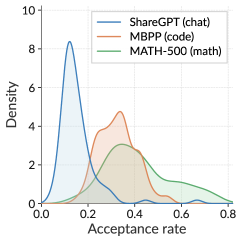
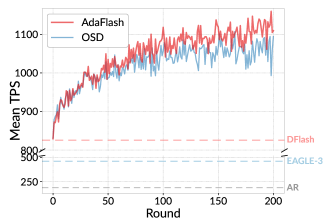
Background Speculative decoding accelerates autoregressive generation by having a small drafter model propose several tokens ahead, which a large target model then verifies and accepts or rejects in one pass. Diffusion models are increasingly used as drafters because their native parallel generation makes proposing multiple tokens at once natural.
배경 추측 디코딩(speculative decoding)은 작은 드래프터 모델이 여러 토큰을 미리 제안하고, 큰 타깃 모델이 이를 한 번에 검증해 받아들이거나 기각하는 방식으로 자기회귀 생성을 가속한다. 최근에는 확산모델을 드래프터로 쓰는 시도가 늘고 있는데, 확산모델은 병렬 생성이 가능해 여러 토큰을 한 번에 제안하기 유리하기 때문이다.
Problem The catch is that a diffusion drafter's bidirectional attention causes its acceptance rate to swing widely both across task domains (chat/code/math) and across token positions within a single draft. That variance undermines token-quality consistency and eats into the speedup speculative decoding is supposed to deliver.
문제 문제는 확산 드래프터의 양방향 어텐션이 도메인(chat/code/math)마다, 그리고 같은 초안 안에서도 토큰 위치마다 수락률(acceptance rate)을 크게 요동치게 만든다는 점이다. 이 편차는 토큰 품질의 일관성을 해쳐, 추측 디코딩이 약속하는 속도 향상을 갉아먹는다.
Prior limitations Prior diffusion-drafter speculative-decoding methods used a fixed candidate length or deployed the drafter as-is without any procedure to stabilize it toward the target distribution, leaving the domain- and position-dependent acceptance-rate swings unaddressed.
기존 한계 기존 확산-드래프터 추측 디코딩 방법들은 고정된 후보 길이를 쓰거나, 드래프터를 타깃 분포에 맞춰 안정화하는 절차 없이 그대로 배치했다. 그 결과 도메인이 바뀌거나 위치가 달라질 때마다 수락률이 들쭉날쭉해지는 문제를 그대로 안고 있었다.
Goal Stabilize the drafter's output distribution toward the target model's acceptance regions, and dynamically adjust candidate length to context, so that domain- and position-dependent acceptance variance shrinks while throughput improves.
목표 드래프터의 출력 분포를 타깃 모델의 수락 영역 쪽으로 안정화하고, 후보 길이를 상황에 맞게 동적으로 조절해, 도메인·위치에 따른 수락률 편차를 줄이면서 처리량을 끌어올리는 것이 목표다.
Method On-policy distillation trains the drafter on its own rollouts to minimize reverse-KL divergence against the target, pulling the drafter's distribution toward regions the target model readily accepts. The adaptive candidate-length head is a separate lightweight module that lengthens the draft when it is trustworthy and shortens it when uncertain. It resembles a speaker watching audience reaction in real time to decide how many sentences to say before pausing to check in — longer runs when the response is good, shorter check-ins when it's ambiguous.
방법 온-폴리시(on-policy) 증류는 드래프터 자신의 롤아웃에 대해 reverse-KL divergence를 최소화하도록 학습시켜, 드래프터 분포를 타깃 모델이 잘 받아들이는 영역 쪽으로 끌어당긴다. 적응형 후보 길이 헤드는 초안이 신뢰할 만할 때는 길게, 불확실할 때는 짧게 후보 길이를 그때그때 조절하는 별도의 경량 모듈이다. 마치 발표자가 청중의 반응을 실시간으로 보며 한 번에 몇 문장을 이어갈지 조절하는 것과 비슷하다 — 반응이 좋으면 길게, 애매하면 짧게 끊어서 확인받는다.
Key idea The core move is treating "stabilizing the distribution" and "adapting proposal length" as two separate axes and attacking both. Distillation alone cannot fully fix position-level variance, and length adaptation alone cannot fully fix domain-level variance; tuning both axes together lets each compensate for the other's residual variance.
핵심 아이디어 핵심은 "분포를 안정화하는 것"과 "제안 길이를 적응시키는 것"을 별개의 축으로 분리해 둘 다 공략한 것이다. 증류만으로는 위치별 편차를 다 잡지 못하고, 길이 적응만으로는 도메인별 편차를 다 잡지 못하는데, 두 축을 동시에 조절해 각각의 잔여 편차를 서로 보완한다.
Validation Throughput is measured against Qwen3-8B and Qwen3-Coder-30B-A3B as target models across six benchmark datasets, alongside a component-level ablation on GSM8K, a hyperparameter sensitivity analysis on GSM8K, and a reverse-KL divergence visualization between drafter and target on a representative GSM8K response.
검증 Qwen3-8B, Qwen3-Coder-30B-A3B를 타깃 모델로 6개 벤치마크 데이터셋에서 처리량을 측정하고, 구성 요소별 ablation(GSM8K), 하이퍼파라미터 민감도 분석(GSM8K), 대표 응답에 대한 드래프터-타깃 reverse-KL 시각화까지 포함한다.
Results Reports up to roughly 66% higher throughput than prior state-of-the-art methods in high-concurrency serving scenarios, with speedup continuing to improve across online-adaptation rounds on MathQA.
결과 고동시성 서빙 시나리오에서 이전 최고 성능 방법 대비 최대 약 66% 높은 처리량을 보고한다. 온라인 적응 라운드가 진행될수록(MathQA) 속도 향상이 꾸준히 개선되는 경향도 함께 보고된다.
Comparison At the abstract-level scope this review draws from, direct comparison numbers against standard AR-drafter speculative decoding are not identifiable — comparisons are reported primarily against prior diffusion-drafter methods (not stated in the paper, from this review's vantage point).
비교 이 리뷰가 참조한 초록 수준에서는 AR 드래프터를 쓰는 표준 추측 디코딩 방법과의 직접 비교 수치는 확인되지 않는다 — 비교는 주로 이전 확산-드래프터 방법들 대비로 보고된다(논문 내 명시 없음, 이 리뷰 범위 기준).
Significance From a serving-efficiency standpoint, this shows that predictability of the acceptance rate, not just raw parallelism, is what makes a diffusion drafter practical — however parallel the drafter is, an erratic acceptance rate does not translate into real throughput gains. Repurposing on-policy distillation, a tool more commonly associated with policy stabilization, for the drafter-target alignment problem is a notable reuse of technique.
의의 서빙 효율 관점에서, 확산모델을 드래프터로 쓰는 접근이 실용적이려면 수락률의 예측 가능성이 관건이라는 점을 보여준다 — 아무리 병렬성이 좋아도 수락률이 들쭉날쭉하면 실제 처리량 이득으로 이어지지 않는다. 온-폴리시 증류라는, 원래 다른 맥락(정책 안정화)에서 쓰이던 도구를 드래프터-타깃 정렬 문제에 재적용한 점이 흥미롭다.
Limitations Whether the domain-level variance is specific to diffusion drafters or would appear in any undistilled drafter is not distinguished by a control comparison at the abstract-level scope this review draws from (reviewer judgment).
한계 AR 드래프터 대비 도메인 편차가 확산 드래프터에 고유한 현상인지, 아니면 증류 없는 임의의 드래프터 일반에 나타나는 현상인지를 가르는 대조군이 이 리뷰가 참조한 초록 수준에서는 보이지 않는다(리뷰어 판단).
Future work No explicit future-work items are identifiable within the abstract-level scope this review draws from.
향후 과제 논문 내 명시된 future-work 항목은 이 리뷰가 참조한 초록 범위에서는 확인되지 않는다.
Released resources No public code repository was found, no public release verified.
자원 공개 공개 코드 저장소는 확인되지 않았다 — 공개 링크 확인 안 됨.
The research thread
Where this paper sits 연구의 흐름
Speculative decoding with diffusion drafters continues a line of work trying to bring the diffusion model's strength, parallel proposal, into autoregressive serving acceleration. Prior work in the DFlash lineage and elsewhere established that a diffusion drafter can propose multiple tokens at once, but how often those proposals actually get accepted was a comparatively under-addressed question.
AdaFlash's shift is moving the focus from "can propose" to "gets accepted reliably." It treats parallelism itself as an asset already secured, and targets head-on the point where that asset gets wasted unevenly across domains and positions. Combining on-policy distillation with adaptive length control reflects an insight: distribution alignment (who gets accepted) and exposure management (how far to commit before checking) can be separated and optimized independently.
The question this paper leaves open is whether this stabilization principle holds as context length grows. The adaptive candidate-length head may implicitly respond to context length, but the paper does not treat this as an explicit length sweep — how this domain/position-variance fix interacts with the acceptance-rate degradation at long context that the speculative-decoding community has separately observed remains an open question.
확산 드래프터를 활용한 추측 디코딩은 병렬 제안이라는 확산모델의 강점을 자기회귀 서빙 가속에 옮겨오려는 흐름의 연장선에 있다. DFlash 계열을 비롯한 앞선 연구들이 확산 드래프터가 여러 토큰을 한 번에 제안할 수 있음을 보여줬지만, 그 제안들이 실제로 얼마나 자주 받아들여지는가는 상대적으로 덜 다뤄진 질문이었다.
AdaFlash의 전환은 "제안할 수 있다"에서 "안정적으로 받아들여지게 만든다"로 초점을 옮긴 데 있다. 병렬성 자체는 이미 확보된 자산으로 취급하고, 그 자산이 도메인과 위치에 따라 들쭉날쭉하게 낭비되는 지점을 정면으로 겨냥한다. 온-폴리시 증류와 적응형 길이 조절이라는 두 도구를 결합한 것은, 분포 정렬(누가 받아들여질지)과 노출 관리(얼마나 길게 걸지)를 분리해서 각각 최적화할 수 있다는 통찰을 반영한다.
이 논문이 여는 질문은 이 안정화 원리가 문맥 길이가 늘어나는 상황에서도 유지되는가이다. 적응형 후보 길이 헤드가 암묵적으로 문맥 길이에 반응할 가능성이 있지만, 논문은 이를 명시적인 문맥-길이 스윕으로 다루지 않는다 — 도메인·위치 편차를 잡는 이 접근이 장문맥에서의 수락률 저하라는, 추측 디코딩 커뮤니티가 별도로 관찰해 온 현상과 어떻게 상호작용할지는 아직 열린 질문이다.
Sparks — where one could take this 아이디어의 씨앗
-
If the adaptive candidate-length head implicitly responds to context length, what shape would an explicit acceptance-vs-context-length curve take — the paper doesn't run this sweep. 적응형 후보 길이 헤드가 문맥 길이에 암묵적으로 반응한다면, 이를 명시적인 acceptance-vs-context-length 곡선으로 측정했을 때 어떤 모양이 나올까 — 논문은 이 스윕을 다루지 않는다.
-
On-policy reverse-KL distillation is used here to reduce domain-level variance for a diffusion drafter — whether the same distillation objective would similarly reduce variance for other parallel-proposal drafter architectures is outside this paper's scope. 온-폴리시 reverse-KL 증류가 도메인별 편차를 줄이는 데 쓰였는데, 같은 증류 목적함수가 확산 드래프터가 아닌 다른 병렬-제안 드래프터 구조에도 비슷하게 편차를 줄여줄지는 논문의 범위 밖이다.
Seeds grounded in the paper's own stated limitations and open questions. 논문이 스스로 밝힌 limitations와 open questions에 뿌리를 둔 씨앗입니다.
Notes
Notes
Linked reviews
DSpark: Confidence-Scheduled Speculative Decoding with Semi-Autoregressive Generation
A semi-autoregressive drafter combined with confidence-scheduled verification fixes the intra-block acceptance decay of parallel speculative-decoding drafters, delivering 51-85% throughput and latency gains in DeepSeek-V4 production serving.
diffusion-llmFast-dLLM: Training-Free Acceleration of Diffusion LLMs via KV Cache and Parallel Decoding
A block-wise approximate KV cache plus confidence-thresholded parallel decoding accelerates open diffusion LLMs by up to 27.6x end-to-end with 1-2 point accuracy loss, entirely training-free.
speculative-decodingAngelSpec: Towards Real-World High Performance Inference with Speculative Decoding
AngelSpec unifies two rival speculative-decoding drafter families -- lightweight autoregressive Multi-Token-Prediction heads and block-parallel diffusion drafters -- by co-specializing each one's training data to the workload it is actually good at, upgrading the diffusion drafter's architecture (DFly), and letting a batch-level scheduler (D-cut) reallocate verification budget online; on Tencent's own Hy3 MoE model family this reaches a 1.98-2.40x speedup over autoregressive decoding, validated against live production traffic rather than a static benchmark.
kv-cacheWindowed-MTP: Removing the Full-Context Draft-KV Tax at Million-Token Context
Windowed-MTP names the long-context draft-attention tax in built-in Multi-Token-Prediction speculative-decoding heads -- the draft re-reads the entire KV cache every step, so at million-token context it can flip speculation net-negative -- and fixes it losslessly with a training-free sink+window applied only to the draft's attention, cutting per-decode-step cost 28-44% across three architecture families at 1M tokens.
speculative-decodingxPress: Parallel Refinement for Diffusion Drafters in Speculative Decoding
Block-diffusion drafters sample every position from its own marginal, so a draft block is individually likely but jointly improbable; xPress adds a low-rank causal refiner that reconciles the whole block through parallel Jacobi iterations, lifting acceptance length from 6.25 to 8.02 tokens.