Paper Review
FourTune: Towards Fully 4-Bit Efficient Post-Training for Diffusion Models
An end-to-end W4A4G4 post-training framework for large diffusion models augments LoRA with a frozen numerical stabilizer to isolate quantization-sensitive outliers, matching full-precision fine-tuning quality on FLUX.1-dev (12B) with up to 2.25x less memory and 2.27x higher training throughput.
대형 diffusion 모델을 위한 end-to-end W4A4G4 post-training 프레임워크로, LoRA에 양자화에 민감한 outlier를 격리하는 고정된(frozen) 수치 안정화 장치를 더해, FLUX.1-dev(12B)에서 full-precision 파인튜닝과 동등한 품질을 최대 2.25배 적은 메모리와 2.27배 높은 학습 처리량으로 달성한다.
Background Diffusion models have become the dominant paradigm for high-quality image generation, and post-training (fine-tuning) is essential for downstream uses such as customization, RL alignment, and distillation. As models scale to FLUX.1-dev (12B) and Qwen-Image (20B), the memory and compute cost of fine-tuning itself becomes the bottleneck. Meanwhile, NVIDIA Blackwell-generation GPUs now natively support NVFP4 4-bit tensor cores, so the hardware substrate for pushing training arithmetic down to 4-bit already exists.
배경 Diffusion 모델은 고품질 이미지 생성의 주류 패러다임이 되었고, customization·RL 정렬·distillation 같은 다운스트림 활용에는 post-training(파인튜닝)이 필수다. 그런데 모델 규모가 FLUX.1-dev 12B, Qwen-Image 20B급으로 커지면서 파인튜닝 자체의 메모리·연산 비용이 병목이 되고 있다. 마침 NVIDIA Blackwell 세대 GPU가 NVFP4 4-bit tensor core를 native로 지원하기 시작해, 학습 연산을 4비트로 내릴 하드웨어 기반은 이미 마련된 상태였다.
Problem Post-training of large diffusion models suffers from prohibitive memory footprints and slow training, and existing parameter-efficient methods fix only one side of a memory-speed trade-off. LoRA cuts trainable parameters but the full-precision backbone weights still occupy GPU memory, while QLoRA saves memory yet slows training because every computation requires on-the-fly dequantization. Neither route delivers fine-tuning that is simultaneously small and fast.
문제 대형 diffusion 모델의 post-training은 메모리 사용량이 과도하고 학습 속도가 느린데, 기존 parameter-efficient 기법들은 메모리-속도 trade-off의 한쪽만 해결한다. LoRA는 학습 파라미터 수는 줄이지만 full-precision backbone 가중치가 GPU 메모리를 그대로 점유하고, QLoRA는 메모리는 줄이지만 연산 때마다 dequantization이 필요해 오히려 느려진다. 결국 "메모리도 작고 속도도 빠른" 파인튜닝은 어느 쪽 경로로도 달성되지 못했다.
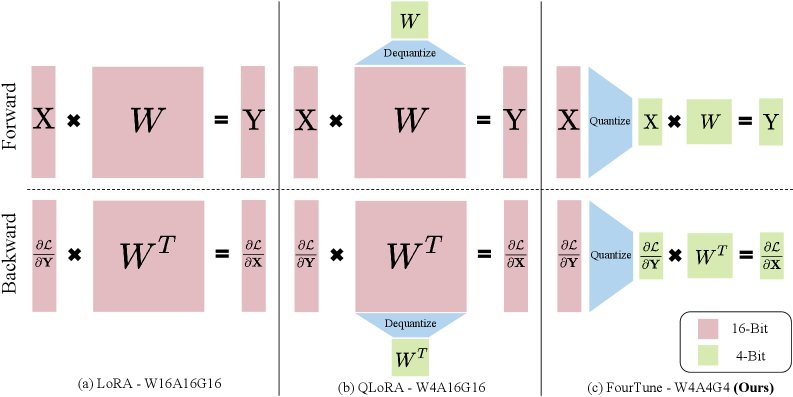
Prior limitations LoRA keeps weights, activations, and gradients all in high precision (BF16), leaving backbone weight memory untouched (22.59 GB for FLUX.1-dev), while QLoRA (W4A16G16) stores 4-bit weights but dequantizes them back to 16-bit before every computation, ending up 2.79× slower than FourTune. It is like keeping files zipped but unzipping them on every access — disk (memory) is saved at the cost of time. Inference-oriented 4-bit diffusion quantization such as SVDQuant, meanwhile, never addresses the numerical-stability problems of the backward pass.
기존 한계 LoRA는 weight·activation·gradient가 전부 고정밀(BF16)이라 backbone 가중치 메모리(FLUX.1-dev 기준 22.59 GB)를 전혀 줄이지 못하고, QLoRA(W4A16G16)는 가중치를 4비트로 저장하되 연산 직전 16비트로 되돌리는 online dequantization 때문에 FourTune 대비 2.79배 느리다. 파일을 zip으로 압축해 두고 쓸 때마다 매번 풀어서 쓰는 것과 같아서, 디스크(메모리)는 아끼지만 시간을 대가로 치르는 구조다. 한편 SVDQuant 같은 diffusion 4-bit 양자화 연구는 inference 전용이라 backward pass의 수치 안정성 문제는 다루지 않았다.
Goal Match standard LoRA fine-tuning quality while attacking memory and speed simultaneously through native W4A4G4 post-training, where weights, activations, and gradients are all computed in 4-bit. Unlike QLoRA, which is 4-bit only in storage, the aim is to run the actual arithmetic on 4-bit tensor cores so that compression itself becomes acceleration.
목표 표준 LoRA 파인튜닝과 동일한 생성 품질을 유지하면서, weight·activation·gradient를 모두 4비트로 계산하는 native W4A4G4 post-training으로 메모리와 속도를 동시에 잡는 것. 저장만 4비트인 QLoRA와 달리 4-bit tensor core에서 실제 연산이 4비트로 돌게 만들어, 압축이 곧 가속이 되게 하는 것이 목표다.
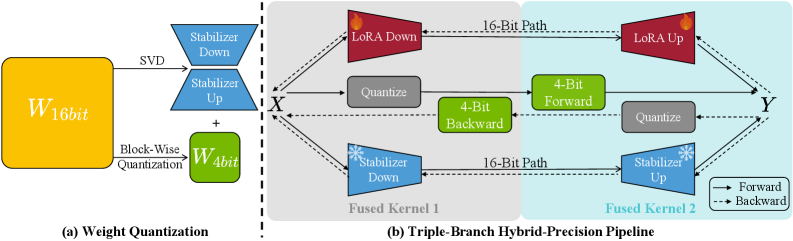
Method FourTune is a triple-branch hybrid-precision pipeline: the pre-trained weight is decomposed via SVD into a quantization-friendly 4-bit residual plus a high-precision low-rank stabilizer, and a trainable LoRA branch is added, so the forward pass is the sum of a 4-bit GEMM, the stabilizer output, and the LoRA output. The backward pass needs transposed quantized weights, so FourTune replaces group-wise (1×16) with 16×16 block-wise quantization, confining scales to square blocks — like tiling a floor with square tiles instead of long planks, so the tile boundaries still line up when the plan is rotated 90 degrees, enabling on-the-fly transposition without dequantization. Custom fused kernels bundling quantization, projections, and the 4-bit GEMM (LoRA fusion 1.82× plus MLP fusion 1.10×, 2.52× combined on the DiT) remove memory-bandwidth overhead. The primary format is Blackwell NVFP4, also validated with INT4 on Ada.
방법 FourTune은 3-분기(triple-branch) hybrid-precision 파이프라인이다: 사전학습 가중치를 SVD로 "양자화 친화적 4-bit residual + 고정밀 저랭크 stabilizer"로 분해하고, 여기에 학습 가능한 LoRA 분기를 더해 forward를 4-bit GEMM + stabilizer + LoRA 출력의 합으로 구성한다. backward에서는 양자화된 가중치의 transpose가 필요한데, group-wise(1×16) 대신 16×16 block-wise 양자화를 써서 scale이 정사각 블록 안에 갇히게 한다 — 길쭉한 마루판 대신 정사각 타일을 깔면 도면을 90도 돌려도 타일 경계가 그대로 맞는 것처럼, dequantization 없이 즉석 transpose가 가능해진다. 여기에 quantization·projection·4-bit GEMM을 묶는 fused kernel(LoRA fusion 1.82배 + MLP fusion 1.10배 → DiT 기준 합산 2.52배)로 메모리 대역폭 오버헤드를 제거한다. 포맷은 Blackwell의 NVFP4가 기본이고, Ada 세대에서는 INT4로도 검증했다.
Key idea Isolate the few quantization-destabilizing outliers into a frozen high-precision low-rank branch (the stabilizer) and run the bulk of the computation in native 4-bit. It is like packing for a move: hand-carry the few fragile items and compress everything else. Without the stabilizer, naive W4A4G4 training diverges via gradient explosion; with it, gradient norms stay stable (Figure 8).
핵심 아이디어 양자화를 불안정하게 만드는 소수의 outlier를 frozen 고정밀 저랭크 분기(stabilizer)로 격리하고, 나머지 대부분의 연산은 native 4비트로 돌리는 것이 핵심이다. 이삿짐을 쌀 때 깨지기 쉬운 몇 점만 따로 손에 들고 나머지는 전부 압축 포장하는 것과 같다. 실제로 stabilizer 없이 naive W4A4G4로 학습하면 gradient explosion으로 발산하지만, stabilizer를 넣으면 gradient norm이 안정적으로 유지된다(Figure 8).
Validation Evaluated across three downstream task families: customization (human identity, artistic style, general subject), reinforcement learning (SRPO with an HPSv2.1 reward), and distillation (π-Flow 4-step student). The primary model is FLUX.1-dev (12B), with Qwen-Image (20B) and SDXL (appendix) checking scale and architecture generalization; efficiency is measured on RTX 5090 and RTX Pro 6000 (Blackwell) GPUs with 4-bit tensor cores.
검증 Customization(인물 identity·화풍·일반 subject), reinforcement learning(SRPO + HPSv2.1 reward), distillation(π-Flow 4-step student) 세 계열의 downstream task에서 평가했다. 주 모델은 FLUX.1-dev(12B)이고 Qwen-Image(20B)와 SDXL(부록)로 규모·아키텍처 일반화를 확인했으며, 효율 측정은 4-bit tensor core를 갖춘 RTX 5090·RTX Pro 6000(Blackwell)에서 수행했다.
Results Quality is on par with full precision across all three tasks: identity similarity 0.783 vs 0.771 for BF16 LoRA, RL aesthetic 6.3119 vs 6.1832, distillation teacher-FID 6.70 vs 5.90. Efficiency: memory drops by up to 2.25× (14.51 GB vs 29.35 GB for end-to-end training, 2.93× for weights alone), and a 0.86 s training step on RTX 5090 is 2.27× faster than BF16 LoRA and 2.79× faster than NF4 QLoRA.
결과 품질은 세 task 모두 full-precision과 동등한 수준이다: identity similarity 0.783 vs BF16 LoRA 0.771, RL aesthetic 6.3119 vs 6.1832, distillation teacher-FID 6.70 vs 5.90. 효율은 메모리를 최대 2.25배 절감하고(end-to-end 학습 기준 14.51 GB vs 29.35 GB, weight만 보면 2.93배), RTX 5090에서 step당 0.86 s로 BF16 LoRA 대비 2.27배, NF4 QLoRA 대비 2.79배 빠르다.
Comparison Against BF16 LoRA, FP8 LoRA, NF4 QLoRA, SparseLoRA, and BF16 full fine-tuning, FourTune is the only method achieving QLoRA-level memory together with speed exceeding full-precision LoRA. The ablations are thorough: varying the precision configuration (W4A4G4 through W4A16G16) causes no quality degradation (Table 4), block-wise (16×16) loses little reconstruction quality versus group-wise (1×16) (LPIPS 0.227 vs 0.203, Table 5), and gradient stability hinges directly on the stabilizer (Figure 8).
비교 BF16 LoRA, FP8 LoRA, NF4 QLoRA, SparseLoRA, BF16 full fine-tuning과 비교해 "QLoRA 수준의 메모리 + full-precision LoRA를 넘는 속도"라는 조합을 유일하게 달성한다. Ablation도 촘촘하다: precision 구성(W4A4G4~W4A16G16)을 바꿔도 품질 저하가 없음을 보이고(Table 4), block-wise(16×16)가 group-wise(1×16) 대비 복원 품질 손실이 미미함(LPIPS 0.227 vs 0.203)을 확인했으며(Table 5), stabilizer 유무에 따라 gradient 안정성이 갈리는 것을 직접 보였다(Figure 8).
Significance By extending 4-bit quantization from inference into the training loop (gradients included), it brings 12B-scale diffusion fine-tuning within a 14.51 GB memory budget. If prior 4-bit diffusion work made delivering the finished dish cheaper (inference), this paper makes the kitchen itself (training) run on a budget. Arriving alongside NVFP4 hardware, it concretely widens access to diffusion customization on consumer GPUs and in resource-constrained settings (reviewer judgment).
의의 4-bit 양자화를 inference에서 training loop(gradient 포함)까지 확장해, 12B급 diffusion 모델 파인튜닝을 14.51 GB 메모리 예산 안으로 끌어내렸다. 지금까지의 diffusion 4-bit 연구가 완성된 요리를 싸게 배달하는 문제(inference)였다면, 이 논문은 주방(학습) 자체를 저비용으로 돌리는 문제를 푼 셈이다. NVFP4 하드웨어의 등장 시점과 맞물려, 소비자급 GPU와 저자원 환경에서의 diffusion customization 접근성을 실질적으로 넓히는 방향이다(리뷰어 판단).
Limitations The authors include no dedicated limitations section; the Impact Statement only notes that easier adaptation may lower the barrier to misuse such as deceptive or harmful content generation. Reviewer judgment: the speedups are tied to 4-bit tensor cores (NVFP4 on Blackwell, INT4 on Ada) and are hard to reproduce on older hardware; distillation teacher-FID slightly trails BF16 LoRA (6.70 vs 5.90); and the block-wise quantization that enables the backward pass itself concedes a small precision loss versus group-wise (LPIPS 0.227 vs 0.203).
한계 저자들은 별도의 limitations 절을 두지 않았고, Impact Statement에서 손쉬운 적응이 기만적·유해 콘텐츠 생성 같은 오남용 장벽도 낮출 수 있다는 위험만 언급한다. 리뷰어 판단으로는: 속도 이득이 4-bit tensor core(Blackwell의 NVFP4, Ada의 INT4)에 묶여 있어 구세대 하드웨어에서는 재현이 어렵고, distillation에서는 teacher-FID가 BF16 LoRA보다 소폭 뒤지며(6.70 vs 5.90), backward를 가능하게 하는 block-wise 양자화 자체도 group-wise 대비 약간의 정밀도 손실(LPIPS 0.227 vs 0.203)을 감수한다.
Future work Not stated in the paper — there is no future-work section. The Impact Statement only recommends safety filters and responsible deployment practices; extensions to non-diffusion architectures or full-parameter 4-bit training seem the natural next steps (reviewer judgment).
향후 과제 논문 내 명시 없음 — 별도의 future work 절이 없다. Impact Statement에서 safety filter와 책임 있는 배포 관행을 권고하는 정도이며, diffusion 외 아키텍처나 full-parameter 4-bit 학습으로의 확장이 자연스러운 후속 방향으로 보인다(리뷰어 판단).
Released resources An ICML 2026 poster page was verified, confirming acceptance, but no public code repository or checkpoint link appears in the paper (the GitHub links in the text are third-party resources such as FLUX and evaluation tools). Experiments ran on 8×RTX 5090 and 8×RTX Pro 6000, and the acknowledgements credit NVIDIA for donating a DGX server.
자원 공개 ICML 2026 포스터 페이지가 확인되어 발표는 확정이지만, 논문 본문에서 공개 코드 저장소나 체크포인트 링크는 확인되지 않았다(본문 내 GitHub 링크는 FLUX·평가 도구 등 제3자 자료뿐). 실험은 8×RTX 5090과 8×RTX Pro 6000에서 수행했으며, 사사에서 NVIDIA의 DGX 서버 기증을 밝히고 있다.
The research thread
Where this paper sits 연구의 흐름
FourTune sits at the junction of two research lines, and its author list tells you which ones. From the MIT Han Lab side comes diffusion inference quantization: SVDQuant (ICLR 2025) introduced the move of peeling quantization-hostile outliers into a high-precision low-rank branch so the residual survives 4-bit, and its nunchaku engine made W4A4 diffusion inference practical. From Haocheng Xi's side comes the low-bit training line — 4-bit integer transformer training (NeurIPS 2023), Jetfire's INT8 data flow, COAT's FP8 — a thread that keeps asking how far the training loop itself can be pushed down. And beneath both runs the PEFT lineage, LoRA to QLoRA, which made "4-bit backbone plus trainable adapter" the standard recipe for fine-tuning large models.
The conceptual shift is to stop treating 4-bit as a storage format and start treating it as the compute format of the entire training loop. QLoRA's four bits are a parking arrangement: weights sleep compressed and are woken up in 16-bit for every matmul, so compression buys memory by spending time. The moment hardware multiplies natively in 4-bit — Blackwell's NVFP4 tensor cores — the question inverts: the obstacle is no longer representation error but the mechanics of backpropagation, where gradients must survive 4-bit without exploding and the quantized weight must be transposable in place for the backward GEMM. Inside this reframing, SVDQuant's low-rank branch gets a new job description: from a reconstruction aid that shrinks quantization error to a frozen stabilizer whose real function is keeping gradient norms finite. The same object, promoted from image quality to training dynamics.
Where this line is heading is a world in which low-precision training is the default rather than a stunt. If W4A4G4 post-training matches BF16 LoRA on a 12B diffusion model, the next dominoes are obvious: LLM and VLM post-training under the same recipe, optimizer states and attention following behind (COAT's territory), and eventually the pretraining question NVIDIA's NVFP4 reports have been circling. The remaining tension is that the gains are welded to a hardware generation — they exist only where 4-bit tensor cores exist — and with no code released yet, this stays for now a demonstration taken on trust.
The recipe itself is not free either: 16×16 block-wise quantization concedes a little fidelity to group-wise, and few-step distillation — the task leaning hardest on gradient precision — is where quality visibly trails BF16. Expect the field to probe exactly there: how far the stabilizer's rank can shrink before divergence returns, which phases of training genuinely demand high precision, and whether the outlier structure stays put when the whole backbone, not just an adapter, trains in 4-bit. The larger pattern is a familiar one — quantization techniques migrating upstream from inference into training, one pass at a time.
FourTune은 두 갈래 연구 계보의 교차점에 서 있고, 저자 명단이 그 계보를 그대로 말해준다. MIT Han Lab 쪽에서는 diffusion inference 양자화 계보가 온다: SVDQuant(ICLR 2025)가 양자화에 적대적인 outlier를 고정밀 low-rank 분기로 떼어내 residual이 4-bit을 버티게 하는 수를 도입했고, nunchaku 엔진으로 W4A4 diffusion inference를 실용화했다. Haocheng Xi 쪽에서는 low-bit training 계보가 온다 — 4-bit integer transformer 학습(NeurIPS 2023), Jetfire의 INT8 data flow, COAT의 FP8 — 학습 루프 자체를 어디까지 끌어내릴 수 있는지 계속 묻던 줄기다. 그리고 이 둘 아래에는 "4-bit backbone + 학습 가능한 adapter"를 파인튜닝의 표준으로 만든 PEFT 계보, LoRA에서 QLoRA로 이어지는 줄기가 흐른다.
개념적 전환은 4-bit을 저장 포맷으로 다루기를 멈추고 학습 루프 전체의 연산 포맷으로 다루는 데 있다. QLoRA의 4비트는 주차장 같은 것이다: 가중치는 압축된 채 잠들어 있다가 matmul 때마다 16-bit로 깨어나므로, 압축은 시간을 지불하고 메모리를 사는 거래였다. 하드웨어가 4-bit 곱셈을 native로 수행하는 순간 — Blackwell의 NVFP4 tensor core — 질문이 뒤집힌다: 장애물은 더 이상 표현 오차가 아니라 backpropagation의 역학이다. gradient가 폭발하지 않고 4-bit을 버텨야 하고, 양자화된 가중치는 backward GEMM을 위해 제자리에서 transpose 가능해야 한다. 이 재구도 속에서 SVDQuant의 low-rank 분기는 직무가 바뀐다: 양자화 오차를 줄이는 복원 보조 장치에서, gradient norm을 유한하게 붙잡는 frozen stabilizer로. 같은 물건이 화질 담당에서 학습 안정성 담당으로 승진한 셈이다.
이 계보가 향하는 곳은 low-precision 학습이 묘기가 아니라 기본값이 되는 세계다. 12B diffusion 모델에서 W4A4G4 post-training이 BF16 LoRA와 대등하다면 다음 도미노는 자명하다: 같은 레시피의 LLM·VLM post-training, 뒤따르는 optimizer state와 attention(COAT의 영토), 그리고 NVIDIA의 NVFP4 리포트들이 맴돌아 온 pretraining 질문. 남는 긴장은 이 이득이 하드웨어 세대에 용접되어 있다는 것 — 4-bit tensor core가 있는 곳에서만 존재한다 — 그리고 코드가 아직 공개되지 않아 당분간은 신뢰에 기대야 하는 시연이라는 점이다.
레시피 자체도 공짜가 아니다: 16×16 block-wise 양자화는 group-wise 대비 약간의 fidelity를 내주고, gradient 정밀도에 가장 크게 기대는 few-step distillation에서는 품질이 BF16에 눈에 띄게 뒤진다. 필드는 바로 그 지점을 파고들 것이다: stabilizer의 rank를 어디까지 줄이면 발산이 되돌아오는지, 학습의 어느 국면이 정말 고정밀을 요구하는지, adapter가 아니라 backbone 전체가 4-bit로 학습될 때도 outlier 구조가 제자리에 머무는지. 더 큰 패턴은 익숙한 것이다 — 양자화 기법이 inference에서 training으로, 한 pass씩 상류로 거슬러 올라가는 이주.
Sparks — where one could take this 아이디어의 씨앗
-
One could try pushing the recipe past LoRA-style adapters to full-parameter 4-bit post-training, testing whether a frozen stabilizer still holds once the backbone's own outlier structure drifts under weight updates. LoRA형 adapter를 넘어 full-parameter 4-bit post-training으로 레시피를 밀어붙여, weight 업데이트로 backbone 자체의 outlier 구조가 표류할 때도 frozen stabilizer가 버티는지 시험해볼 수 있다.
-
One could try dissecting why few-step distillation is the most 4-bit-sensitive task (teacher-FID 6.70 vs 5.90) and whether a short high-precision warm-up or a task-dependent stabilizer rank closes the gap. few-step distillation이 왜 4-bit에 가장 민감한 task인지(teacher-FID 6.70 vs 5.90) 해부하고, 짧은 고정밀 warm-up이나 task별 stabilizer rank로 그 격차가 닫히는지 확인해볼 수 있다.
-
One could try replaying the pipeline on pre-Blackwell GPUs through INT8/INT4 paths to separate how much of the reported gain is algorithmic and how much is tensor-core-bound. Blackwell 이전 GPU에서 INT8/INT4 경로로 파이프라인을 재연해, 보고된 이득 중 얼마가 알고리즘의 몫이고 얼마가 4-bit tensor core의 몫인지 분리해볼 수 있다.
Seeds grounded in the paper's own stated limitations and open questions. 논문이 스스로 밝힌 limitations와 open questions에 뿌리를 둔 씨앗입니다.
Notes
Notes
The framing is worth noting precisely: this is 4-bit training (post-training/fine-tuning, W4A4G4 including gradients), not 4-bit inference-only PTQ — a harder numerical-stability problem than the more common inference-quantization line (e.g. SVDQuant/nunchaku for diffusion inference), since gradients must also survive 4-bit precision without diverging.