Paper Review
Nemotron-Labs-3-Puzzle-75B-A9B: Compressing Hybrid MoE LLMs
An iterative pruning-plus-distillation pipeline compresses a hybrid Mamba/MoE model from 120.7B to 75.3B total parameters, roughly doubling server throughput at matched user-throughput constraints while retaining most downstream accuracy.
반복적 pruning과 distillation 파이프라인으로 하이브리드 Mamba/MoE 모델을 총 파라미터 1207억에서 753억으로 압축해, 동일한 사용자 처리량 제약에서 서버 처리량을 약 2배로 늘리면서 대부분의 다운스트림 정확도를 유지한다.
Background Large hybrid Mixture-of-Experts (MoE) models that combine attention with Mamba state-space layers offer strong accuracy, but their size and memory footprint limit interactive deployment throughput. The parent model here, Nemotron-3-Super, spans 120.7B total / 12.8B active parameters over a hybrid stack of 40 Mamba blocks, 40 MoE blocks, and 8 attention blocks. Which resource binds depends on the workload: long-input requests are compute-bound, long-output requests are IO-bound, and ultra-long-context requests are capped by device memory through the KV-cache and Mamba-state footprint.
배경 Attention과 Mamba state-space layer를 결합한 대형 hybrid Mixture-of-Experts(MoE) 모델은 높은 정확도를 제공하지만, 그 크기와 메모리 사용량이 interactive 배포 처리량을 제한한다. 여기서의 부모 모델 Nemotron-3-Super는 Mamba 블록 40개, MoE 블록 40개, attention 블록 8개의 hybrid 스택에 걸쳐 총 1207억 / 활성 128억 파라미터 규모다. 어떤 자원이 병목이 되는지는 워크로드에 따라 갈린다: 긴 입력 요청은 compute-bound, 긴 출력 요청은 IO-bound이며, 초장문맥 요청은 KV-cache와 Mamba-state 메모리 때문에 디바이스 메모리가 한계로 작용한다.
Problem Deploying a very large hybrid MoE model like Nemotron-3-Super under strict per-user latency constraints limits how many concurrent users a server can serve, especially at very long context lengths. Concretely, a single H100 can hold only 1 concurrent 1M-token request of the parent model once parameters, KV cache, and Mamba state are all accounted for. It is like a restaurant where every table must be served within minutes — the real question is not how much food the kitchen can cook in total, but how many tables it can seat at once without any of them waiting. The paper fixes the per-user floor at 100 tokens/s and asks how many users fit under that condition.
문제 Nemotron-3-Super 같은 매우 큰 hybrid MoE 모델을 엄격한 사용자별 지연 제약 하에서 배포하면, 특히 매우 긴 문맥 길이에서 서버가 동시에 처리할 수 있는 사용자 수가 제한된다. 실제로 H100 한 장에서는 파라미터·KV cache·Mamba state를 모두 합산하면 부모 모델의 1M-token 요청을 동시에 1개밖에 수용하지 못한다. 모든 테이블에 몇 분 안에 음식이 나가야 하는 레스토랑과 같다 — 진짜 질문은 주방이 총 몇 인분을 만들 수 있느냐가 아니라, 어느 테이블도 기다리게 하지 않으면서 동시에 몇 테이블을 받을 수 있느냐다. 논문은 사용자당 100 tokens/s를 하한으로 고정하고 그 조건에서의 동시 수용량을 묻는다.
Prior limitations Existing post-training compression — pruning, quantization, distillation — faces an acute efficiency-versus-capability tradeoff on hybrid MoE architectures, whose cost depends jointly on total parameters, active parameters, KV-cache size, and Mamba-state size. In particular, the original Puzzle framework is single-shot: each candidate layer replacement is scored by swapping it alone into the parent model, assuming quality impacts are approximately additive. That misses higher-order interactions — pruning one MoE layer changes the representations later layers see, making some blocks more important and others more redundant than their replace-one scores suggest.
기존 한계 Pruning·quantization·distillation 같은 기존 post-training 압축은 효율과 능력 보존 사이의 까다로운 tradeoff를 안고 있으며, 비용이 총 파라미터·활성 파라미터·KV-cache·Mamba-state 크기에 동시에 걸려 있는 hybrid MoE 구조에서 이 문제가 특히 심하다. 특히 원래의 Puzzle 프레임워크는 single-shot이다: 각 후보 layer 교체를 부모 모델에 하나씩만 끼워 넣어 점수를 매기고, 품질 영향이 근사적으로 가산적(additive)이라고 가정한다. 이는 고차 상호작용을 놓친다 — 한 MoE layer를 pruning하면 뒤 layer들이 보는 표현이 바뀌어, 어떤 블록은 replace-one 점수가 시사하는 것보다 더 중요해지고 어떤 블록은 더 불필요해진다.
Goal Produce a substantially smaller hybrid MoE model that maximizes server throughput under interactive deployment constraints while retaining as much of the parent model's downstream accuracy as possible. The paper states its deployment targets up front: roughly 2x server throughput over the parent at an operating point of at least 100 tokens/s per user on one 8xB200 node, and 8 concurrent 1M-token requests on a single H100. The optimization is anchored to two representative regimes: prefill-heavy 50K/2K (long-context analysis, RAG) and decode-heavy 8K/64K (reasoning-style generation).
목표 Interactive 배포 제약 하에서 서버 처리량을 최대화하면서, 부모 모델의 다운스트림 정확도를 최대한 유지하는 훨씬 작은 hybrid MoE 모델을 만드는 것. 논문은 배포 목표를 처음부터 명시한다: 8xB200 노드 1대에서 사용자당 최소 100 tokens/s 운영점 기준 부모 대비 약 2배 서버 처리량, 그리고 H100 한 장에서 1M-token 요청 8개 동시 처리. 최적화는 prefill-heavy 50K/2K(장문맥 분석·RAG)와 decode-heavy 8K/64K(reasoning형 생성)라는 두 대표 regime에 맞춰진다.
Method The Iterative Puzzle framework alternates moderate hardware-aware pruning with short knowledge-distillation (KD) healing phases, then finishes with long-context KD, reinforcement-learning (RL) recovery, and a Multi-Token Prediction (MTP) head. Three staged rounds each target a different axis: round 1 trims MoE weights and the Mamba SSM state to 75% of the teacher (healed on 24B tokens), round 2 cuts MoE weights to 60% (43.2B tokens), and round 3 constrains the activated routed-expert budget to 50%, letting a mixed-integer program distribute it non-uniformly across layers (52.8B tokens). Recovery KD distills the teacher's logits on a 30% pretraining / 70% SFT mix, growing sequence length from 32K to 128K and then 512K, while RL focuses on software engineering — the capability that degraded most under compression. The rhythm is that of pruning a bonsai: trim a little, let it recover, re-judge which branches matter, then trim again — rather than hacking out the final shape in one cut.
방법 Iterative Puzzle 프레임워크는 완만한 hardware-aware pruning과 짧은 knowledge-distillation(KD) 회복 단계를 번갈아 수행한 뒤, 장문맥 KD·강화학습(RL) 복구·Multi-Token Prediction(MTP) head로 마무리한다. 3개 라운드가 각기 다른 축을 겨냥한다: 1라운드는 MoE 가중치와 Mamba SSM state를 teacher의 75%로 줄이고(24B token으로 heal), 2라운드는 MoE 가중치를 60%로(43.2B token), 3라운드는 활성 routed-expert 예산을 50%로 제한하되 mixed-integer program이 layer별로 불균일하게 배분한다(52.8B token). 복구 KD는 pretraining 30% + SFT 70% 데이터에서 teacher logit을 증류하며 시퀀스 길이를 32K→128K→512K로 늘리고, RL은 압축으로 가장 크게 손상된 능력인 software engineering에 집중한다. 리듬은 분재 가지치기와 같다: 조금 자르고, 회복시키고, 어느 가지가 중요한지 다시 판단한 뒤 또 자른다 — 최종 형태를 한 번에 잘라내지 않는다.
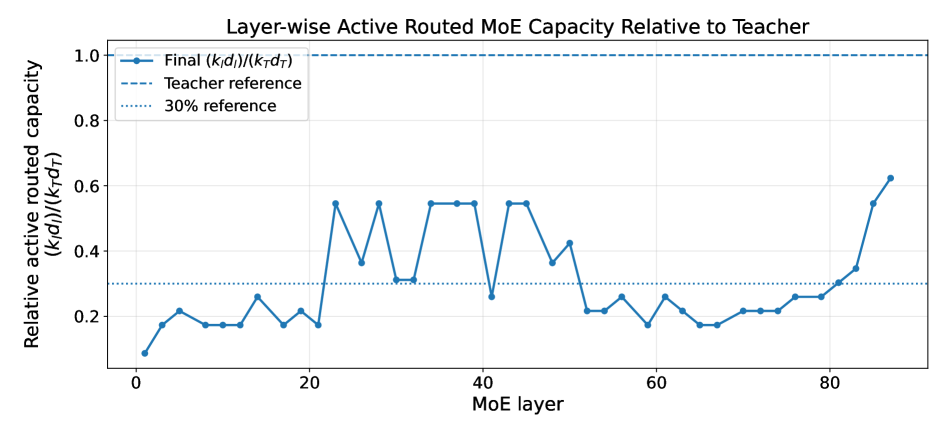
Key idea Compression is treated as re-balancing rather than shrinking: a mixed-integer program allocates MoE capacity non-uniformly across depth from measured layer sensitivity, while the Mamba SSM state is pruned uniformly from 128 to 96 channels (an inference-framework constraint) and attention layers are left untouched. The final model keeps between 8.7% and 62.3% (mean 30.9%) of the teacher's per-layer active routed-expert capacity — like remixing a track by adjusting each instrument's fader individually instead of dragging down the master volume, layers that carry the signal keep their capacity while redundant ones are cut hard. Re-scoring candidates after each healing phase lets later pruning decisions account for how earlier cuts changed the network's internal representations — something a one-shot search cannot do.
핵심 아이디어 압축을 축소가 아니라 재배분으로 다룬다: mixed-integer program이 측정된 layer 민감도에 따라 MoE 용량을 깊이 방향으로 불균일하게 배분하고, Mamba SSM state는 (inference framework 제약으로) 전 layer 균일하게 128→96 채널로 pruning하며, attention layer는 손대지 않는다. 최종 모델은 layer별로 teacher 활성 routed-expert 용량의 8.7%~62.3%(평균 30.9%)만 남긴다 — master 볼륨을 통째로 내리는 대신 악기별 페이더를 따로 조절해 트랙을 리믹스하듯, 신호를 싣는 layer는 용량을 지키고 불필요한 layer는 과감히 깎는다. 매 회복 단계 후 후보 점수를 다시 계산하므로, 앞선 절단이 내부 표현을 어떻게 바꿨는지를 이후의 pruning 결정이 반영할 수 있다 — one-shot 탐색으로는 불가능한 부분이다.
Validation Evaluated on a suite spanning general knowledge (MMLU-Pro), reasoning and coding (AIME25, HMMT, GPQA, LiveCodeBench, SciCode, HLE), agentic tasks (Terminal-Bench, SWE-Bench, TauBench V2), instruction following (IFBench, Arena-Hard-V2), long context (AA-LCR, RULER at 256K/512K/1M tokens), and multilingual benchmarks (MMLU-ProX, WMT24++), in both BF16 and NVFP4 precision. Throughput uses a Pareto methodology on a single 8xB200 node: sweep tensor parallelism over {1,2,4,8}, expert parallelism on/off, and batch size, then report the best total throughput at fixed user-throughput thresholds of 100/125/150 tokens/s. Ultra-long-context concurrency is measured on a single H100, and a dedicated ablation isolates iterative versus single-step Puzzle at the same compression target.
검증 General knowledge(MMLU-Pro), 추론·코딩(AIME25, HMMT, GPQA, LiveCodeBench, SciCode, HLE), agentic(Terminal-Bench, SWE-Bench, TauBench V2), instruction following(IFBench, Arena-Hard-V2), 장문맥(AA-LCR, RULER 256K/512K/1M token), 다국어(MMLU-ProX, WMT24++)를 아우르는 벤치마크 스위트를 BF16과 NVFP4 정밀도 모두에서 평가했다. 처리량은 8xB200 노드 1대에서 Pareto 방법론으로 측정한다: tensor parallelism {1,2,4,8}, expert parallelism on/off, batch size를 sweep한 뒤 사용자 처리량 100/125/150 tokens/s 임계값에서 최고 총 처리량을 보고한다. 초장문맥 동시성은 H100 한 장에서 측정했고, 동일 압축 목표에서 iterative vs single-step Puzzle을 가르는 전용 ablation도 수행했다.
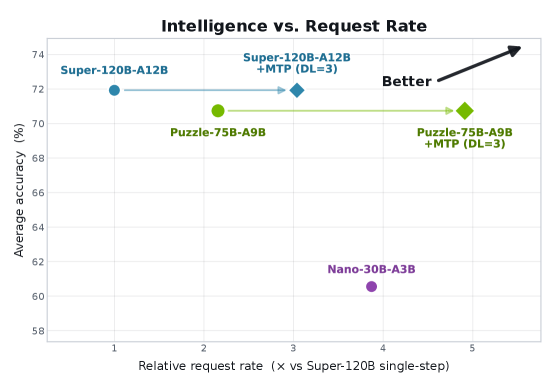
Results Total parameters drop from 120.7B to 75.3B (62.4% of the original) and active parameters from 12.8B to 9.3B (73.1%), while single-step server throughput reaches 1.60-2.14x the parent across six operating points (about 2x in the decode-heavy 8K/64K regime), and 1M-token concurrency on one H100 rises from 1 to 8 requests. Accuracy stays close to the parent, e.g. AIME25 89.7 vs. 92.2, RULER-1M 92.2 vs. 93.9, MMLU-Pro 82.4 vs. 83.8 (BF16). In the ablation, Iterative Puzzle beats single-step Puzzle by +0.57 average points over ten benchmarks at the same compression target. Within the recovery pipeline, the first short-context KD stage alone restores most benchmark categories to over 97% of the teacher, while the measured impact of RL was small.
결과 총 파라미터는 1207억에서 753억(원본의 62.4%)으로, 활성 파라미터는 128억에서 93억(73.1%)으로 줄었고, single-step 서버 처리량은 6개 운영점에 걸쳐 부모의 1.60~2.14배(decode-heavy 8K/64K regime에서 약 2배)에 도달하며, H100 한 장의 1M-token 동시 처리는 1개에서 8개 요청으로 늘어난다. 정확도는 부모에 근접한다: AIME25 89.7 vs 92.2, RULER-1M 92.2 vs 93.9, MMLU-Pro 82.4 vs 83.8(BF16). Ablation에서 Iterative Puzzle은 single-step Puzzle 대비 동일 압축 목표 기준 10개 벤치마크 평균 +0.57점의 이득을 보인다. 복구 파이프라인에서는 첫 short-context KD 단계만으로 대부분의 벤치마크 카테고리가 teacher의 97% 이상으로 회복되고, RL의 측정된 효과는 작았다.
Comparison Compared directly against the parent Nemotron-3-Super at matched BF16 and NVFP4 precision, and positioned against the much smaller Nemotron-3-Nano (30B total / 3.5B active) on the accuracy-throughput plane. Continued MTP training raises mean acceptance length from 3.45 to 4.34 in BF16 (3.31 to 4.31 in NVFP4), a roughly 25-30% gain concentrated at deeper draft positions where the teacher-forced/autoregressive mismatch hurts most. Against Nano, raw token throughput favors the smaller model, but after adjusting for Nano's 1.6x generation verbosity, Puzzle-75B-A9B+MTP completes a comparable number of user requests per minute at near-parent accuracy.
비교 부모 모델 Nemotron-3-Super와 BF16·NVFP4 동일 정밀도에서 직접 비교하고, 훨씬 작은 Nemotron-3-Nano(총 30B/활성 3.5B)와는 정확도-처리량 평면에서 포지셔닝한다. 지속 MTP 학습은 평균 수락 길이(acceptance length)를 BF16에서 3.45→4.34(NVFP4에서는 3.31→4.31)로 올리는데, 약 25~30% 개선이며 teacher-forced 학습과 autoregressive 추론의 불일치가 가장 큰 깊은 draft 위치에서 이득이 집중된다. Nano 대비 raw token 처리량은 밀리지만, Nano의 1.6배 생성 verbosity를 보정하면 Puzzle-75B-A9B+MTP는 부모급 정확도로 분당 비슷한 수의 사용자 요청을 완료한다.
Significance It demonstrates that a production-grade hybrid MoE+Mamba model can shed more than a third of its total parameters while preserving most downstream capability, by jointly pruning MoE experts, the active-parameter budget, and the Mamba state rather than any single axis. The evaluation framing is itself a contribution: reporting Pareto-optimal total throughput at fixed per-user throughput answers the actual deployment question ("how much can a server push through under this interactivity constraint?") rather than a kernel microbenchmark. The verbosity-adjusted request-completion comparison also warns that raw tokens/s overstates lighter models — a chattier model must generate more tokens per answer.
의의 실서비스급 hybrid MoE+Mamba 모델이 MoE expert·활성 파라미터 예산·Mamba state를 (단일 축이 아니라) 결합해 pruning하면 총 파라미터의 3분의 1 이상을 덜어내고도 대부분의 다운스트림 능력을 지킬 수 있음을 보여준다. 평가 프레이밍 자체도 기여다: 사용자별 처리량을 고정한 Pareto-optimal 총 처리량 보고는 kernel microbenchmark가 아니라 실제 배포 질문("이 interactivity 제약에서 서버가 얼마나 밀어낼 수 있나")에 답한다. Verbosity를 보정한 요청 완료율 비교는 raw tokens/s가 가벼운 모델을 과대평가한다는 경고이기도 하다 — 말이 많은 모델은 답 하나에 더 많은 token을 생성해야 하기 때문이다.
Limitations The paper states the largest accuracy gaps appear on instruction-following and agentic evaluations — Arena-Hard-V2 (68.6 vs. 72.8 in BF16) and certain TauBench domains — which it describes as more sensitive to aggressive compression. The RL recovery stage had only a small measured effect in the reported experiments. Structurally, the heterogeneous search was applied only to the MoE layers: Mamba layers were pruned uniformly due to inference-framework limitations and attention layers were left untouched, so two of the three layer types never benefit from per-layer allocation (reviewer judgment: likely remaining headroom).
한계 논문은 가장 큰 정확도 격차가 instruction-following·agentic 평가, 구체적으로 Arena-Hard-V2(BF16 68.6 vs 72.8)와 특정 TauBench 도메인에서 나타나며, 이들이 공격적 압축에 더 민감하다고 명시한다. RL 복구 단계의 측정된 효과는 보고된 실험에서 작았다. 구조적으로 heterogeneous 탐색은 MoE layer에만 적용됐다: Mamba layer는 inference framework 제약으로 균일하게 pruning했고 attention layer는 손대지 않았으므로, 세 layer 유형 중 둘은 layer별 배분의 혜택을 받지 못한다(리뷰어 판단: 남은 headroom일 가능성).
Future work The conclusion explicitly plans to apply Iterative Puzzle more aggressively and to expand the pruning techniques toward "extreme LLM compression" — much higher compression rates while preserving strong accuracy. Since the measured RL impact was small, the authors also state they plan to research more RL environments and additional post-training techniques. (Reviewer judgment: extending heterogeneous allocation to the Mamba and attention axes, once framework support lands, is a natural adjacent direction.)
향후 과제 결론에서 명시적으로, Iterative Puzzle을 더 공격적으로 적용하고 pruning 기법을 확장해 정확도를 지키면서 훨씬 높은 압축률의 "extreme LLM compression"에 도달하겠다는 계획을 밝힌다. RL의 측정 효과가 작았던 만큼, 더 많은 RL environment와 추가 post-training 기법 연구도 future work로 명시한다. (리뷰어 판단: framework 지원이 갖춰지면 Mamba·attention 축으로 heterogeneous 배분을 확장하는 것이 자연스러운 인접 방향이다.)
Released resources The models are publicly released on Hugging Face in three checkpoints — BF16, NVFP4 (Blackwell-targeted), and FP8 (Hopper-targeted). The compression stack runs on the Puzzletron implementation inside NVIDIA's open-source Model-Optimizer repository. MTP quality was evaluated with SPEED-Bench, and the parent Nemotron-3-Super checkpoints referenced in the paper are likewise public on Hugging Face.
자원 공개 모델은 Hugging Face에 BF16, NVFP4(Blackwell 대상), FP8(Hopper 대상) 세 체크포인트로 공개되어 있다. 압축 스택은 NVIDIA의 오픈소스 Model-Optimizer 저장소 안 Puzzletron 구현 위에서 동작한다. MTP 품질은 SPEED-Bench로 평가했으며, 논문이 참조하는 부모 Nemotron-3-Super 체크포인트들도 Hugging Face에 공개되어 있다.
The research thread
Where this paper sits 연구의 흐름
This paper is the third act of a lineage NVIDIA has been writing for two years. The original Puzzle (Bercovich et al., 2024) recast inference-optimized model design as distillation-guided architecture search — score a library of cheaper layer alternatives, then let a mixed-integer program assemble the best child under a hardware budget — the recipe that carved Llama-3.1-Nemotron-51B out of a 70B parent. Behind it runs the pruning-plus-distillation line — Minitron (Muralidharan et al., 2024) and Sheared LLaMA showed pruning plus modest distillation can replace training a small model from scratch. And alongside both runs the hybrid-architecture line — Mamba-2, Gated DeltaNet (reviewed on this site), Nemotron-H — which swapped most attention layers for state-space blocks. This paper stands where they collide: Puzzle machinery aimed at a parent that is simultaneously MoE, Mamba, and attention.
The conceptual shift is double. First, single-shot becomes iterative: the original Puzzle scored each candidate alone in the parent, betting that quality impacts add up. Iterative Puzzle abandons that bet — layer sensitivity is a moving target that shifts with every cut, so measurement and surgery must interleave: prune moderately, heal by distillation, re-score, cut again. Second, the objective moves off the model card and onto the serving dashboard: the target is not a parameter count but an operating point — Pareto-optimal server throughput at a fixed 100 tokens/s per user. Compression stops meaning 'make it smaller' and becomes capacity re-allocation under an interactivity constraint — which is why the result looks nothing like a uniformly scaled-down teacher.
The authors name 'extreme LLM compression' as the ambition, but the sharper opening hides in what they could not yet do: of three layer types, only MoE received heterogeneous treatment — Mamba states were trimmed uniformly for inference-framework reasons, and attention was left untouched. Per-layer allocation across all three axes is the natural next move once frameworks catch up. The honest accounting opens a subtler thread too: losses concentrate on agentic and instruction-following evaluations while knowledge benchmarks barely flinch — suite-average recovery can hide capability-specific damage, and the field will want sensitivity maps per capability, not per benchmark.
The unresolved tension is the healing bill. Three recovery rounds consume roughly 120B teacher-distillation tokens — accuracy bought with compute few outside frontier labs can spend — so cheaper, more sample-efficient healing is a live problem, and the RL stage's small measured effect leaves open which post-training signal actually restores what pruning removed. Meanwhile the verbosity-adjusted requests-per-minute framing may outlast the model itself: once evaluation asks 'how many users at fixed interactivity,' architecture, compression, and speculative decoding (the MTP head here) stop being separate papers and merge into one co-design loop.
이 논문은 NVIDIA가 2년째 써 내려온 계보의 3막이다. 원조 Puzzle(Bercovich et al., 2024)은 inference 최적화 모델 설계를 distillation 기반 architecture search로 재정의했다 — 더 싼 layer 대안들의 라이브러리에 점수를 매기고, mixed-integer program이 hardware 예산 아래에서 최적의 child를 조립하게 하는 레시피로, Llama-3.1-Nemotron-51B를 70B 부모에서 깎아냈다. 그 뒤에는 pruning+distillation 계보가 흐른다 — Minitron(Muralidharan et al., 2024)과 Sheared LLaMA는 pruning에 적당한 distillation을 더하면 작은 모델을 처음부터 학습하는 것을 대체할 수 있음을 보였다. 그리고 그 옆에는 hybrid 아키텍처 계보가 있다 — Mamba-2, Gated DeltaNet(본 사이트에 리뷰), Nemotron-H — attention 대부분을 state-space 블록으로 바꾼 흐름이다. 이 논문은 그 계보들이 충돌하는 지점에 서 있다: MoE이면서 Mamba이면서 attention인 부모를 향해 Puzzle 기계를 겨눈 것이다.
개념적 전환은 이중적이다. 첫째, single-shot이 iterative가 된다: 원조 Puzzle은 각 후보를 부모에 하나씩 끼워 점수를 매기며 품질 영향이 가산적이라는 데 베팅했다. Iterative Puzzle은 그 베팅을 버린다 — layer 민감도는 자를 때마다 움직이는 표적이므로 측정과 절단이 교차해야 한다: 적당히 자르고, distillation으로 회복시키고, 다시 점수 매기고, 또 자른다. 둘째, 목적함수가 model card에서 serving 대시보드로 옮겨간다: 목표는 파라미터 수가 아니라 운영점 — 사용자당 100 tokens/s 고정 하의 Pareto-optimal 서버 처리량이다. 압축은 '작게 만들기'가 아니라 interactivity 제약 아래의 용량 재배분 문제가 되고, 그래서 결과물이 teacher의 균일 축소판과 전혀 닮지 않은 것이다.
저자들은 'extreme LLM compression'을 야심으로 명시하지만, 더 날카로운 틈은 아직 하지 못한 것에 숨어 있다: 세 layer 유형 중 heterogeneous 처리를 받은 것은 MoE뿐이고, Mamba state는 inference framework 제약으로 균일하게 잘렸으며 attention은 손대지 않았다. Framework가 따라오는 순간 세 축 모두에 대한 layer별 배분이 자연스러운 다음 수다. 정직한 회계는 더 미묘한 실마리도 연다: 손실이 agentic·instruction-following 평가에 집중되고 지식 벤치마크는 거의 흔들리지 않는다 — 스위트 평균 회복률은 능력별 손상을 가릴 수 있고, field는 벤치마크별이 아니라 능력별 민감도 지도를 원하게 될 것이다.
풀리지 않은 긴장은 치유 비용 청구서다. 세 라운드의 회복 distillation이 약 120B teacher token을 소모한다 — frontier lab 바깥에서는 감당하기 어려운 compute로 정확도를 산 셈이라, 더 싸고 sample-efficient한 healing이 살아있는 문제이고, RL 단계의 측정 효과가 작았다는 사실은 pruning이 제거한 것을 어떤 post-training 신호가 실제로 복원하는지를 열린 질문으로 남긴다. 한편 verbosity를 보정한 분당 요청 완료 프레이밍은 모델 자체보다 오래 살아남을지 모른다: 평가가 '고정 interactivity에서 몇 명의 사용자인가'를 묻는 순간, 아키텍처·압축·speculative decoding(여기서는 MTP head)은 별개의 논문이기를 멈추고 하나의 co-design 루프로 합쳐진다.
Sparks — where one could take this 아이디어의 씨앗
-
Following the paper's own stated limitation, one could try extending the heterogeneous per-layer search from MoE experts to Mamba state channels and attention layers once inference frameworks support non-uniform state sizes, measuring how much headroom uniform pruning left behind. 논문 스스로 밝힌 한계를 따라, inference framework가 비균일 state 크기를 지원하는 시점에 heterogeneous layer별 탐색을 MoE expert에서 Mamba state 채널과 attention layer로 확장해, 균일 pruning이 남긴 headroom이 얼마인지 측정해볼 수 있다.
-
One could build a per-capability compression-sensitivity profile — tracking agentic and instruction-following scores across compression rates — to test whether these skills genuinely live in the low-redundancy capacity that pruning removes first. 압축률을 바꿔가며 agentic·instruction-following 점수를 추적하는 능력별 압축 민감도 프로파일을 만들어, 이 능력들이 정말 pruning이 먼저 제거하는 low-redundancy 용량에 사는지 시험해볼 수 있다.
-
Given the small measured effect of the RL recovery stage, one could compare healing signals — KD, SFT, RL — at matched token budgets to determine which post-training stage restores compression-damaged capabilities most efficiently per token spent. RL 회복 단계의 측정 효과가 작았던 만큼, 동일 token 예산에서 KD·SFT·RL healing 신호를 비교해 어떤 post-training 단계가 압축으로 손상된 능력을 token당 가장 효율적으로 복원하는지 가려볼 수 있다.
Seeds grounded in the paper's own stated limitations and open questions. 논문이 스스로 밝힌 limitations와 open questions에 뿌리를 둔 씨앗입니다.
Notes
Notes
The headline efficiency number (roughly 2x server throughput at matched user-throughput) comes from jointly pruning three different structural axes at once (MoE experts, active-parameter budget, Mamba state size) rather than optimizing any one of them in isolation, recovered with staged distillation between rounds rather than a single compression pass. The honestly-reported accuracy gaps concentrate on agentic/instruction-following evals, which is a useful signal about where aggressive hybrid-model compression is currently weakest.
Linked reviews
Gated Delta Networks: Improving Mamba2 with Delta Rule
Unifies Mamba2-style gated decay with the delta-rule targeted memory update into a single hardware-efficient linear-attention layer that beats both parents and anchors strong hybrid stacks with sliding-window attention.
quantizationFourTune: Towards Fully 4-Bit Efficient Post-Training for Diffusion Models
An end-to-end W4A4G4 post-training framework for large diffusion models augments LoRA with a frozen numerical stabilizer to isolate quantization-sensitive outliers, matching full-precision fine-tuning quality on FLUX.1-dev (12B) with up to 2.25x less memory and 2.27x higher training throughput.