Paper Review
Strong Drafts Need Compact Memories: Long-Context Speculative Decoding with Compressed KV Cache
Gives an independent speculative-decoding drafter a compressed KV memory instead of a full cache, so it keeps the acceptance rate of a strong drafter without its KV-access cost growing with context length.
독립 드래프트 모델에 전체 KV 캐시 대신 압축된 KV 메모리를 주어, 강한 드래프트 모델의 수락률은 유지하면서 컨텍스트 길이에 따라 커지는 KV 접근 비용은 피한다.
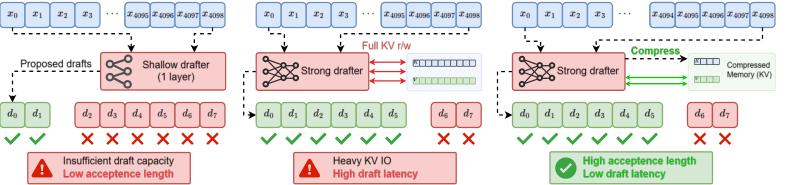
Background Speculative decoding (SD) speeds up generation by having a lightweight draft model propose candidate tokens that a target model verifies in parallel, without changing the output distribution. Its speedup depends on both the number of accepted draft tokens and the latency of each draft step.
배경 추측 디코딩(speculative decoding)은 가벼운 드래프트 모델이 여러 토큰 후보를 제안하고 타깃 모델이 이를 병렬로 검증해, 출력 분포를 바꾸지 않으면서 자기회귀 디코딩의 순차성 병목을 줄인다. 속도 향상 폭은 수락된 드래프트 토큰 수와 드래프트 단계 자체의 지연 시간 둘 다에 좌우된다.
Problem As applications like document summarization and multi-turn agents increasingly condition on prefixes spanning tens of thousands of tokens, each decoding step gets more expensive as the prefix grows -- attention has to read a larger KV cache.
문제 문서 요약이나 멀티턴 에이전트처럼 수만 토큰짜리 프리픽스에서 생성하는 애플리케이션이 늘면서, 프리픽스가 길어질수록 각 디코딩 스텝의 비용도 커진다 — 어텐션이 더 큰 KV 캐시를 읽어야 하기 때문이다.
Prior limitations Lightweight drafts (EAGLE-class) keep draft latency low over short prefixes, but their limited capacity fails to capture long-range dependencies, so acceptance declines as context grows. Strong independent drafts recover acceptance, but every draft step streams the full historical KV cache, so at long prefixes this KV cost comes to dominate draft latency and erodes SD's speedup.
기존 한계 EAGLE류의 가벼운 드래프트는 짧은 프리픽스에서는 지연이 낮지만, 용량이 제한적이라 장거리 의존성을 포착하지 못해 컨텍스트가 길어질수록 수락률이 떨어진다. 반대로 강한 독립 드래프트 모델은 수락률은 회복하지만, 매 드래프트 스텝마다 자신의 전체 히스토리 KV 캐시를 스트리밍해야 해서 프리픽스가 길어지면 이 KV 비용이 드래프트 지연을 지배하게 된다.
Goal The goal is a draft with enough capacity to capture long-range dependencies while maintaining both high acceptance and low latency as the prefix grows.
목표 목표는 프리픽스가 길어져도 장거리 의존성을 포착할 만큼 충분한 용량을 가지면서, 동시에 수락률과 낮은 지연을 모두 유지하는 드래프트를 설계하는 것이다.
Method The paper proposes memory-augmented drafting: an independent draft model is given a compressed KV memory instead of a full KV cache. A lightweight memory adaptor constructs and incrementally updates this memory, compressing distant history while preserving exact recent context. The target verifier keeps its own unmodified full KV cache and applies the standard accept/reject rule, so speculative decoding's lossless guarantee is unaffected.
방법 메모리 증강 드래프팅(memory-augmented drafting)을 제안한다: 독립 드래프트 모델에 전체 KV 캐시 대신 압축된 KV 메모리를 준다. 가벼운 메모리 어댑터가 이 메모리를 구성하고 점진적으로 갱신하며, 먼 과거 정보는 압축해 보존하고 최근 컨텍스트는 그대로 정확히 유지한다. 타깃 검증 모델은 자신의 전체 KV 캐시를 그대로 쓰고 표준 수락/거부 규칙을 적용하므로, 추측 디코딩의 무손실 보장은 그대로 유지된다.
Key idea The key move is compressing only the draft side, leaving verification untouched. Memory slots are materialized every r tokens by compressing the current local window into long-term KV state, and successive slots form an incremental compression chain -- each slot reads prior slots -- rather than independent segment summaries. Training touches only mirrored K/V projection matrices; the draft backbone stays frozen.
핵심 아이디어 핵심은 압축을 드래프트 쪽에만 적용하고 검증 쪽은 건드리지 않는 것이다. 메모리 슬롯은 매 r토큰마다 현재 로컬 윈도우를 장기 KV 상태로 압축해 만들어지며, 각 슬롯이 이전 슬롯들을 읽으면서 형성되는 점진적 압축 체인을 이룬다 — 독립적인 구간 요약이 아니다. 학습은 미러링된 K/V 투영 행렬만 갱신하고 드래프트 백본 자체는 고정한다.
Validation Tested on Llama 3.1-8B and -70B targets at prefix lengths up to 32K, against both a lightweight (EAGLE-style) baseline and a full-KV independent-draft baseline.
검증 Llama 3.1-8B와 70B 타깃 모델에서 프리픽스 길이 최대 32K까지, 경량 드래프트(EAGLE류)와 풀-KV 독립 드래프트 두 베이스라인 계열 모두와 비교했다.
Results Draft-side memory drops by over 70%, with reported end-to-end speedups over autoregressive decoding of up to 2.08x (8B target) and 3.33x (70B target).
결과 드래프트 쪽 메모리를 70% 이상 줄이면서, 자기회귀 디코딩 대비 최대 2.08배(8B 타깃) 및 3.33배(70B 타깃) 속도 향상을 달성했다고 보고한다.
Comparison The method is reported to consistently outperform both baseline families -- a claim of occupying the "sufficient capacity AND low draft latency" corner that neither baseline alone reaches. The sections reviewed here did not include an explicit table of acceptance rate as a function of prefix length (an α(L) curve); the speedup and memory numbers are given directly alongside a qualitative account (Figure 1), and whether a dedicated acceptance-vs-length curve exists elsewhere in the paper was not confirmed in this review.
비교 두 베이스라인 계열 모두를 일관되게 앞서는 것으로 보고되며, 이는 "충분한 용량"과 "낮은 드래프트 지연"이라는, 그동안 어느 한쪽만 가능했던 두 목표를 동시에 달성했다는 주장이다. 다만 이 리뷰에서 확인한 구간에는 수락률을 프리픽스 길이의 명시적 함수(곡선)로 표로 제시한 부분은 없었고, 속도·메모리 수치와 정성적 설명(그림 1)으로만 제시되어 있다 — 수락률 대 컨텍스트 길이의 구체적 곡선이 논문 다른 곳에 있는지는 이 리뷰에서 확인되지 않았다.
Significance The problem this paper solves -- that a stronger drafter's own KV-access cost becomes the bottleneck -- is a structural tension in any attempt to make speculative-decoding drafters more capable. Compressing the draft's own KV cache is an axis that can compose separately from KV-compression work that targets the verifier's cache instead.
의의 이 논문이 푸는 문제 — "강한 드래프트일수록 자기 자신의 KV 접근 비용이 문제가 된다" — 는 추측 디코딩용 드래프트를 더 강하게 만들려는 어떤 시도에도 구조적으로 따라붙는 긴장이다. 드래프트 자체의 KV 캐시를 압축한다는 접근은, 검증 모델의 KV 캐시를 건드리는 다른 KV 압축 연구들과는 별개의 축으로 조합 가능하다.
Limitations (paper-stated) The memory adaptor is trained on only 2B tokens at 8K context length -- longer training contexts, larger corpora, and fuller fine-tuning of the draft model (beyond the mirrored projections) are left open. (paper-stated) Local-window size, sink-token count, and slot interval are all fixed rather than adaptive. (paper-stated) Self-speculative decoding (using a compressed version of the target model itself as the drafter) is explicitly out of scope.
한계 (저자 명시) 메모리 어댑터는 2B 토큰, 8K 컨텍스트 길이라는 제한된 자원으로만 학습되었다 — 더 긴 컨텍스트, 더 큰 학습 코퍼스, 드래프트 모델의 전체 파인튜닝(미러링된 투영만이 아니라)에 대한 연구는 열려 있다. (저자 명시) 로컬 윈도우 크기, 싱크 토큰 수, 슬롯 생성 간격이 모두 고정값이며 적응적이지 않다. (저자 명시) 셀프-추측 디코딩(타깃 모델 자체를 압축해 드래프트로 쓰는 방식)은 명시적으로 범위 밖이다.
Future work (paper-stated) Adaptive allocation of local-window size, sink-token count, and slot interval, plus extension to self-speculative decoding (with its cost-effectiveness trade-off), are named as future work.
향후 과제 (저자 명시) 로컬 윈도우·싱크 토큰·슬롯 간격에 대한 적응적 할당과, 셀프-추측 디코딩으로의 확장(비용 효율성 트레이드오프 포함)을 향후 과제로 제시한다.
Released resources No public code or checkpoint release was found in the paper (no public release verified).
자원 공개 별도의 공개 코드나 체크포인트 링크는 논문에서 확인되지 않았다 (공개 링크 확인 안 됨).
The research thread
Where this paper sits 연구의 흐름
Drafter design in speculative decoding has long been framed as a trade-off between "light enough to be fast" and "strong enough to be accepted." EAGLE-class methods chose the former; strong independent drafters chose the latter.
This paper reframes that trade-off itself as a KV-cache problem. It identifies that what makes a stronger drafter expensive isn't compute, but the cost of re-reading its own KV cache at every step, and removes only that cost via compression -- leaving verification completely untouched. By separating drafter strength from drafter latency this way, it targets a different axis than most KV-compression work, which compresses the verifier's cache instead.
What it opens next is how well this compressed-memory drafter composes with other drafter improvements. Whether the same compression principle would apply to block-diffusion drafters (dFlash-class) as they are made stronger, and how the cost-effectiveness trade-off shifts under self-speculative decoding, are open questions the authors name directly.
추측 디코딩의 드래프트 모델 설계는 오랫동안 "얼마나 가벼워야 빠른가"와 "얼마나 강해야 잘 맞히는가" 사이의 트레이드오프로 다뤄졌다. EAGLE류는 전자를, 강한 독립 드래프트 모델들은 후자를 택해 왔다.
이 논문이 바꾸는 지점은 그 트레이드오프 자체를 KV 캐시 문제로 재해석하는 것이다. 드래프트가 강해질수록 문제가 되는 것은 연산량이 아니라 자기 자신의 KV 캐시를 매 스텝 다시 읽어야 하는 비용이라고 짚고, 그 비용만을 압축으로 없앤다 — 검증 쪽은 전혀 건드리지 않는다. 드래프트 강도와 드래프트 지연을 분리해서 다룬다는 점에서, 검증 모델의 KV를 압축하는 대다수 KV 압축 연구와는 다른 축을 겨냥한다.
다음으로 열리는 질문은 이 압축-메모리 드래프트가 다른 드래프트 개선 기법들과 얼마나 잘 조합되는지다. 예컨대 block-diffusion 드래프트 모델(dFlash류)이 강해지면서 겪게 될 KV 비용 문제에도 같은 압축 원리가 적용될 수 있을지, 그리고 셀프-추측 디코딩으로 확장했을 때 비용 효율성이 어떻게 변할지가 저자들이 직접 남긴 미해결 질문이다.
Sparks — where one could take this 아이디어의 씨앗
-
If block-diffusion drafters (dFlash-class) were scaled up in strength, would the same compressed-memory principle address their growing KV-access cost the same way it does here for AR drafters? block-diffusion 드래프트 모델(dFlash류)을 더 강하게 만들 때도 같은 압축-메모리 원리를 적용하면, 그쪽에서 문제가 되는 KV 비용도 줄일 수 있을까?
-
Applied to self-speculative decoding, how much of the cost-effectiveness the authors worry about would actually be lost -- is the trade-off mild or severe in practice? 셀프-추측 디코딩(타깃 모델 일부를 드래프트로 쓰는 방식)에 이 압축 메모리를 적용하면, 저자들이 우려한 비용 효율성 저하를 실제로 얼마나 겪게 될까?
Seeds grounded in the paper's own stated limitations and open questions. 논문이 스스로 밝힌 limitations와 open questions에 뿌리를 둔 씨앗입니다.
Notes
Notes
Linked reviews
xPress: Parallel Refinement for Diffusion Drafters in Speculative Decoding
Block-diffusion drafters sample every position from its own marginal, so a draft block is individually likely but jointly improbable; xPress adds a low-rank causal refiner that reconciles the whole block through parallel Jacobi iterations, lifting acceptance length from 6.25 to 8.02 tokens.
kv-cacheWindowed-MTP: Removing the Full-Context Draft-KV Tax at Million-Token Context
Windowed-MTP names the long-context draft-attention tax in built-in Multi-Token-Prediction speculative-decoding heads -- the draft re-reads the entire KV cache every step, so at million-token context it can flip speculation net-negative -- and fixes it losslessly with a training-free sink+window applied only to the draft's attention, cutting per-decode-step cost 28-44% across three architecture families at 1M tokens.
speculative-decodingDSpark: Confidence-Scheduled Speculative Decoding with Semi-Autoregressive Generation
A semi-autoregressive drafter combined with confidence-scheduled verification fixes the intra-block acceptance decay of parallel speculative-decoding drafters, delivering 51-85% throughput and latency gains in DeepSeek-V4 production serving.
speculative-decodingAgentSpec: Speculative Decoding for Batch Inference of LLM Agents
A structure-isolated speculative decoding scheme for LLM agents that fixes the batch-size collapse where existing methods become slower than plain autoregressive decoding, delivering up to 2.02x speedup by tracking semantic block boundaries and allocating draft budget by historical redundancy.