Paper Review
AdaLook: Adaptive Multi-Step Lookahead Decoding for Diffusion Language Models
AdaLook makes diffusion-LM lookahead decoding adaptive-depth instead of fixed-depth — a variance-gated continue/stop rule plus branch expansion from informative intermediate states — Pareto-dominating one-step lookahead and confidence-only decoding on the accuracy/decoding-steps trade-off across MMLU, GSM8K, MATH500 and BBH.
AdaLook은 확산 언어모델의 lookahead 디코딩을 고정 깊이가 아니라 분산-게이트 기반의 적응적 깊이로 만든다 — candidate-score 분산으로 계속/정지를 결정하고 유용한 중간 상태에서 branch expansion을 재개해, MMLU·GSM8K·MATH500·BBH 전반에서 one-step lookahead와 confidence-only 디코딩을 정확도-디코딩스텝 트레이드오프에서 앞선다.
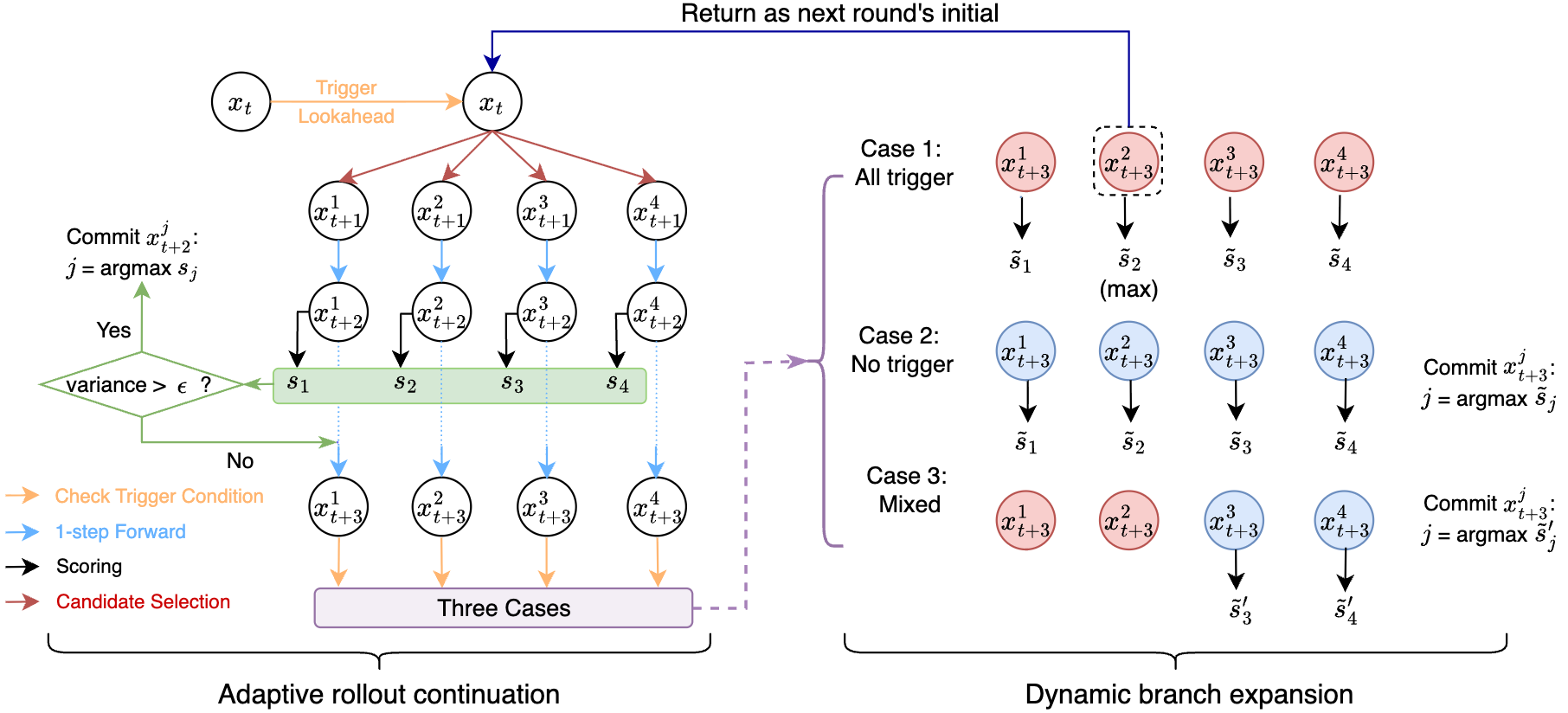
Background Masked diffusion language models (DLMs) generate text in parallel by iteratively refining masked tokens rather than token-by-token, offering, in principle, far more flexible and efficient inference than autoregressive decoding. But the diffusion training objective itself does not prescribe any specific decoding order or token-selection strategy at inference time, leaving that design space wide open with real consequences for both quality and efficiency. Recent lookahead-based decoding (ETE, Fu et al. 2025) tries to exploit this space by exploring future decoding states before committing token updates whenever confidence is low.
배경 마스크 확산 언어모델(DLM)은 마스크된 토큰들을 반복적으로 정제해 병렬로 텍스트를 생성하며, 원리적으로는 autoregressive 디코딩보다 훨씬 유연하고 효율적인 추론이 가능하다. 그러나 확산 학습 목적함수 자체는 추론 시 어떤 디코딩 순서나 토큰 선택 전략을 써야 하는지 규정하지 않아, 그 설계 공간이 생성 품질과 효율 모두에 큰 영향을 미치는 채로 열려 있다. 최근의 lookahead 기반 디코딩(ETE, Fu et al. 2025)은 신뢰도가 낮을 때 토큰 업데이트를 확정하기 전에 미래의 디코딩 상태를 미리 탐색해 이 공간을 활용하려 한다.
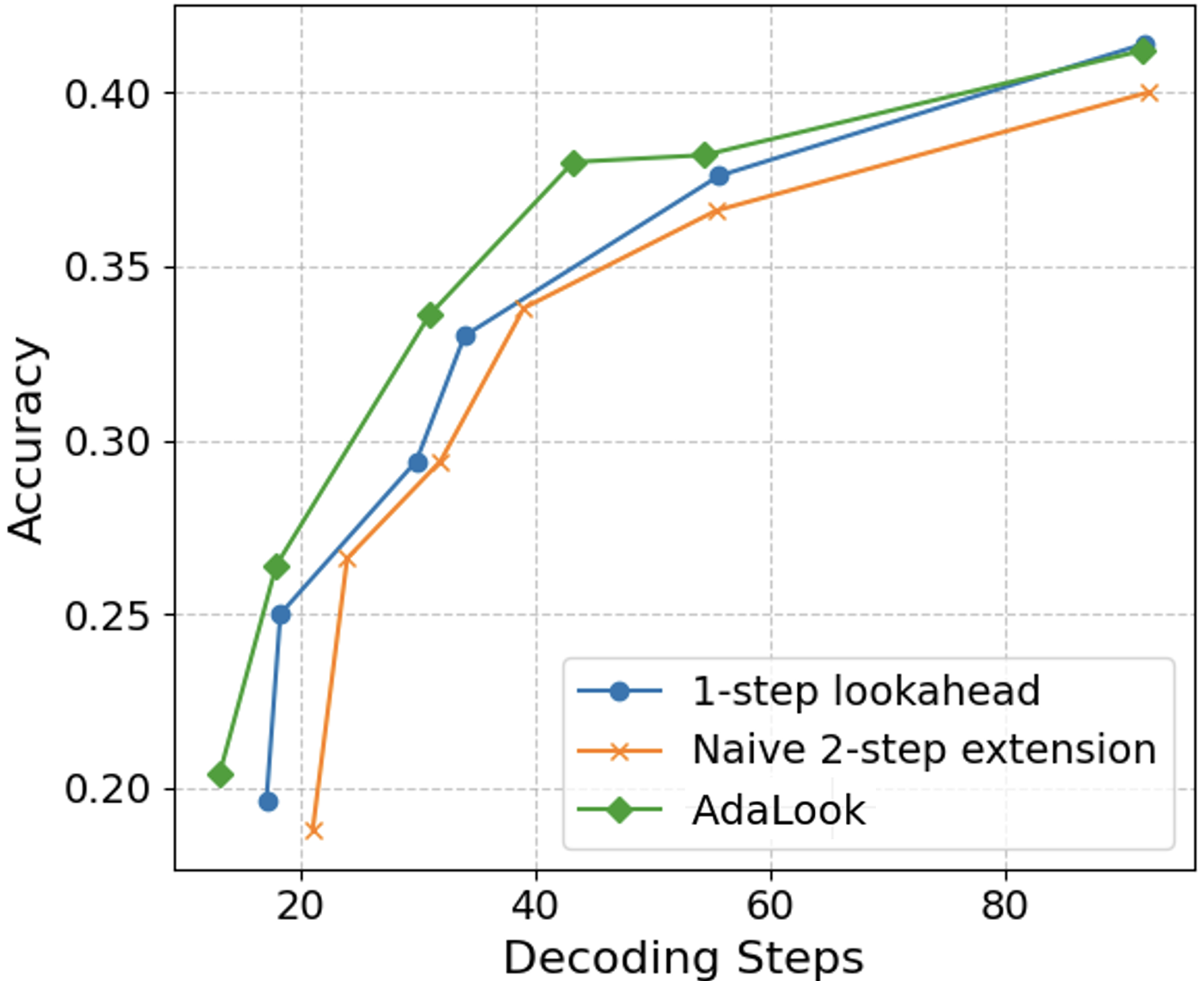
Problem Existing lookahead is shallow — exactly one step. It picks the candidate commitment that unlocks the most subsequent high-confidence positions immediately, optimizing only short-horizon information gain, which can trap the decoder in a locally-good but globally suboptimal trajectory. The authors' own ablation (Fig. 1, MATH500 on LLaDA-8B-Instruct) shows that naively extending to a fixed, deeper rollout doesn't help either — the ideal rollout depth varies both across examples and across decoding steps within the same example, so a uniformly fixed depth wastes computation on easy steps and under-explores hard ones.
문제 기존 lookahead는 얕다 — 딱 한 스텝뿐이다. 즉시 가장 많은 후속 고신뢰 위치를 여는 후보를 고르는 방식이라 즉각적이고 짧은 시야의 정보 이득만 최적화하며, 국소적으로는 좋지만 전역적으로는 최선이 아닌 디코딩 궤적에 갇힐 수 있다. 저자들 자신의 ablation(Fig. 1, LLaDA-8B-Instruct의 MATH500)은 단순히 고정된 더 깊은 rollout으로 확장하는 것 역시 도움이 되지 않음을 보여준다 — 최적 rollout 깊이는 예제마다, 그리고 같은 예제 안에서도 디코딩 스텝마다 달라지므로, 균일하게 고정된 깊이는 쉬운 스텝에서는 연산을 낭비하고 어려운 스텝에서는 탐색이 부족해진다.
Prior limitations The lineage running from fixed-step parallel decoding (early DLM inference), through confidence-aware fixed/dynamic-threshold decoding (Fast-dLLM and related work), to one-step lookahead (ETE), never treats "how deep to search" as anything but absent or fixed. AdaLook inherits ETE's candidate-scoring formula unchanged (confidence near a target level c_info=0.2, weighted toward later within-block positions) and builds directly on top of it.
기존 한계 고정-스텝 병렬 디코딩(초기 DLM 추론) → 신뢰도-인지 고정/동적 임계값 디코딩(Fast-dLLM 등) → one-step lookahead(ETE)로 이어지는 계보 전체가 "얼마나 깊이 탐색할 것인가"를 아예 다루지 않거나 고정값으로만 다뤄왔다. AdaLook은 ETE의 후보 채점 공식(목표 신뢰도 c_info=0.2 근처, 블록 뒤쪽 위치에 가중)을 그대로 물려받아 그 위에 구축한다.
Goal Explore longer decoding horizons than one-step lookahead while avoiding both failure modes of naive fixed-depth deeper rollout: wasted computation on easy cases, and an inability to adapt to how informative an intermediate rollout state actually turns out to be.
목표 One-step lookahead보다 긴 디코딩 시야를 탐색하되, 고정 깊이 rollout이 갖는 두 가지 실패 — 쉬운 경우에 연산을 낭비하는 것과 중간 rollout 상태가 실제로 얼마나 유용한지에 적응하지 못하는 것 — 를 모두 피하는 lookahead 메커니즘을 설계하는 것이 목표다.
Method AdaLook adds two mechanisms on top of ETE's one-step lookahead machinery: (a) a variance-gated continue/stop rule — after each rollout step, check the variance across candidate hypothesis scores; if it's still high (candidates meaningfully disagree), keep rolling out deeper, and once it settles (low variance), stop and commit; (b) branch expansion — rather than being locked into one fixed-depth path chosen upfront, re-trigger additional lookahead from intermediate decoding states that turn out to be especially informative. Critically, AdaLook introduces no new tunable hyperparameters beyond what ETE already needs (N, C, γ) — the adaptive mechanism's own parameters are fixed once via a small calibration set and held fixed across all experiments.
방법 AdaLook은 ETE의 one-step lookahead 장치 위에 두 메커니즘을 더한다 — (a) 분산-게이트 계속/정지 규칙: 매 rollout 스텝 후 후보 가설 점수들의 분산을 보고, 분산이 여전히 크면(후보들이 유의미하게 엇갈리면) 더 깊이 탐색하고, 분산이 가라앉으면(정착되면) 멈추고 확정한다; (b) branch expansion: 미리 정한 하나의 고정 깊이 경로에 갇히는 대신, 특히 유용하다고 판명된 중간 디코딩 상태에서 추가 lookahead 탐색을 다시 트리거한다. 결정적으로 AdaLook은 ETE가 이미 필요로 하는 것(N, C, γ) 외에 새로운 튜닝 하이퍼파라미터를 추가하지 않는다 — 적응 메커니즘 자체의 파라미터는 작은 calibration set에서 한 번 정해져 전 실험에 고정된다.
Key idea The core idea is that "how deep should I look ahead" should itself be decided adaptively from the search's own uncertainty rather than fixed in advance — using the spread (variance) across candidate hypotheses as a real-time signal for whether further exploration is worth its cost. Like a hiker who only pulls out the map for a longer look when the trail ahead is genuinely ambiguous, and puts it away the moment one path is clearly right — rather than never checking the map at all (one-step) or always unfolding it for a fixed interval at every fork (fixed-depth rollout).
핵심 아이디어 핵심은 "얼마나 깊이 내다볼 것인가" 자체를 미리 고정하는 대신 탐색 스스로의 불확실성으로부터 적응적으로 결정한다는 것이다 — 후보 가설들 사이의 퍼짐(분산)을 실시간으로 "더 탐색할 가치가 있는가"의 신호로 쓴다. 갈림길이 정말로 애매할 때만 지도를 꺼내 오래 들여다보고 한쪽 길이 분명해지면 바로 지도를 접는 등산객과 같다 — 아예 지도를 안 보는 것(one-step)도 아니고, 갈림길마다 무조건 5분씩 지도를 펼치는 것(고정 깊이 rollout)도 아니다.
Validation Evaluated on LLaDA-8B-Instruct across MMLU, GSM8K (full 1,319-example test set), MATH500 (all 500 examples), and BBH (500 sampled examples); generation length 512, block size 64, greedy decoding, NVIDIA H200 GPUs. Compared against ETE (the one-step lookahead method it builds on) and Fast-dLLM's confidence-aware parallel decoding. Cross-backbone generality checked on Dream-v0-Instruct-7B (Appendix C). A separate latency analysis (Table 1, H200 and B200) measures actual end-to-end wall-clock time per decoding step across beam sizes, not just forward-pass counts.
검증 LLaDA-8B-Instruct에서 MMLU, GSM8K(전체 1,319문항), MATH500(전체 500문항), BBH(500문항 샘플) 네 벤치마크로 평가한다. 생성 길이 512, 블록 크기 64, greedy 디코딩, NVIDIA H200 GPU. Beseline은 AdaLook이 그 위에 구축한 ETE(one-step lookahead)와 Fast-dLLM의 신뢰도-인지 병렬 디코딩이다. Dream-v0-Instruct-7B로 백본 간 일반성도 확인한다(Appendix C). 별도의 지연시간 분석(Table 1, H200·B200)은 forward-pass 횟수가 아니라 실제 end-to-end wall-clock 시간을 다양한 beam size에서 측정한다.
Results AdaLook Pareto-dominates both baselines on the accuracy-vs-decoding-steps trade-off across all four benchmarks (AdaLook >> ETE >> Fast-dLLM). At roughly 45 decoding steps, AdaLook (Optimized) reaches about 4.5% higher accuracy than ETE (Optimized). Gains are modest on GSM8K but much larger on harder benchmarks — e.g. best MATH accuracy: AdaLook 43.6% vs. ETE 42.6% vs. Fast-dLLM 42.2%.
결과 AdaLook은 네 벤치마크 전부에서 정확도-디코딩스텝 트레이드오프를 파레토 지배한다(AdaLook >> ETE >> Fast-dLLM). 약 45 디코딩 스텝에서 AdaLook(Optimized)은 ETE(Optimized) 대비 약 4.5% 더 높은 정확도를 낸다. 이득은 GSM8K에서는 완만하지만 MATH·BBH처럼 더 어려운 벤치마크에서 훨씬 크다 — 예를 들어 MATH 최고 정확도는 AdaLook 43.6% vs ETE 42.6% vs Fast-dLLM 42.2%.
Comparison Fast-dLLM's purely confidence-aware decoding, with no lookahead search at all, only matches the AdaLook/ETE trade-off on the easiest benchmark (GSM8K) when given enough decoding steps, and falls behind on harder reasoning tasks — interpreted by the authors as evidence that confidence alone, without a strategic exploration mechanism, is insufficient once low-confidence regions become frequent. The gain over ETE specifically is present on every benchmark but scales with task difficulty (larger on MATH/BBH/MMLU than GSM8K).
비교 Lookahead 탐색이 전혀 없는 Fast-dLLM의 순수 신뢰도-인지 디코딩은 충분한 디코딩 스텝이 주어졌을 때 가장 쉬운 벤치마크(GSM8K)에서만 AdaLook/ETE와 비슷한 트레이드오프를 내고, 더 어려운 추론 과제에서는 뒤처진다 — 저자들은 이를 저신뢰 영역이 빈번해질수록 전략적 탐색 메커니즘 없는 신뢰도만으로는 부족하다는 증거로 해석한다. ETE 대비 이득은 모든 벤치마크에서 나타나지만 과제 난이도에 비례해 커진다(GSM8K보다 MATH/BBH/MMLU에서 더 큰 이득).
Significance Pushes dLLM decoding-time acceleration from "confidence-only" and "fixed lookahead" toward genuinely adaptive, search-budget-aware inference — directly relevant to how much wall-clock and compute a dLLM serving stack spends per generated token, and demonstrates this adaptivity can be added with zero extra tunable hyperparameters over the existing ETE machinery (the serving-relevance framing is reviewer judgment).
의의 dLLM 디코딩-시점 가속을 "신뢰도만" 보거나 "고정 lookahead"를 쓰는 단계에서, 진짜로 적응적이고 탐색-예산을 인지하는 추론으로 밀어붙인다 — 이는 dLLM 서빙 스택이 토큰 하나를 생성하는 데 실제로 얼마의 wall-clock·연산을 쓰는지에 직접 관련이 있으며, 이 적응성이 기존 ETE 장치 대비 추가 튜닝 하이퍼파라미터 없이 달성된다는 점도 보여준다(서빙 관련성 프레이밍은 리뷰어 판단).
Limitations The authors state directly, in their own Limitations section, that the adaptive multi-step lookahead adds slightly higher per-decoding-step computational overhead than one-step lookahead, because hypothesis evaluation requires batched forward passes — even on high-end GPUs (H200/B200). They express a belief, not a demonstrated fact, that this overhead will become increasingly negligible as batched-inference hardware improves.
한계 저자들이 자체 Limitations 절에서 직접 밝히는 한계는, 적응적 multi-step lookahead가 가설 평가를 위한 배치 forward pass 때문에 one-step lookahead보다 디코딩 스텝당 연산 오버헤드가 다소 높다는 것이다 — H200·B200 같은 고성능 GPU에서도 마찬가지다. 저자들은 배치 추론 하드웨어가 발전하면 이 오버헤드가 점점 무시할 만해질 것이라 기대하지만, 이는 실증된 사실이 아니라 저자들의 예상이다.
Future work Not stated in the paper — there is no separate future-work section; the Conclusion moves directly into the Limitations paragraph, followed by references.
향후 과제 논문에 별도의 future-work 절은 없다 — Conclusion 다음 바로 Limitations로 넘어가고 References로 끝난다(논문 구조 기준, 논문 내 명시 없음).
Released resources No official GitHub repository or code release is linked anywhere in the paper or its HTML rendering — no public release verified. Only the arXiv abstract page was confirmed (curl, HTTP 200).
자원 공개 논문 본문·HTML 어디에도 공식 GitHub나 코드 저장소 링크가 없다 — 공개 링크 확인 안 됨. arXiv 초록 페이지만 curl로 200 응답을 확인했다.
The research thread
Where this paper sits 연구의 흐름
dLLM inference-time decoding strategy has evolved from fixed-step parallel decoding, through confidence-aware thresholding (the Fast-dLLM line), to genuine inference-time search that explores future decoding states before committing — ETE's one-step lookahead. What this entire lineage shares is that the question "how deep should the search look" is either never asked (confidence-based methods) or answered with one fixed value (one step).
AdaLook's shift is to make the search's own depth a function of how settled the search currently is — rather than a fixed depth chosen in advance, it uses the variance across candidate hypotheses as a real-time signal for whether to continue or stop (variance-gating). And instead of being locked into one rollout path, it can re-open exploration from intermediate states that turn out, unexpectedly, to be informative (branch expansion). It inherits ETE's candidate-scoring formula unchanged, handing only the "how deep" decision over to the search itself — that's the conceptual move.
The limitation the authors state themselves — that batched hypothesis evaluation raises per-step latency — opens the natural next question for this line: where exactly is the crossover point, across hardware and batch sizes, at which step-count savings outweigh the added per-step search cost? And could the same principle behind deciding "how deep" extend to deciding "how wide" — how many candidates to explore at once?
dLLM 추론-시점 디코딩 전략은 고정-스텝 병렬 디코딩에서, 신뢰도-인지 임계값 방식(Fast-dLLM 계열)으로, 그리고 다시 확정하기 전에 미래 디코딩 상태를 실제로 탐색하는 추론-시점 검색 — ETE의 one-step lookahead — 으로 이어지며 진화해 왔다. 이 계보 전체가 공유하는 한 가지는, "얼마나 깊이 내다볼 것인가"라는 질문 자체를 다루지 않거나(신뢰도 기반 방식들) 하나의 고정된 값(one-step)으로만 다뤄왔다는 것이다.
AdaLook의 전환은 탐색의 깊이 자체를 탐색이 지금 얼마나 "정착"했는지의 함수로 만든다는 데 있다 — 미리 정한 고정 깊이가 아니라, 후보 가설들의 분산을 실시간 신호로 써서 계속할지 멈출지 결정한다(분산-게이트). 그리고 하나의 rollout 경로에 갇히는 대신, 예상외로 유용했던 중간 상태에서 탐색을 다시 열 수 있게 한다(branch expansion). ETE의 후보 채점 공식은 그대로 물려받으면서, "얼마나 깊이"라는 결정만 검색 스스로에게 맡기는 것 — 이것이 이 논문의 개념적 이동이다.
저자들 스스로 밝히는 한계 — 배치 가설 평가가 스텝당 지연시간을 늘린다는 것 — 는 이 계보의 다음 질문을 자연스럽게 연다: 스텝 수 절감이 스텝당 늘어난 탐색 비용을 상쇄하는 실제 교차점은 하드웨어와 배치 크기에 따라 어디인가? 그리고 "얼마나 깊이"를 적응적으로 결정하는 것과 같은 원리가 "얼마나 넓게"(몇 개의 후보를 탐색할지) 결정하는 데까지 확장될 수 있는가?
Sparks — where one could take this 아이디어의 씨앗
-
The authors' own stated limitation — that batched hypothesis evaluation raises per-step latency even on H200/B200 — leaves open exactly where, across different serving batch sizes, the step-count savings stop compensating for that added per-step cost. 저자들이 자체 Limitations에서 밝힌 것 — 배치 가설 평가가 H200·B200에서도 스텝당 지연시간을 늘린다는 점 — 은 다양한 서빙 배치 크기에서 스텝 수 절감이 그 추가 비용을 정확히 언제 상쇄하는지가 아직 측정되지 않은 열린 질문임을 뜻한다.
-
The authors state they expect this overhead to become negligible as batched-inference hardware improves, but this is an unverified expectation rather than a demonstrated fact — whether future GPU generations actually bear this out, or whether the same hardware trends that make step-count savings valuable also scale up the per-step cost, remains open. 저자들은 배치 추론 하드웨어가 발전하면 이 오버헤드가 무시할 만해질 것이라 기대한다고 밝히는데, 이는 아직 실증되지 않은 예상이다 — 차세대 GPU가 실제로 그 기대를 확인해줄지, 아니면 스텝-수 절감을 가치 있게 만드는 바로 그 하드웨어 트렌드가 스텝당 비용도 함께 키울지는 열린 질문이다.
Seeds grounded in the paper's own stated limitations and open questions. 논문이 스스로 밝힌 limitations와 open questions에 뿌리를 둔 씨앗입니다.
Notes
Notes
Linked reviews
Fast-dLLM: Training-Free Acceleration of Diffusion LLMs via KV Cache and Parallel Decoding
A block-wise approximate KV cache plus confidence-thresholded parallel decoding accelerates open diffusion LLMs by up to 27.6x end-to-end with 1-2 point accuracy loss, entirely training-free.
diffusion-llmLLaDA: Large Language Diffusion Models
An 8B masked-diffusion language model trained from scratch on 2.3T tokens that matches LLaMA3-8B-class autoregressive baselines, showing next-token prediction is not the only recipe for LLM capabilities.
diffusion-llmConditional Total Correlation and the Serial Depth of Adaptive Parallel Sampling
Proves an exact information-theoretic identity showing that a parallel-decoding policy approximation error equals the conditional total correlation it discards each round, then uses it to show the confidence-based heuristics deployed in real masked diffusion language models are information-theoretically worse than decoding in random order.