Paper Review
LLaDA: Large Language Diffusion Models
An 8B masked-diffusion language model trained from scratch on 2.3T tokens that matches LLaMA3-8B-class autoregressive baselines, showing next-token prediction is not the only recipe for LLM capabilities.
2.3T token으로 from scratch 학습한 8B masked diffusion LM이 LLaMA3 8B급 autoregressive baseline과 대등한 성능을 내며, LLM 능력이 next-token prediction만의 산물이 아님을 보인 논문.
Background Scalability, in-context learning, and instruction following — the capabilities that define modern LLMs — had been demonstrated at scale almost exclusively under the autoregressive next-token-prediction recipe, making AR factorization look synonymous with the term LLM. The paper targets this belief head-on, arguing that scalability comes from the interplay of Transformers, model size, data size, and the Fisher consistency induced by the generative principle, rather than from AR modeling per se. Masked diffusion itself was an established approach with a well-defined likelihood bound; what was missing was evidence at scale.
배경 Scalability, in-context learning, instruction following 같은 현대 LLM의 핵심 능력은 사실상 autoregressive next-token prediction 레시피에서만 대규모로 검증되어 왔고, 그 결과 AR factorization이 LLM과 동의어처럼 취급되어 왔다. 논문은 이 통념을 정면으로 겨냥해, scalability는 AR 고유의 산물이 아니라 Transformer·model size·data size와 generative principle이 유도하는 Fisher consistency의 상호작용에서 나온다고 주장한다. Masked diffusion 자체는 likelihood bound가 정립된 기존 접근이었으므로, 남은 것은 이 주장을 지탱할 규모의 실증뿐이었다.
Problem Whether these capabilities are intrinsic to left-to-right AR decoding or follow from generative-modeling principles in general had never been discriminated experimentally, because no non-AR generative LM had been trained at competitive scale. The discriminating experiment requires running the full standard pipeline (pretraining + SFT) at 8B scale under a non-AR principle, and that cost kept the question open. It is as if everyone credited a dish''s flavor to the order the ingredients go in, while nobody had ever cooked it in a different order at full scale — LLaDA is the paper that actually cooks it.
문제 이 능력들이 left-to-right AR decoding 고유의 산물인지 generative modeling 원리 일반의 산물인지는, non-AR 생성 LM이 경쟁 가능한 규모로 학습된 적이 없어 한 번도 실험적으로 판별되지 않았다. 판별하려면 AR이 아닌 원리로 표준 파이프라인 전체(pretraining+SFT)를 8B급에서 밟는 실험이 필요한데, 그 비용 때문에 질문이 공백으로 남아 있었다. 요리의 맛이 재료를 넣는 순서에서 온다고 모두가 믿는데 정작 다른 순서로 풀 스케일 요리를 해 본 사람이 없던 상황과 같다 — LLaDA는 그 요리를 실제로 해 본 논문이다.
Prior limitations Prior masked-diffusion LMs stayed in the 10^18–10^20 FLOPs regime (roughly 1B parameters or below) without a full pretrain-plus-SFT pipeline, so they never faced AR LLMs on standard benchmark suites. The earlier scaling analysis of Nie et al. also stopped at 10^18–10^20 FLOPs, which this paper extends to 10^20–10^23 FLOPs. Likelihood, moreover, is an indirect proxy for downstream ability, and diffusion optimizes only a bound on it, so benchmark head-to-head was effectively the only fair comparison left.
기존 한계 기존 masked diffusion LM들은 10^18–10^20 FLOPs(약 1B 이하) 규모에 머물렀고 pretrain+SFT 전체 파이프라인 없이 학습되어, 표준 벤치마크 스위트에서 AR LLM과 정면 비교된 적이 없었다. 선행 연구(Nie et al.)의 scaling 분석도 10^18–10^20 FLOPs 구간에서 멈췄고, 본 논문이 이를 10^20–10^23 FLOPs로 확장했다. 게다가 likelihood는 downstream 성능의 간접 지표인 데다 diffusion은 그 bound만 최적화하므로, ARM과 공정하게 견줄 수단은 사실상 벤치마크 head-to-head뿐이었다.
Goal Train a masked-diffusion language model entirely from scratch at the 8B scale through the standard LLM pipeline (pretraining + SFT) and test head-to-head whether it matches same-scale AR baselines. No special techniques are used and the data protocol follows existing LLM practice, so that any capability gap is attributable to the modeling principle itself. Compute-matched ARM baselines trained by the authors on the same data (identical architecture, data, and configuration at the 1B scale) anchor the scaling comparison.
목표 8B 규모 masked diffusion LM을 표준 LLM 파이프라인(pretraining+SFT)으로 완전히 from scratch 학습하여 동급 AR baseline과 head-to-head로 비교 검증하는 것이 목표다. 특수 기법 없이 기존 LLM과 유사한 data protocol을 따라 학습해, 성능 차이가 modeling 원리의 차이로 귀속되도록 설계했다. 동일 데이터로 자체 학습한 compute-matched ARM baseline(1B 규모에서는 architecture·데이터·설정까지 동일)이 scaling 비교의 기준점이 된다.
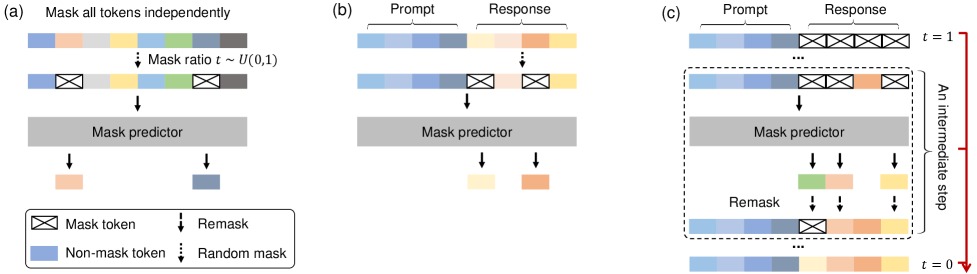
Method A forward process masks each token independently at ratio t~U[0,1], and a causal-mask-free Transformer mask predictor predicts all masked tokens simultaneously — vanilla MHA replaces GQA (the architecture is incompatible with KV caching anyway), with the FFN dimension trimmed to 12,288 to keep the total at 8.02B parameters. Training minimizes a 1/t-weighted cross-entropy over masked positions only — an upper bound on negative log-likelihood, estimated via Monte Carlo — through 2.3T-token pretraining (0.13M H800 GPU-hours) plus 4.5M-pair SFT in which prompts stay visible and only response tokens are masked. Decoding starts from a fully masked response and iterates predict-then-remask; the remasking should in principle be random, but a MaskGIT-style low-confidence rule instead remasks the s/t fraction of least-confident predictions (optionally block-wise, i.e., semi-autoregressive). It works like solving a crossword in pencil: fill every square each round, ink in the answers you trust, and erase the shaky ones to retry.
방법 Forward process가 각 token을 t~U[0,1] 비율로 독립적으로 masking하면, causal mask 없는 Transformer mask predictor가 masked token 전부를 동시에 예측한다 — KV caching과 비호환인 구조라 GQA 대신 vanilla MHA를 쓰고, FFN dimension을 12,288로 줄여 총 8.02B로 크기를 맞췄다. 학습은 masked 위치에만 걸리는 1/t-가중 cross-entropy(negative log-likelihood의 upper bound, Monte Carlo 추정)로 2.3T token pretraining(0.13M H800 GPU-hours)과 prompt는 남기고 response만 masking하는 4.5M pair SFT를 수행한다. 추론은 전부 masked된 response에서 시작해 예측→일부 remask를 반복하는데, 원칙상 random이어야 할 remask 대상을 MaskGIT식으로 confidence 최하위 s/t 비율로 고르는 low-confidence remasking(선택적으로 block 단위 semi-autoregressive)을 쓴다. 십자말풀이를 연필로 푸는 것과 같다 — 매 라운드 전 칸을 채워 보고, 확신 있는 칸만 잉크로 굳히고, 애매한 칸은 지워 다시 푼다.
Key idea The claim is that the generative-modeling principle — a likelihood bound over bidirectional masked prediction — rather than AR factorization itself delivers LLM capabilities. The authors ground scalability in the interplay of Transformers, model scale, data scale, and Fisher consistency, and the bidirectional any-order structure removes order-asymmetric failures like the reversal curse by construction. As a side effect, decoding becomes iterative refinement, making the sampling-step count a new quality–compute knob.
핵심 아이디어 LLM 능력의 원천은 AR factorization이 아니라 generative modeling 원리(양방향 masked prediction에 대한 likelihood bound)라는 것이 핵심 주장이다. 저자들은 scalability를 Transformer·모델 규모·데이터 규모와 Fisher consistency의 상호작용으로 설명하고, 어느 방향으로든 예측하는 bidirectional 구조 덕에 reversal curse 같은 순서-비대칭 실패가 구조적으로 사라진다고 본다. 부수 효과로 decoding이 iterative refinement가 되면서 sampling step 수가 새로운 quality–compute 조절축이 된다.
Validation Evaluated on 15 standard zero/few-shot benchmarks (MMLU, BBH, GSM8K, MATH, HumanEval, MBPP, CMMLU, C-Eval, etc.) against LLaMA3 8B and LLaMA2 7B re-evaluated under the same protocol. Scaling is tested against ARM baselines trained by the authors on the same data over 10^20–10^23 FLOPs on six tasks (MMLU, GSM8K, PIQA, MATH, HumanEval, MBPP), with pre-training compute as the single scaling metric. A Chinese poem forward/reversal completion probe against GPT-4o and Qwen2.5 separately targets the reversal curse.
검증 MMLU, BBH, GSM8K, MATH, HumanEval, MBPP, CMMLU, C-Eval 등 15개 표준 zero/few-shot 벤치마크에서 동일 프로토콜로 재평가한 LLaMA3 8B/LLaMA2 7B와 비교했다. Scaling은 동일 데이터로 자체 학습한 ARM baseline과 10^20–10^23 FLOPs 구간, 6개 task(MMLU, GSM8K, PIQA, MATH, HumanEval, MBPP)에서 pre-training compute를 단일 scaling 지표로 놓고 검증했다. 여기에 한시(poem) forward/reversal completion으로 GPT-4o·Qwen2.5 대비 reversal curse를 별도로 검증했다.
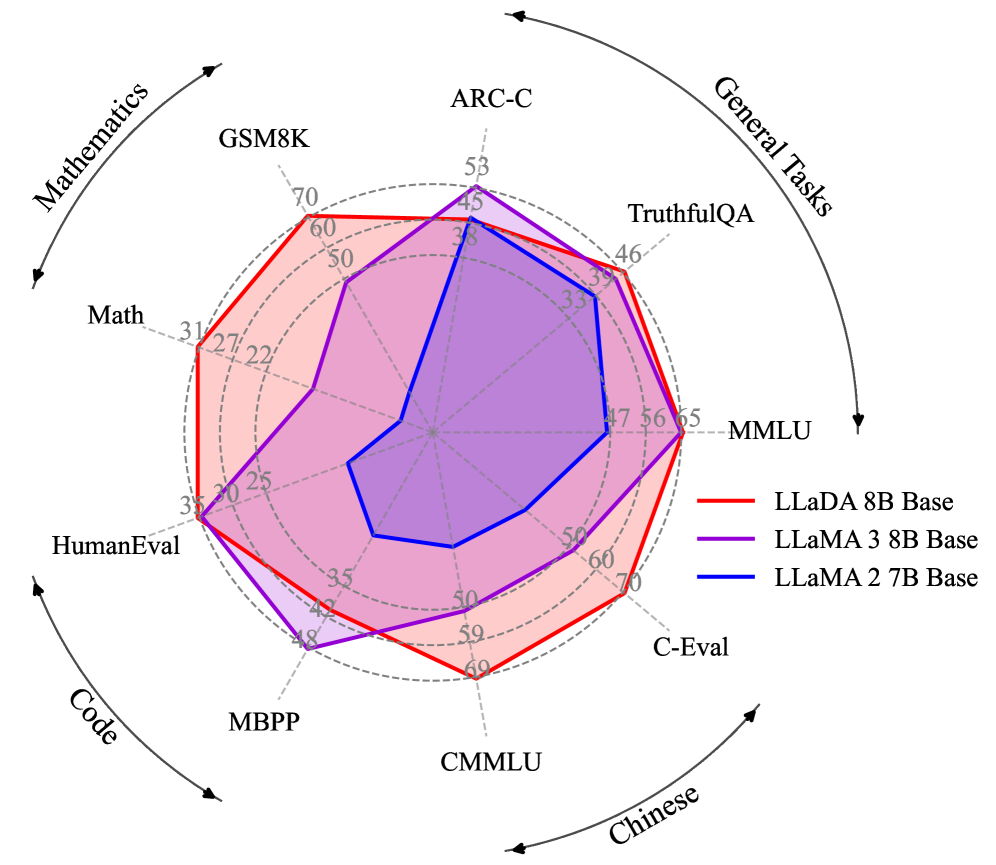
Results LLaDA 8B Base scores MMLU 65.9 (LLaMA3 8B: 65.4), GSM8K 70.3 (vs 48.7), MATH 31.4 (vs 16.0), and HumanEval 35.4 (vs 34.8), with large leads on Chinese suites — CMMLU 69.9 (vs 50.7) and C-Eval 70.5 (vs 51.7). The Instruct model beats GPT-4o on reversal poem completion at 45.6 vs 34.3, and the symmetry matters more than the win: GPT-4o collapses from 82.7 forward to 34.3 reversal while LLaDA stays nearly direction-invariant at 51.8→45.6. In the scaling study LLaDA tracks the ARM baselines up to 10^23 FLOPs with a highly competitive overall trend.
결과 LLaDA 8B Base는 MMLU 65.9(LLaMA3 8B 65.4), GSM8K 70.3(vs 48.7), MATH 31.4(vs 16.0), HumanEval 35.4(vs 34.8)를 기록했고, 중국어 CMMLU 69.9(vs 50.7)·C-Eval 70.5(vs 51.7)에서는 크게 앞섰다. Instruct 모델은 reversal poem completion에서 GPT-4o를 45.6 vs 34.3으로 앞섰는데, 승패보다 대칭성이 요점이다 — GPT-4o는 forward 82.7에서 reversal 34.3으로 붕괴하는 반면 LLaDA는 51.8→45.6으로 방향에 거의 무관하다. Scaling 실험에서도 10^23 FLOPs까지 ARM baseline과 대등한 전반적 추세를 보였다.
Comparison Against LLaMA3 8B, LLaMA2 7B (both re-evaluated in-house), Qwen2/2.5 7B, Mistral 7B, and Deepseek 7B it trails on suites like BBH (49.7 vs 62.1) and ARC-C (45.9 vs 53.1), yet leads on math and Chinese tasks despite training on only 2.3T tokens versus 15T for LLaMA3 (18T for Qwen2.5). The Instruct comparison is even more lopsided: LLaDA had SFT only while every comparator adds RL alignment, and the authors state their results trail LLaMA3 8B Instruct partly for this reason. The tables disclose training tokens and post-training regimes side by side, which makes the asymmetry transparent (reviewer judgment).
비교 LLaMA3 8B, LLaMA2 7B(둘 다 자체 재평가), Qwen2/2.5 7B, Mistral 7B, Deepseek 7B와 비교해 BBH(49.7 vs 62.1)·ARC-C(45.9 vs 53.1) 등 일부에서는 뒤지지만, 학습 token이 LLaMA3의 15T(Qwen2.5는 18T) 대비 2.3T뿐인데도 수학·중국어 task에서는 앞선다. Instruct 비교는 더 불리한 조건인데, LLaDA는 SFT만 거친 반면 비교 대상은 모두 SFT+RL alignment를 거쳤고, 저자들도 RL 미적용 탓에 LLaMA3 8B Instruct에 다소 뒤진다고 명시한다. 표에 훈련 token 수와 post-training 방식을 병기해 이 비대칭을 투명하게 드러낸 점은 평가할 만하다(리뷰어 판단).
Significance It is the first existence proof that a non-autoregressive, diffusion-trained LM is competitive at 8B scale, legitimizing the dLLM line of work (parallel decoding, any-order generation). Like the four-minute mile, the point is less the number than the proof of possibility — subsequent dLLM research all stands on this result. The disappearance of the reversal curse without any fine-tuning is rare causal evidence that the factorization choice shapes what a model can do, and since bidirectional attention breaks exact KV caching, the paper simultaneously opened a new inference-efficiency axis.
의의 Non-autoregressive diffusion 학습 LM이 8B 규모에서 경쟁력 있다는 최초의 존재 증명으로서 parallel decoding·any-order generation을 다루는 dLLM 연구 계열을 정당화했다. 4분 마일 기록처럼 수치 자체보다 "가능하다"는 사실이 판을 바꾼 경우다 — 이후 dLLM 연구는 전부 이 존재 증명 위에 서 있다. Fine-tuning 없이 reversal curse가 사라진 것은 factorization 선택이 능력의 형태까지 결정한다는 드문 인과적 증거이고, 동시에 bidirectional attention이 exact KV cache를 깨기 때문에 새로운 inference-efficiency 문제 축이 열렸다.
Limitations The paper states that inference lacks KV-cache-style system-level optimization and is compute-heavy, generation length is a user-set hyperparameter, no RL alignment was applied, no diffusion-specialized attention or position embeddings were designed, and the ARM-baseline scaling comparison stops below 10^23 FLOPs. The practical bottleneck is that vanilla decoding recomputes full bidirectional attention over the sequence at every step — like re-reading an entire document from the top after each single edit — leaving wall-clock far behind KV-cached AR decoding (reviewer judgment). The paper also notes that a few metrics such as MMLU declined after SFT, attributed only speculatively to SFT data quality.
한계 논문 스스로 추론에 KV cache류 system-level 최적화가 없어 연산 비용이 크고, generation length가 사용자 지정 hyperparameter이며, RL alignment 미적용, diffusion 특화 attention/position embedding 부재, ARM baseline과의 scaling 비교가 10^23 FLOPs 이하로 제한됨을 명시한다. 실질적 병목은 vanilla decoding이 매 step 전체 sequence에 대한 bidirectional attention을 재계산한다는 점이다 — 한 줄 고칠 때마다 문서 전체를 처음부터 다시 읽는 셈이라 wall-clock에서 KV-cached AR에 크게 불리하다(리뷰어 판단). SFT 후 MMLU 등 일부 지표가 오히려 하락한 점도 SFT 데이터 품질 문제로 추정만 하고 넘어간다.
Future work The paper names further scaling, RL-based alignment, multimodal extension, agent-system integration, O1-style post-training, and more efficient, controllable sampling algorithms as next steps. Of these, inference acceleration (caching, parallel decoding) was the frontier that filled fastest, becoming the direct starting point for Fast-dLLM-style follow-up work (reviewer judgment).
향후 과제 논문은 추가 scaling, RL 기반 alignment, multimodal 확장, agent 시스템 통합, O1류 post-training, 그리고 더 효율적이고 제어 가능한 sampling 알고리즘을 향후 과제로 제시한다. 이 중 추론 가속(caching·parallel decoding)이 가장 빠르게 채워진 전선으로, Fast-dLLM류 후속 연구의 직접적 출발점이 되었다(리뷰어 판단).
Released resources Code and the project page are released on GitHub, and LLaDA-8B Base/Instruct checkpoints are available on HuggingFace. The paper appendix includes pseudo-code algorithms for pretraining, SFT, sampling, and conditional likelihood evaluation, making the reproduction path explicit.
자원 공개 GitHub에 코드와 project page가, HuggingFace에 LLaDA-8B Base/Instruct checkpoint가 공개되어 있다. 논문 Appendix에 pretraining·SFT·sampling·conditional likelihood 평가의 pseudo-code 알고리즘이 수록되어 있어 재현 경로가 명확하다.
The research thread
Where this paper sits 연구의 흐름
LLaDA arrives at the end of a lineage that spent four years earning the right to scale. D3PM (Austin et al., 2021) first carried denoising diffusion into discrete state spaces; SEDD (Lou et al., 2024) made discrete diffusion competitive at GPT-2 scale; then MDLM (Sahoo et al., 2024) and RADD (Ou et al., 2024) distilled the masked, absorbing-state variant down to something almost embarrassingly simple — a 1/t-weighted cross-entropy on masked positions, provably an upper bound on negative log-likelihood. Nie et al. (2024), the same group behind this paper, then measured scaling laws for exactly that objective up to 10^20 FLOPs. Even the sampler has ancestry: low-confidence remasking is a rule imported from MaskGIT (Chang et al., 2022) in image generation. Every ingredient existed; nobody had yet paid to see whether the recipe survives contact with the standard LLM pipeline at 8B and 2.3T tokens.
The shift is a reattribution, not an invention. Before LLaDA, the field's question was "can diffusion LMs catch up to AR on perplexity?" — a race with autoregression as the finish line. LLaDA asks whether the finish line was ever AR-specific: it argues that scalability, in-context learning, and instruction following are products of the generative principle — a likelihood-grounded objective plus Transformers plus scale — and that left-to-right factorization was merely the recipe that got there first. The reversal-curse result is the sharpest edge of the argument, not as a benchmark win but as evidence that the very shape of a capability tracks the factorization — direction-invariance falls out of bidirectionality by construction, rather than being patched in with data.
What it opens is a two-sided frontier. On the capability side, the paper leaves post-training conspicuously unfinished — SFT only, no RL alignment, generation length as a user-fixed hyperparameter — and itself names scaling, multimodal extension, and O1-style post-training as next steps. On the systems side, the existence proof arrives with a bill attached: bidirectional attention admits no exact KV cache, so vanilla decoding re-attends over the whole sequence at every step. That cost structure, written into the paper's own limitations, is precisely the gap the Fast-dLLM line of follow-ups began filling within months.
The remaining tension is that the proof concerns capability per training FLOP, not answers per second. AR decoding carries a decade of systems investment, and diffusion's parallel-decoding promise collides with the fact that tokens revealed in the same step are conditionally independent. Commercial-scale demonstrations such as Mercury and Gemini Diffusion suggest the wall-clock argument can be turned around, and the field's next moves fork from here — samplers that spend fewer, better-placed steps, semi-autoregressive hybrids that negotiate block size against quality, and alignment recipes native to a bounded likelihood. The four-minute mile has been run; the open race is making it cheap.
LLaDA는 scale을 감당할 자격을 4년에 걸쳐 쌓아 온 계보의 끝에 서 있다. D3PM(Austin et al., 2021)이 denoising diffusion을 discrete state space로 처음 옮겼고, SEDD(Lou et al., 2024)가 GPT-2급에서 discrete diffusion을 경쟁권으로 끌어올렸으며, MDLM(Sahoo et al., 2024)과 RADD(Ou et al., 2024)는 masked(absorbing-state) 변형을 거의 민망할 만큼 단순한 형태 — negative log-likelihood의 upper bound임이 증명된, masked 위치에 대한 1/t-가중 cross-entropy — 로 증류했다. 이 논문과 같은 그룹의 Nie et al.(2024)은 바로 그 objective의 scaling law를 10^20 FLOPs까지 측정해 두었다. sampler에도 족보가 있다: low-confidence remasking은 image generation의 MaskGIT(Chang et al., 2022)에서 수입한 규칙이다. 재료는 전부 있었다. 없던 것은 이 레시피가 표준 LLM 파이프라인과 8B·2.3T token 규모에서 부딪혀도 살아남는지 확인할 비용을 치를 사람이었다.
이 논문의 전환은 발명이 아니라 재귀속(reattribution)이다. LLaDA 이전 field의 질문은 "diffusion LM이 perplexity에서 AR을 따라잡을 수 있나"였다 — autoregression을 결승선으로 놓은 경주. LLaDA는 그 결승선 자체가 AR 고유의 것이었냐고 질문을 바꾼다. scalability, in-context learning, instruction following은 generative principle — likelihood에 근거한 objective + Transformer + scale — 의 산물이고, left-to-right factorization은 거기 먼저 도달한 레시피였을 뿐이라는 주장이다. reversal curse 결과가 이 논증의 가장 날카로운 날인데, benchmark 승리여서가 아니라 능력의 '형태'가 factorization을 따라 바뀐다는 증거이기 때문이다 — 방향 불변성은 데이터로 때운 것이 아니라 bidirectionality에서 구조적으로 따라 나온다.
열리는 전선은 양면이다. capability 쪽에서 논문은 post-training을 눈에 띄게 미완으로 남겼다 — SFT뿐, RL alignment 없음, generation length는 사용자가 고정하는 hyperparameter — 그리고 scaling, multimodal 확장, O1류 post-training을 다음 단계로 직접 지목한다. systems 쪽에서는 존재 증명에 청구서가 따라온다: bidirectional attention은 exact KV cache를 허용하지 않아 vanilla decoding이 매 step 전체 sequence를 다시 attend한다. 논문 스스로 limitations에 적어 둔 이 비용 구조가 바로 Fast-dLLM 계열 후속들이 몇 달 만에 메우기 시작한 틈이다.
남은 긴장은, 이 증명이 training FLOP당 capability에 대한 것이지 초당 답변 수에 대한 것이 아니라는 점이다. AR decoding에는 십 년치 systems 투자가 쌓여 있고, diffusion의 parallel decoding 약속은 같은 step에 공개되는 token들이 조건부 독립이라는 사실과 충돌한다. Mercury나 Gemini Diffusion 같은 상용 규모 시연은 wall-clock 논쟁이 뒤집힐 수 있음을 시사하며, field의 다음 수도 여기서 갈라진다 — 더 적고 더 잘 배치된 step을 쓰는 sampler, block 크기와 품질을 흥정하는 semi-autoregressive hybrid, bounded likelihood에 native한 alignment 레시피. 4분 마일은 이미 달렸다. 남은 경주는 그것을 싸게 만드는 일이다.
Sparks — where one could take this 아이디어의 씨앗
-
One could try making generation length a learned quantity — a model that predicts or expands its own response budget during denoising — instead of the user-fixed hyperparameter the paper flags as a limitation. 논문이 한계로 명시한 user-fixed generation length를, denoising 도중 모델이 스스로 response 길이를 예측하거나 늘려 가는 learned quantity로 바꾸는 시도를 해볼 수 있다.
-
One could try porting preference-based alignment (RLHF- or DPO-style) onto masked diffusion, where only a likelihood bound is available, and test whether bound-derived weights make usable reward signals. likelihood가 bound로만 주어지는 masked diffusion 위에 RLHF·DPO류 preference alignment를 이식해, bound에서 유도한 가중치가 쓸 만한 reward 신호가 되는지 검증해볼 수 있다.
-
One could try extending the compute-matched AR-versus-diffusion scaling comparison past the paper's 10^23-FLOPs cutoff — especially under data repetition — to locate where, or whether, the two curves cross. 논문이 10^23 FLOPs에서 멈춘 compute-matched AR 대 diffusion scaling 비교를 — 특히 data repetition 조건에서 — 그 너머로 연장해 두 곡선이 어디서, 혹은 정말로 교차하는지 확인해볼 수 있다.
Seeds grounded in the paper's own stated limitations and open questions. 논문이 스스로 밝힌 limitations와 open questions에 뿌리를 둔 씨앗입니다.
Notes
Notes
LLaDA is the reference starting point of the diffusion-LLM literature: most subsequent dLLM work — parallel and block-wise decoding, approximate caching, step reduction — is defined relative to its masked-diffusion formulation and its inference cost profile. Its most consequential engineering property is what it removes: bidirectional attention admits no exact KV cache, so every demasking step re-attends over the whole sequence, which is precisely the gap that Fast-dLLM-style acceleration targets. It is also a clean evidence point in the AR-versus-diffusion debate, since capabilities tracked the likelihood-bound objective plus data and compute scale rather than the factorization order. dLLM 가속 연구의 사실상 공통 baseline이며, sampling step 수라는 quality–compute 축이 여기서 처음 실전 규모로 등장했다.
Linked reviews
Fast-dLLM: Training-Free Acceleration of Diffusion LLMs via KV Cache and Parallel Decoding
A block-wise approximate KV cache plus confidence-thresholded parallel decoding accelerates open diffusion LLMs by up to 27.6x end-to-end with 1-2 point accuracy loss, entirely training-free.
diffusion-llmAdaLook: Adaptive Multi-Step Lookahead Decoding for Diffusion Language Models
AdaLook makes diffusion-LM lookahead decoding adaptive-depth instead of fixed-depth — a variance-gated continue/stop rule plus branch expansion from informative intermediate states — Pareto-dominating one-step lookahead and confidence-only decoding on the accuracy/decoding-steps trade-off across MMLU, GSM8K, MATH500 and BBH.
diffusion-llmCARVE: Counterfactual-Aware Reveal with Verified Expansion for Diffusion Language Models
CARVE lets a masked diffusion language model grow its answer canvas mid-generation, accepting the extra space only when a counterfactual stability check confirms the insertion will not disturb the model's existing predictions.
dllmConstrained Decoding for Diffusion Language Models via Efficient Inference over Finite Automata
An exact algorithm samples from the constraint-satisfying mean-field posterior of a diffusion language model for any constraint expressible as a finite automaton, fixing a correctness gap left open by autoregressive-style token masking and lifting Dream-7B's BFCL-Live function-calling accuracy under stochastic sampling from 22.3% to 69.0% with under 5% overhead.
dllmFlowBlock: Wavefront-Parallel Decoding for Self-Correcting Diffusion Language Models
FlowBlock is a training-free decoding framework for block-diffusion language models that turns each block's self-correction ability into scheduling slack, letting adjacent blocks decode in an overlapping wavefront instead of strictly one-after-another, for up to 4.01x higher throughput and a small accuracy gain over serial LLaDA-2.x decoding.
dllmLaCache: Exact Caching and Precision-Adaptive Inference for Diffusion Large Language Models
LaCache is a training-free acceleration framework for diffusion LLMs that eliminates redundant denoising-step computation via exact intermediate-result caching and adds per-group FP8 quantization to FFN layers, reaching 1.3x speedup alone and up to 40.2x when stacked with existing acceleration methods.
diffusion-llmMulti-Mask Diffusion Language Models for Few-Step Generation
MultiMDM fixes a structural obstacle to few-step generation in masked diffusion language models -- all forward trajectories collapsing to the same single fully-masked state, leaving no terminal entropy for consistency distillation -- by replacing the single mask token with a designated set of masks per clean token, preserving masking structure while restoring terminal diversity.
dllmNemotron-Labs-Diffusion: A Tri-Mode Language Model Unifying Autoregressive, Diffusion, and Self-Speculation Decoding
A single NVIDIA model switches between autoregressive, block-wise diffusion, and self-speculative decoding from one set of weights, with self-speculation (diffusion drafts, the same model's AR pass verifies) beating multi-token prediction and the 8B model decoding 6x more tokens per forward than Qwen3-8B at comparable accuracy.
diffusionSeeing the End at Step Zero: Accelerating Diffusion MLLMs via MLP Sparsity-Aware Truncation
Seer exploits a sharp MLP activation-sparsity jump at diffusion step zero to predict a diffusion multimodal LLM's true output length before generation, then permanently truncates the redundant end-of-text padding and routes batches through a hybrid static/variable-length execution scheme, reaching up to 31x throughput gains across nine vision-language benchmarks without hurting accuracy.
dllmSet Diffusion: Interpolating Token Orderings Between Autoregression and Diffusion for Fast and Flexible Decoding
A new diffusion language model class factorizes generation over flexible token sets instead of fixed blocks, using a set-causal architecture that supports exact KV cache updates after every step and arbitrary-order decoding.
diffusion-llmServing Masked Diffusion LLMs: Characterization and Design Principles from Real Hardware
The first real-hardware characterization of masked-diffusion LLM serving finds that denoising-step difficulty clusters into 11 discrete, unpredictable levels, that CPU dispatch (not GPU compute) is the dominant per-request cost, and derives a batch-timeout rule from measured queueing behavior.
diffusion-llmSurvival-Guided Length Control for Efficient Diffusion Language Models
Recasts how long a diffusion language model should generate as a discrete-time survival problem over the end-of-sequence token, yielding a training-free plug-in that speeds up decoding 3-7x with no accuracy loss.