Paper Review
Conditional Total Correlation and the Serial Depth of Adaptive Parallel Sampling
Proves an exact information-theoretic identity showing that a parallel-decoding policy approximation error equals the conditional total correlation it discards each round, then uses it to show the confidence-based heuristics deployed in real masked diffusion language models are information-theoretically worse than decoding in random order.
병렬 디코딩 정책의 근사 오차가 매 라운드마다 버리는 조건부 총상관량(conditional total correlation)과 정확히 같다는 정보이론적 항등식을 증명하고, 이를 이용해 실제 마스크 확산 언어모델이 배포한 신뢰도 기반 휴리스틱이 무작위 순서로 디코딩하는 것보다 정보이론적으로 더 나쁘다는 것을 보인다.
Background Masked diffusion language models (MDLMs) generate text by revealing masked positions over multiple rounds, choosing in each round which positions to fill based on model confidence in its own predictions -- a design that trades sequential (autoregressive) generation for parallelism, at the cost of some accuracy because tokens revealed in the same round are sampled independently even though the true distribution treats them as dependent.
배경 마스크 확산 언어모델(MDLM)은 여러 라운드에 걸쳐 마스크된 위치를 드러내며 텍스트를 생성하는데, 각 라운드에서 어느 위치를 채울지는 모델 자신의 예측에 대한 신뢰도를 기준으로 정한다 -- 이는 순차적(자기회귀) 생성을 병렬성과 맞바꾸는 설계이며, 같은 라운드에서 드러난 토큰들이 실제 분포에서는 서로 의존적임에도 독립적으로 샘플링되기 때문에 일부 정확도를 대가로 치른다.
Problem No existing theory pinned down the minimum number of rounds a value-adaptive policy needs to hit a given accuracy target for a fixed, known target distribution -- prior analyses either fixed the reveal schedule in advance (not adapting to what has already been generated) or bounded round complexity using entropy or negative log-likelihood, quantities this paper shows are fundamentally insufficient: two distributions with identical entropy can require a different number of rounds.
문제 기존 이론 중 어느 것도 고정된, 알려진 목표 분포에 대해 값 적응적(value-adaptive) 정책이 주어진 정확도 목표를 달성하는 데 필요한 최소 라운드 수를 정확히 짚어내지 못했다 -- 기존 분석들은 리빌 스케줄을 사전에 고정하거나(이미 생성된 것에 적응하지 않음), 엔트로피나 음의 로그우도로 라운드 복잡도를 경계 지었는데, 이 논문은 이 값들이 근본적으로 불충분함을 보인다: 엔트로피가 동일한 두 분포도 필요한 라운드 수가 다를 수 있다.
Prior limitations Entropy- and likelihood-based round bounds are properties of a specific decoder class (e.g. confidence-thresholded decoders), not of the target distribution itself -- a distribution can have high entropy yet fully independent coordinates that need only one round, so no entropy-based argument can certify how many rounds a general adaptive policy truly needs.
기존 한계 엔트로피, 우도 기반 라운드 경계는 목표 분포 자체가 아니라 특정 디코더 클래스(예: 신뢰도 임계값 디코더)의 성질이다 -- 어떤 분포는 엔트로피가 높으면서도 좌표들이 완전히 독립적이어서 단 한 라운드만 필요할 수 있으므로, 엔트로피 기반 논증만으로는 일반 적응 정책이 실제로 몇 라운드를 필요로 하는지 확정할 수 없다.
Goal The goal is to find the exact quantity that governs how many rounds of independent-within-round sampling are unavoidable for a given distribution and error budget, and to check what it implies for the confidence-based decoding rules real masked diffusion models actually deploy.
목표 목표는 주어진 분포와 오차 예산에 대해 라운드 내 독립 샘플링이 몇 라운드까지 불가피한지를 지배하는 정확한 양을 찾아내고, 이것이 실제 마스크 확산 모델이 배포하는 신뢰도 기반 디코딩 규칙에 무엇을 함의하는지 확인하는 것이다.
Method The authors define serial depth as the minimum expected number of reveal rounds needed to meet a KL-divergence accuracy target, then prove that this error exactly equals the expected conditional total correlation -- a classical multivariate-dependence quantity -- accumulated over the policy reveal rounds. They then derive round-complexity bounds for several distribution families (Markov chains, random walks, random permutations, structured binary strings) and separately measure realized costs on a small masked diffusion model (Qwen2.5-0.5B) converted to an MDLM and run on real WikiText text.
방법 저자들은 시리얼 깊이(serial depth)를 KL 발산 정확도 목표를 만족하는 데 필요한 최소 기대 리빌 라운드 수로 정의한 뒤, 이 오차가 정확히 정책의 리빌 라운드에 걸쳐 누적된 조건부 총상관량(conditional total correlation, 고전적인 다변량 의존성 지표) 값과 같음을 증명한다. 이어서 여러 분포 계열(마르코프 연쇄, 랜덤 워크, 랜덤 순열, 구조화된 이진 문자열)에 대한 라운드 복잡도 경계를 유도하고, 별도로 작은 마스크 확산 모델(Qwen2.5-0.5B를 MDLM으로 변환)을 실제 WikiText 텍스트에서 구동해 실측 비용을 측정한다.
Key idea The key idea is that total correlation -- not entropy, not likelihood -- is the exact currency of parallel-decoding cost: every bit of dependence a policy discards by sampling several positions independently in one round shows up, without approximation, as forward-KL error. This reframes the vague intuition of why parallel decoding loses accuracy into an exact accounting identity, the way a strict energy-conservation law lets a system behavior be predicted rather than only observed empirically.
핵심 아이디어 핵심 아이디어는 병렬 디코딩 비용의 정확한 통화가 엔트로피도 우도도 아닌 총상관량이라는 것이다: 정책이 한 라운드에서 여러 위치를 독립적으로 샘플링함으로써 버리는 의존성의 매 비트는 근사 없이 정확히 forward-KL 오차로 나타난다. 이는 왜 병렬 디코딩이 정확도를 잃는가라는 막연한 직관을 정확한 회계 항등식으로 바꾸는데, 엄밀한 에너지 보존 법칙이 시스템의 거동을 경험적으로 관찰하는 대신 예측할 수 있게 해주는 것과 비슷하다.
Validation Beyond the exact theorems (proved for idealized distributions with known conditionals), the authors run a controlled empirical study on 542 real texts (WikiText plus model-generated code/math/prose/structured-data samples), comparing left-to-right, random, hierarchical-bisection, and greedy-confidence reveal schedules, and then measuring the schedules actually deployed by masked diffusion decoders (confidence top-k, global/block thresholding) under the identical protocol.
검증 이상화된 분포에 대해 증명된 정확한 정리들 외에도, 저자들은 542개의 실제 텍스트(WikiText와 모델 생성 코드, 수학, 산문, 구조화 데이터 샘플)에 대한 통제된 실증 연구를 수행하여 좌에서 우로, 무작위, 계층적 이분법, 탐욕적 신뢰도 순서의 리빌 스케줄을 비교한 다음, 마스크 확산 디코더가 실제로 배포하는 규칙들(신뢰도 top-k, 전역/블록 임계값)을 동일한 프로토콜 하에서 측정한다.
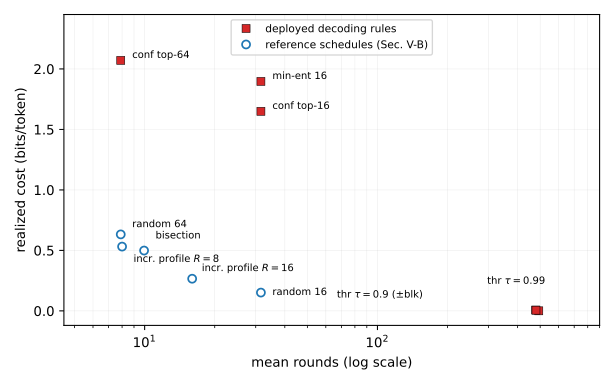
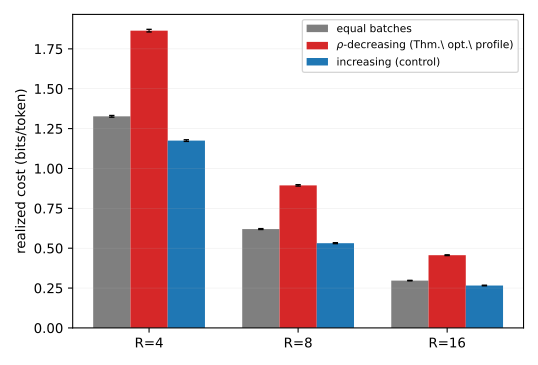
Results Left-to-right block decoding -- the standard semi-autoregressive mode most deployed dLLMs use -- is the worst reveal order, costing 2.7-29x more than random order at matched round budgets. Greedy minimum-confidence selection, the exact heuristic underlying standard MDLM decoders, costs 1.4-13x more than simple random-order reveals at equal parallelism, losing on every one of the 542 tested texts for the top-16 comparison. Threshold decoders achieve near-zero measured error only by secretly near-fully serializing -- at a 0.99 confidence threshold, on average only about one position clears the bar per round.
결과 배포된 dLLM 대부분이 사용하는 표준 준-자기회귀 모드인 좌-우 블록 디코딩이 동일 라운드 예산에서 무작위 순서보다 2.7~29배 더 비싼, 가장 나쁜 리빌 순서임이 밝혀졌다. 표준 MDLM 디코더의 근간이 되는 정확히 그 휴리스틱인 탐욕적 최소 신뢰도 선택은 동일한 병렬성에서 단순 무작위 순서 리빌보다 1.4~13배 더 비싸며, top-16 비교에서는 테스트된 542개 텍스트 전부에서 패배한다. 임계값 디코더는 사실상 거의 완전히 순차화함으로써만 근제로 오차를 달성한다 -- 신뢰도 임계값 0.99에서는 라운드당 평균 약 한 개의 위치만 기준을 통과한다.
Comparison Against generic reference schedules at matched round counts, the deployed confidence-based rules are 3.9-11x more information-theoretically costly than a simple random-order or hierarchical schedule -- the diagnostic in this paper directly separates the information cost of parallelism (measured here) from the wall-clock speedups threshold decoders report elsewhere, which the authors attribute to caching and self-generation confidence dynamics rather than to genuinely resolving more dependence per round.
비교 동일 라운드 수의 일반 참조 스케줄 대비, 배포된 신뢰도 기반 규칙들은 정보이론적으로 3.9~11배 더 비싸다 -- 이 논문의 진단은 여기서 측정한 병렬성의 정보 비용을, 다른 곳에서 보고되는 임계값 디코더의 실시간(wall-clock) 속도 향상과 명확히 분리한다. 저자들은 후자를 라운드당 더 많은 의존성을 실제로 해소해서가 아니라 캐싱과 자기생성 신뢰도 동역학 때문이라고 본다.
Significance For anyone building or evaluating masked-diffusion decoding schedules, this gives a decoder-independent diagnostic -- conditional total correlation, or its practically measurable pseudo-cost proxy -- that can audit a proposed decoding rule before deployment, rather than only benchmarking wall-clock speed after the fact; it also gives a principled explanation for why the field default confidence-ordering heuristic is a specifically costly choice, not just an empirically imperfect one.
의의 마스크 확산 디코딩 스케줄을 설계하거나 평가하는 사람에게, 이 논문은 배포 후 실시간 속도만 벤치마킹하는 대신 배포 전에 제안된 디코딩 규칙을 감사할 수 있는 디코더 독립적 진단 도구(조건부 총상관량, 또는 그 실용적으로 측정 가능한 의사비용 대리지표)를 제공한다. 또한 이 분야의 기본값인 신뢰도 순서 휴리스틱이 그저 경험적으로 불완전한 선택이 아니라 특히 비용이 큰 선택임을 원리적으로 설명해준다.
Limitations The theorems apply to an idealized exact conditional-marginal oracle; the empirical measurements on a real MDLM are honestly flagged as order-dependent pseudo-costs rather than the total correlation of one coherent joint distribution, since a learned model conditionals need not be globally consistent. The empirical study also uses a single, small (0.5B-parameter) model and a single sampling temperature, which the authors explicitly call diagnostic rather than a universal benchmark.
한계 정리들은 이상화된 정확한 조건부 주변확률 오라클에 적용된다. 실제 MDLM에 대한 실증 측정치는 학습된 모델의 조건부 확률이 전역적으로 일관될 필요가 없기 때문에, 하나의 정합적인 결합분포의 총상관량이 아니라 순서 의존적인 의사비용(pseudo-cost)이라고 정직하게 명시된다. 실증 연구도 단일하고 작은(0.5B 파라미터) 모델과 단일 샘플링 온도만 사용했으며, 저자들은 이를 명시적으로 범용 벤치마크가 아닌 진단적 성격이라고 밝힌다.
Future work The paper leaves as an explicit open theoretical question whether binary-alphabet serial depth can exceed the square-root exponent established here, up to the linear depth achieved by uniform random permutations.
향후 과제 논문은 이진 알파벳에서의 시리얼 깊이가 저자들이 확립한 제곱근 지수를 넘어, 균등 무작위 순열이 달성하는 선형 깊이까지 도달할 수 있는지를 명시적인 열린 이론적 질문으로 남긴다.
Released resources No public code release verified.
자원 공개 공개된 코드 배포는 확인되지 않았다.
The research thread
Where this paper sits 연구의 흐름
First paragraph -- lineage. Parallel decoding for masked diffusion language models has mostly been analyzed empirically -- confidence thresholds, entropy budgets, and various which-positions-to-reveal-next heuristics compared by measured accuracy and speed, with round-complexity theory (when it exists) typically bounding specific decoder classes via entropy or negative log-likelihood. This site has tracked the practical side of that line through reviews like [[flowblock]] (wavefront-parallel decoding schedules) and [[adalook]] (adaptive multi-step lookahead), both of which propose new decoding schedules without a distribution-level theory of what the irreducible cost of parallelism actually is.
Second paragraph -- the shift. This paper supplies exactly that missing piece -- an exact identity, not a heuristic or a bound, connecting a parallel-decoding policy approximation error to a single classical information-theoretic quantity (conditional total correlation). That reframes the question from which heuristic decodes fastest in practice to how much resolvable dependence a fixed target distribution actually contains, and whether a given decoding order throws that dependence away for free or is forced to pay for it. Applied back to real masked-diffusion decoders, the identity delivers an uncomfortable empirical verdict: the field default choice, confidence-ordered revealing, is close to the worst possible ordering by this exact measure, not merely a decent-but-imperfect one.
Third paragraph -- what it opens. The clearest open thread is bridging the gap between this idealized-oracle theory and a real model own, possibly incoherent, learned conditionals -- the authors already flag their empirical numbers as pseudo-costs rather than true total correlations for exactly this reason. If that gap can be closed (for example by relating pseudo-cost to a model calibration quality), conditional total correlation could become a practical, decoder-agnostic diagnostic to check before deploying any new masked-diffusion decoding schedule, rather than only after benchmarking its wall-clock speed.
첫 문단 -- lineage. 마스크 확산 언어모델의 병렬 디코딩은 대체로 경험적으로 분석되어 왔다 -- 신뢰도 임계값, 엔트로피 예산, 다음에 어느 위치를 드러낼 것인가에 대한 다양한 휴리스틱들이 측정된 정확도와 속도로 비교되었고, 라운드 복잡도 이론이 존재하는 경우에도 대개 엔트로피나 음의 로그우도로 특정 디코더 클래스를 경계 짓는 데 그쳤다. 이 사이트는 이 흐름의 실용적인 측면을 [[flowblock]](웨이브프론트 병렬 디코딩 스케줄), [[adalook]](적응형 다단계 lookahead 디코딩) 같은 리뷰로 추적해왔는데, 둘 다 병렬성의 환원 불가능한 비용이 실제로 무엇인지에 대한 분포 수준 이론 없이 새로운 디코딩 스케줄을 제안한다.
둘째 문단 -- the shift. 이 논문은 정확히 그 빠진 조각을 제공한다 -- 휴리스틱이나 경계가 아니라, 병렬 디코딩 정책의 근사 오차를 하나의 고전적 정보이론 지표(조건부 총상관량)에 정확히 연결하는 항등식이다. 이는 질문을 어느 휴리스틱이 실전에서 가장 빨리 디코딩하는가에서, 고정된 목표 분포가 실제로 얼마나 많은 해소 가능한 의존성을 담고 있으며 주어진 디코딩 순서가 그것을 공짜로 버리고 있는가 아니면 어쩔 수 없이 비용을 치르고 있는가로 재구성한다. 실제 마스크 확산 디코더에 적용하면 이 항등식은 불편한 실증적 판정을 내린다: 이 분야의 기본 선택인 신뢰도 순서 리빌은 이 정확한 척도로 볼 때 최악에 가까운 순서이지, 그저 괜찮지만 불완전한 선택이 아니다.
셋째 문단 -- what it opens. 가장 뚜렷하게 열려 있는 흐름은 이 이상화된 오라클 이론과 실제 모델 자신의, 전역적으로 일관되지 않을 수 있는 학습된 조건부 확률 사이의 간극을 메우는 것이다 -- 저자들도 바로 이 이유로 자신들의 실증 수치를 진정한 총상관량이 아니라 의사비용이라고 이미 표시해두었다. 만약 이 간극을(예컨대 의사비용을 모델의 보정(calibration) 품질과 연결하는 방식으로) 메울 수 있다면, 조건부 총상관량은 새로운 마스크 확산 디코딩 스케줄을 배포한 뒤 실시간 속도를 벤치마킹하는 것뿐 아니라 배포하기 전에 점검할 수 있는 실용적이고 디코더에 무관한 진단 도구가 될 수 있다.
Sparks — where one could take this 아이디어의 씨앗
-
The paper proves binary-alphabet serial depth up to a square-root exponent (via one-hot blocks) but explicitly leaves open whether some binary distribution can push all the way to the linear depth achieved by random permutations -- closing that gap would complete the picture of exactly how deep parallel decoding can get forced, even in the simplest possible alphabet. 이 논문은(원-핫 블록을 통해) 이진 알파벳에서 제곱근 지수까지의 시리얼 깊이를 증명하지만, 어떤 이진 분포가 랜덤 순열이 달성하는 선형 깊이까지 도달할 수 있는지는 명시적으로 열어둔다 -- 이 간극을 메운다면 가장 단순한 알파벳에서조차 병렬 디코딩이 얼마나 깊어질 수 있는지에 대한 그림이 완성될 것이다.
-
Because the authors flag their real-model measurements as order-dependent pseudo-costs rather than true total correlations (a learned MDLM conditionals need not be globally coherent), a natural next question is whether that gap correlates with a model calibration quality -- which would turn pseudo-cost into a deployable, pre-deployment diagnostic rather than only a post-hoc measurement. 저자들은 실제 모델에 대한 측정치를 진정한 총상관량이 아니라 순서 의존적인 의사비용이라고 표시하는데(학습된 MDLM의 조건부 확률은 전역적으로 일관될 필요가 없으므로), 자연스러운 다음 질문은 이 간극이 모델의 보정(calibration) 품질과 상관관계가 있는지이다 -- 그렇다면 의사비용은 사후 측정값이 아니라 배포 전에 쓸 수 있는 실용적 진단 도구가 될 수 있다.
Seeds grounded in the paper's own stated limitations and open questions. 논문이 스스로 밝힌 limitations와 open questions에 뿌리를 둔 씨앗입니다.
Notes
Notes
Linked reviews
FlowBlock: Wavefront-Parallel Decoding for Self-Correcting Diffusion Language Models
FlowBlock is a training-free decoding framework for block-diffusion language models that turns each block's self-correction ability into scheduling slack, letting adjacent blocks decode in an overlapping wavefront instead of strictly one-after-another, for up to 4.01x higher throughput and a small accuracy gain over serial LLaDA-2.x decoding.
diffusion-llmAdaLook: Adaptive Multi-Step Lookahead Decoding for Diffusion Language Models
AdaLook makes diffusion-LM lookahead decoding adaptive-depth instead of fixed-depth — a variance-gated continue/stop rule plus branch expansion from informative intermediate states — Pareto-dominating one-step lookahead and confidence-only decoding on the accuracy/decoding-steps trade-off across MMLU, GSM8K, MATH500 and BBH.
dllmSet Diffusion: Interpolating Token Orderings Between Autoregression and Diffusion for Fast and Flexible Decoding
A new diffusion language model class factorizes generation over flexible token sets instead of fixed blocks, using a set-causal architecture that supports exact KV cache updates after every step and arbitrary-order decoding.