Paper Review
FlowBlock: Wavefront-Parallel Decoding for Self-Correcting Diffusion Language Models
FlowBlock is a training-free decoding framework for block-diffusion language models that turns each block's self-correction ability into scheduling slack, letting adjacent blocks decode in an overlapping wavefront instead of strictly one-after-another, for up to 4.01x higher throughput and a small accuracy gain over serial LLaDA-2.x decoding.
FlowBlock은 블록-확산 언어모델의 자기수정(self-correction) 능력을 스케줄링 여유로 전환하는 학습-불필요 디코딩 프레임워크로, 인접 블록을 완전 순차 대신 겹치는 웨이브프론트로 디코딩해 순차 LLaDA-2.x 대비 최대 4.01배 처리량과 소폭의 정확도 향상을 동시에 얻는다.
Background Block-diffusion large language models (dLLMs such as LLaDA-2.x) split a sequence into fixed-length blocks and denoise block by block, but the premise that a block must be fully finalized before the next block can reuse its KV cache makes inter-block decoding strictly serial. That serialism eats into the very parallelism that is supposed to make dLLMs fast at serving time.
배경 블록-확산 대형언어모델(block-diffusion dLLM, 예: LLaDA-2.x)은 시퀀스를 고정 길이 블록으로 나눠 블록 단위로 디노이징하는데, 한 블록이 완전히 확정(finalize)되어야 다음 블록이 그 KV 캐시를 재사용할 수 있다는 전제 때문에 블록 간 디코딩이 철저히 순차적이다. 이 순차성은 병렬 디코딩이라는 dLLM의 원래 강점을 서빙 단계에서 갉아먹는 병목이다.
Problem Prior attempts to unlock inter-block parallelism typically required post-training and still bought only modest speedups, often at an accuracy cost. The real question is whether "a block must be fully finalized before the next one can proceed" is too strong a requirement in the first place.
문제 블록 간 병렬성을 여는 기존 시도들은 대개 후속학습(post-training)을 요구했고, 그마저도 속도 향상은 제한적이었으며 종종 정확도를 깎아먹었다. 문제는 "한 블록이 다음 블록을 위해 반드시 완전히 확정되어야 한다"는 전제 자체가 지나치게 강한 요구인지 여부다.
Prior limitations Earlier approaches either retrained the block ordering itself or parallelized only approximately, never escaping the accuracy-speed trade-off. This paper's comparison baseline, D2F, is a training-based inter-block-parallel method that FlowBlock beats on both accuracy and batched serving throughput (up to a 16x throughput gap).
기존 한계 이전 접근들은 블록 순서 자체를 재학습하거나 근사적으로만 병렬화해, 정확도-속도 트레이드오프에서 벗어나지 못했다. 이 논문이 비교 대상으로 삼는 D2F는 학습 기반 블록-간-병렬 베이스라인으로, FlowBlock 대비 정확도와 배치 서빙 처리량 모두에서 뒤진다(최대 16배 처리량 격차).
Goal Without any additional training, turn block finality from a hard dependency into a scheduling resource by requiring only an "informative draft" of the next block, not a finalized prediction.
목표 추가 학습 없이, "다음 블록은 확정된 예측 블록이 아니라 정보량이 충분한 초안(draft)만 있으면 된다"는 발상으로 블록 확정을 하드 의존성에서 스케줄링 자원으로 바꾸는 것이 목표다.
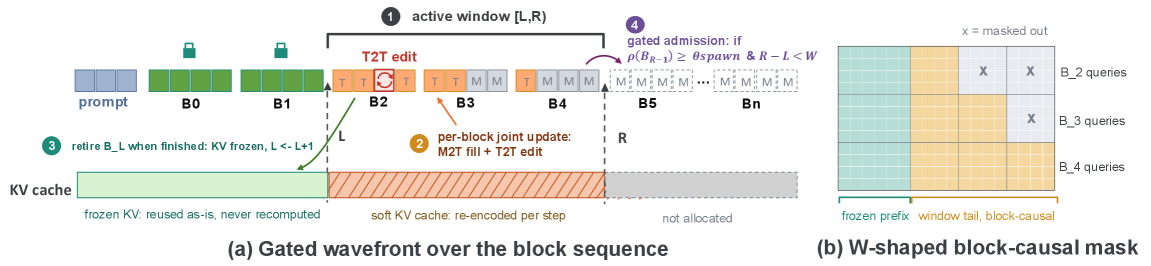
Method The key observation is that self-correcting dLLMs can repair tokens drafted against a slightly stale upstream context via token-to-token (T2T) editing. Gated Wavefront Decoding admits blocks into a bounded wavefront only when a readiness gate fires, jointly refines the active blocks via T2T editing, and commits them in order under a windowed block-causal mask that preserves exact frozen-prefix KV reuse. Heterogeneous Wavefront Packing batches each request's independently-progressing wavefront into dense, shape-stable forward passes. It resembles an assembly line where the next worker starts on a partial handoff before the previous one is fully done, while corrections keep happening a few steps behind.
방법 핵심 관찰은 self-correcting dLLM의 token-to-token(T2T) 편집이 약간 낡은(stale) 상류 컨텍스트로 만들어진 토큰도 나중에 고쳐 쓸 수 있다는 것이다. Gated Wavefront Decoding은 준비도 게이트가 열릴 때만 블록을 경계 있는 웨이브프론트에 진입시키고, T2T 편집으로 활성 블록들을 함께 다듬으며, 정확히 동일한 frozen-prefix KV 재사용을 보존하는 윈도우형 block-causal 마스크 아래 순서대로 커밋한다. Heterogeneous Wavefront Packing은 요청마다 독립적으로 진행하는 웨이브프론트를 조밀하고 형태가 고정된 배치 forward로 함께 묶는다. 마치 조립 라인에서 다음 작업자가 앞선 작업이 완전히 끝나기 전에 부분 결과물을 받아 작업을 시작하되, 문제가 있으면 뒤에서 계속 다듬어 가는 것과 비슷하다.
Key idea The core move is turning the hard rule "a block must be finalized" into a soft one — instead of demanding finality, it demands only a sufficiently informative draft, and lets self-correction fill in the rest downstream. It is like an editor who starts working from a colleague's unfinished draft; if the colleague fixes a typo later, the work already in progress doesn't need to be thrown out.
핵심 아이디어 "블록 확정"이라는 하드 규칙을 소프트 규칙으로 바꾼 것이 핵심이다 — 확정을 요구하는 대신 "충분히 정보가 담긴 초안"만 요구하고, 나머지는 self-correction이 뒤에서 메운다. 편집자가 동료의 완성되지 않은 초고를 미리 받아 작업을 시작하고, 동료가 나중에 오탈자를 고쳐도 이미 진행된 작업이 크게 어긋나지 않는 상황과 비슷하다.
Validation Evaluated across eight math and code benchmarks (including GSM8K) against serial LLaDA-2.0/2.1 baselines and D2F (a training-based inter-block-parallel baseline), measuring throughput, latency, and accuracy. Also includes a throughput-latency sweep across batch sizes and a sensitivity analysis over the readiness-gate threshold and window width.
검증 수학 4개, 코드 4개, 총 8개 벤치마크(GSM8K 포함)에서 LLaDA-2.0/2.1 순차 베이스라인 및 D2F(학습 기반 블록-간-병렬 베이스라인) 대비 처리량·지연시간·정확도를 측정한다. 배치 크기에 따른 서빙 처리량-지연시간 스윕과, 준비도 게이트 임계값·윈도우 폭에 대한 민감도 분석도 포함한다.
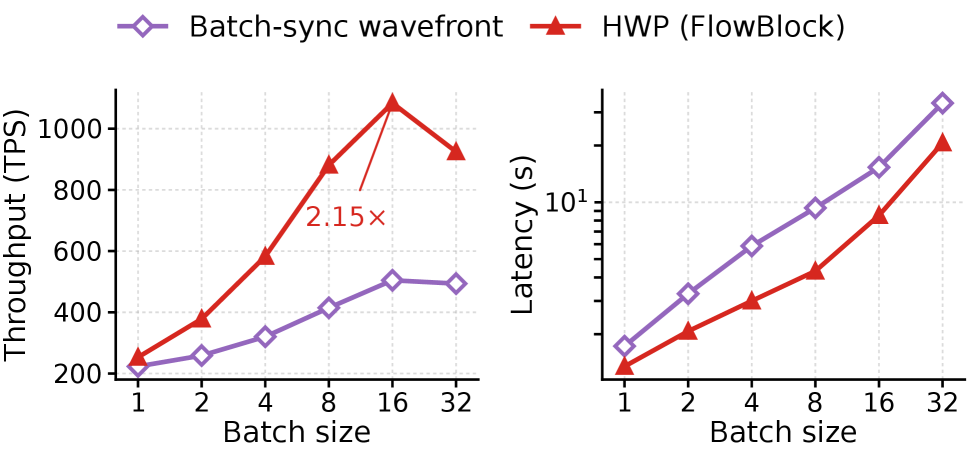
Results Reports up to 2.95x/4.01x tokens-per-second over LLaDA-2.1/LLaDA-2.0, up to 53.6%/77.1% lower latency, and a +1.3-point average accuracy gain (an improvement, not a regression). Against D2F, FlowBlock wins on both accuracy and batched serving throughput, by up to 16x. On GSM8K, Heterogeneous Wavefront Packing alone reaches 2.15x throughput at batch size 16 and cuts latency by 38% at batch size 32.
결과 LLaDA-2.1/LLaDA-2.0 대비 최대 2.95배/4.01배 토큰당 처리량, 최대 53.6%/77.1% 지연시간 감소, 평균 +1.3점 정확도 향상(저하가 아니라 향상)을 보고한다. D2F 대비로는 정확도와 배치 서빙 처리량 모두 우세하며 처리량 격차는 최대 16배에 달한다. GSM8K에서 Heterogeneous Wavefront Packing은 배치 16에서 2.15배 처리량, 배치 32에서 38% 지연시간 감소를 낸다.
Comparison Against D2F (training-based), FlowBlock needs no training at all yet still wins on both accuracy and batched throughput — an inversion of the expected trade-off where the training-based method should have the edge. Against the serial LLaDA-x baselines, the surprising part is not just speed but a small accuracy gain rather than a cost.
비교 D2F(학습 기반)와 비교해 FlowBlock은 학습이 전혀 필요 없으면서도 정확도와 배치 서빙 처리량 모두를 능가한다 — 학습 기반 방법이 당연히 이길 것이라는 기대를 뒤집는 결과다. 순차 LLaDA-2.x 베이스라인과 비교해서도 속도만 얻는 게 아니라 정확도가 소폭 오른다는 점이 이례적이다.
Significance Shows that the long-standing assumption that block-diffusion dLLM serving "must" be serial for correctness can be broken simply by redirecting the slack self-correction already provides toward scheduling. A practical lever for closing the batched-serving throughput gap between dLLMs and AR serving stacks.
의의 블록-확산 dLLM 서빙에서 "정확성을 위해 반드시 순차적이어야 한다"는 오래된 전제가 self-correction이 이미 확보한 여유를 스케줄링 쪽으로 옮기기만 하면 깨질 수 있음을 보여준다. 배치 서빙 환경에서 dLLM이 AR 서빙 스택과 경쟁하기 위한 처리량 격차를 좁히는 실용적 레버다.
Limitations The paper has no dedicated Limitations section in its conclusion. That evaluation is confined to two models (LLaDA-2.0/2.1) and eight benchmarks, and that the mechanism behind the reported accuracy *gain* (how much is benchmark variance vs. a genuine side-effect of T2T editing catching errors) is not analyzed at the abstract level, are reviewer additions (reviewer judgment).
한계 논문 자체의 결론부에는 별도 Limitations 절이 없다. 평가가 LLaDA-2.0/2.1 두 모델과 8개 벤치마크에 한정된다는 점, 그리고 정확도가 오히려 향상된 이유(어느 정도가 벤치마크 변동폭인지, T2T 편집이 실제로 일부 오류를 잡아내는 부수효과인지)가 abstract 수준에서는 분석되지 않는다는 점은 리뷰어가 덧붙인다(리뷰어 판단).
Future work Not stated in the paper. The Conclusion ends by summarizing that FlowBlock improves throughput and latency while matching or exceeding baseline accuracy across eight math and code benchmarks, and scales effectively under batched serving.
향후 과제 논문 내 명시된 별도 future-work 절은 없다. Conclusion은 8개 수학·코드 벤치마크에서 처리량과 지연시간을 개선하면서 베이스라인 정확도를 유지하거나 능가하고, 배치 서빙에서 효과적으로 확장된다는 결과 요약으로 끝난다.
Released resources An official GitHub repository is verified (Red-EAD/FlowBlock, confirmed via curl, HTTP 200) — the code is publicly released.
자원 공개 공식 GitHub 저장소가 확인된다(Red-EAD/FlowBlock, curl로 200 응답 확인) — 코드가 공개되어 있다.
The research thread
Where this paper sits 연구의 흐름
Block-diffusion dLLMs, starting with LLaDA and its block-wise KV caching design, seemed to break the autoregressive premise that generation must be serial — but the same serialism resurfaced at the boundary between blocks: a block's cache only becomes valid for its successor once that block is finished. Prior work like D2F tried to dissolve that boundary through training, buying limited speed at the cost of accuracy.
FlowBlock's conceptual shift is to redefine what "block finality" has to mean in the first place. Instead of treating finality as a binary event (done or not done), it leans on the T2T editing ability self-correcting dLLMs already have and argues that a "sufficiently informative draft" is enough for the next block to start working. Finality doesn't disappear — it just gets demoted from a hard gate to a tunable scheduling resource. That redefinition is what lets adjacent blocks overlap while still preserving exact frozen-prefix KV reuse (cache validity is never sacrificed).
The question this paper leaves open is how far the "finality as a scheduling resource" principle can travel. Here it's applied to the inter-block latency bottleneck, but the paper doesn't explore whether the same idea could absorb other forms of cache staleness — quantization error, or long-horizon revocation cascades, for instance. As the first clear demonstration that self-correction can function as a scheduling lever rather than just an error-tolerance property, it signals to dLLM serving-stack designers that "finality" is a renegotiable concept, not a fixed constraint.
블록-확산 dLLM은 LLaDA와 뒤이은 블록-단위 KV 캐싱 설계로 "생성은 순차적이어야 한다"는 자기회귀 모델의 전제를 깨는 것처럼 보였지만, 정작 블록 사이의 경계에서는 같은 순차성이 다시 나타났다 — 한 블록이 끝나야 다음 블록의 캐시가 유효해지는 것이다. D2F 같은 선행 연구는 이 경계를 학습으로 허물어보려 했지만 속도 이득이 제한적이었고 정확도를 깎아먹는 대가를 치렀다.
FlowBlock의 개념적 전환은 "블록 확정"을 아예 다른 종류의 요구로 재정의하는 데 있다. 확정을 이분법적 사건(끝났다/안 끝났다)으로 보는 대신, self-correcting dLLM이 이미 가진 T2T 편집 능력을 근거로 "충분히 정보가 담긴 초안"이면 다음 블록이 작업을 시작하기에 족하다고 본다. 확정은 사라지지 않는다 — 다만 하드 게이트에서 스케줄링이 조정 가능한 자원으로 격하될 뿐이다. 이 재정의 덕분에 정확히 동일한 frozen-prefix KV 재사용을 유지하면서도(캐시 유효성을 포기하지 않고) 인접 블록들이 겹쳐 진행될 수 있다.
이 논문이 여는 다음 질문은, 이 "확정을 스케줄링 자원으로" 원칙이 얼마나 멀리 갈 수 있는가이다. 지금은 인접 블록 사이의 지연시간 병목에 적용됐지만, 같은 발상이 캐시의 다른 형태의 "낡음"(staleness) — 예를 들어 양자화 오차나 장기 revocation cascade — 에도 흡수 가능한 여유를 제공할지는 이 논문이 다루지 않는다. self-correction이 스케줄링 레버로 작동한다는 것을 보여준 첫 사례로서, dLLM 서빙 스택 설계자들에게 "확정"을 재협상 가능한 개념으로 다루라는 신호를 보낸다.
Sparks — where one could take this 아이디어의 씨앗
-
The paper validates only on LLaDA-2.0/2.1 — whether the readiness-gate threshold or wavefront width transfers zero-shot to other block-diffusion dLLM families without retuning is untested. 논문은 LLaDA-2.0/2.1 두 모델에서만 검증한다 — 준비도 게이트 임계값(θ_spawn)이나 웨이브프론트 폭이 다른 블록-확산 dLLM 계열에도 재조정 없이 그대로 전이될지는 미검증이다.
-
The paper doesn't explore whether wavefront-parallel decoding's staleness tolerance compounds with, or gets eaten by, orthogonal memory-compression techniques like KV-cache quantization when the two are combined. 웨이브프론트 병렬 디코딩이 KV 캐시 양자화 같은 직교적인 메모리 압축 기법과 결합될 때, 두 기법의 지연-허용 여유가 서로 상쇄되는지 아니면 함께 쌓이는지는 논문이 다루지 않는다.
Seeds grounded in the paper's own stated limitations and open questions. 논문이 스스로 밝힌 limitations와 open questions에 뿌리를 둔 씨앗입니다.
Notes
Notes
Linked reviews
Fast-dLLM: Training-Free Acceleration of Diffusion LLMs via KV Cache and Parallel Decoding
A block-wise approximate KV cache plus confidence-thresholded parallel decoding accelerates open diffusion LLMs by up to 27.6x end-to-end with 1-2 point accuracy loss, entirely training-free.
diffusion-llmLLaDA: Large Language Diffusion Models
An 8B masked-diffusion language model trained from scratch on 2.3T tokens that matches LLaMA3-8B-class autoregressive baselines, showing next-token prediction is not the only recipe for LLM capabilities.
dllmSangam: Efficiently Serving Diffusion LLMs with the AR Stack
A dedicated serving system for cached diffusion-LLM inference introduces a deficit token-budget scheduler that manages prefill/decode interference without AR-style chunked prefill, sustaining 3x the query rate of an in-system Fast-dLLM baseline on LLaDA-8B and Dream-7B.
dllmLaCache: Exact Caching and Precision-Adaptive Inference for Diffusion Large Language Models
LaCache is a training-free acceleration framework for diffusion LLMs that eliminates redundant denoising-step computation via exact intermediate-result caching and adds per-group FP8 quantization to FFN layers, reaching 1.3x speedup alone and up to 40.2x when stacked with existing acceleration methods.
diffusion-llmConditional Total Correlation and the Serial Depth of Adaptive Parallel Sampling
Proves an exact information-theoretic identity showing that a parallel-decoding policy approximation error equals the conditional total correlation it discards each round, then uses it to show the confidence-based heuristics deployed in real masked diffusion language models are information-theoretically worse than decoding in random order.