Paper Review
Set Diffusion: Interpolating Token Orderings Between Autoregression and Diffusion for Fast and Flexible Decoding
A new diffusion language model class factorizes generation over flexible token sets instead of fixed blocks, using a set-causal architecture that supports exact KV cache updates after every step and arbitrary-order decoding.
고정된 block 대신 유연한 token 집합에 대해 생성을 인수분해하는 새로운 diffusion 언어모델 클래스로, 매 step마다 정확한 KV 캐시 갱신과 임의 순서 디코딩을 지원하는 set-causal 구조를 사용한다.
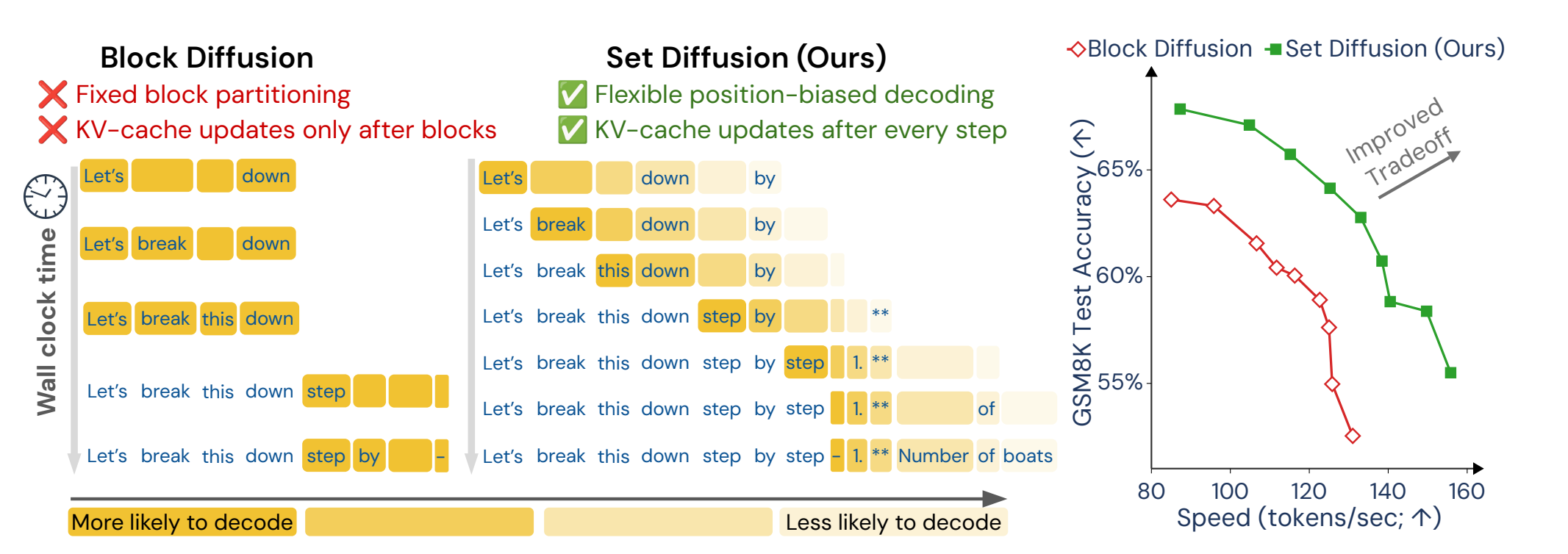
Background Discrete diffusion language models have steadily closed the quality gap with autoregressive (AR) models while offering parallel generation, but two structural handicaps remain: they are normally constrained to fixed-length generation, and their bidirectional attention prevents key-value (KV) caching. Block diffusion (BD3LM, ICLR 2025) partially bridged the two paradigms by running diffusion inside contiguous left-to-right blocks, recovering variable-length generation and per-block KV caching. This paper is the direct successor from the same Cornell group behind MDLM and BD3LM.
배경 이산 diffusion 언어모델은 병렬 생성을 제공하며 autoregressive(AR) 모델과의 품질 격차를 꾸준히 좁혀왔지만, 구조적 약점이 두 가지 남아 있다: 통상 고정 길이 생성에 묶여 있고, bidirectional attention 때문에 key-value(KV) 캐싱이 불가능하다. Block diffusion(BD3LM, ICLR 2025)은 연속된 좌→우 block 내부에서 diffusion을 돌리는 방식으로 두 패러다임을 부분적으로 이어, 가변 길이 생성과 block 단위 KV 캐싱을 복원했다. 이 논문은 MDLM과 BD3LM을 낸 Cornell 그룹의 직계 후속작이다.
Problem Block diffusion's rigid structure leaves three costs on the table: fixed left-to-right blocks preclude any-order tasks like infilling and arbitrary-position insertion; each block must finish before the next begins, capping parallelism; and because within-block denoising relies on bidirectional context, KV cache updates must wait until a block completes. It is like a toll gate that only admits a full busload at a time — even a token that is already finalized cannot enter the cache until the rest of its block is done.
문제 Block diffusion의 경직된 구조는 세 가지 비용을 남긴다: 고정된 좌→우 block은 infilling·임의 위치 삽입 같은 any-order 과제를 막고, 각 block이 끝나야 다음으로 넘어가므로 병렬성이 제한되며, block 내부 denoising이 bidirectional context에 의존하기 때문에 KV 캐시 갱신도 block이 완결될 때까지 미뤄진다. 버스 한 대가 다 차야만 통과시키는 톨게이트처럼, 이미 확정된 token조차 같은 block의 나머지가 끝날 때까지 캐시에 반영되지 못하는 셈이다.
Prior limitations Each neighboring approach gives something up: FlexMDM supports any-order flexible-length diffusion but needs a separate insertion network and a bidirectional transformer, precluding KV caching, while Esoteric LMs get caching from a causal architecture but supervise only randomly masked positions (sparser training signal) and do not handle variable-length generation. WeDLM adopts causal attention for caching but offers no tunable AR-diffusion interpolation, and classical any-order AR models (AO-ARMs) train over uniform orders with high-variance single-step estimators.
기존 한계 인접 연구들은 각자 무언가를 포기한다: FlexMDM은 any-order 가변 길이 diffusion을 지원하지만 별도 insertion network와 bidirectional transformer가 필요해 KV 캐싱이 불가능하고, Esoteric LM은 causal 구조로 캐싱은 되지만 무작위로 마스킹된 위치에만 supervision을 줘 학습 신호가 희소하며 가변 길이 생성을 다루지 않는다. WeDLM은 causal attention을 채택하나 AR-diffusion 간 조절 가능한 interpolation이 없고, 고전 any-order AR(AO-ARM) 계열은 uniform한 순서 위에서 고분산 estimator로 학습된다.
Goal Reframe the AR-diffusion interpolation axis itself: instead of varying a fixed block size, vary the *order* in which token sets are generated. Concretely, design a diffusion language model whose likelihood is autoregressive over flexible-position, flexible-length token sets, and whose architecture supports exact KV cache updates after every inference step plus arbitrary-order decoding, including sliding windows.
목표 AR-diffusion interpolation의 축 자체를 재정의한다: 고정 block 크기를 바꾸는 대신, token 집합이 생성되는 *순서*를 바꾼다. 구체적으로는 유연한 위치·길이의 token 집합에 대해 autoregressive한 우도를 갖고, 매 추론 step마다 정확한 KV 캐시 갱신과 sliding-window를 포함한 임의 순서 디코딩을 지원하는 diffusion 언어모델을 설계하는 것이 목표다.
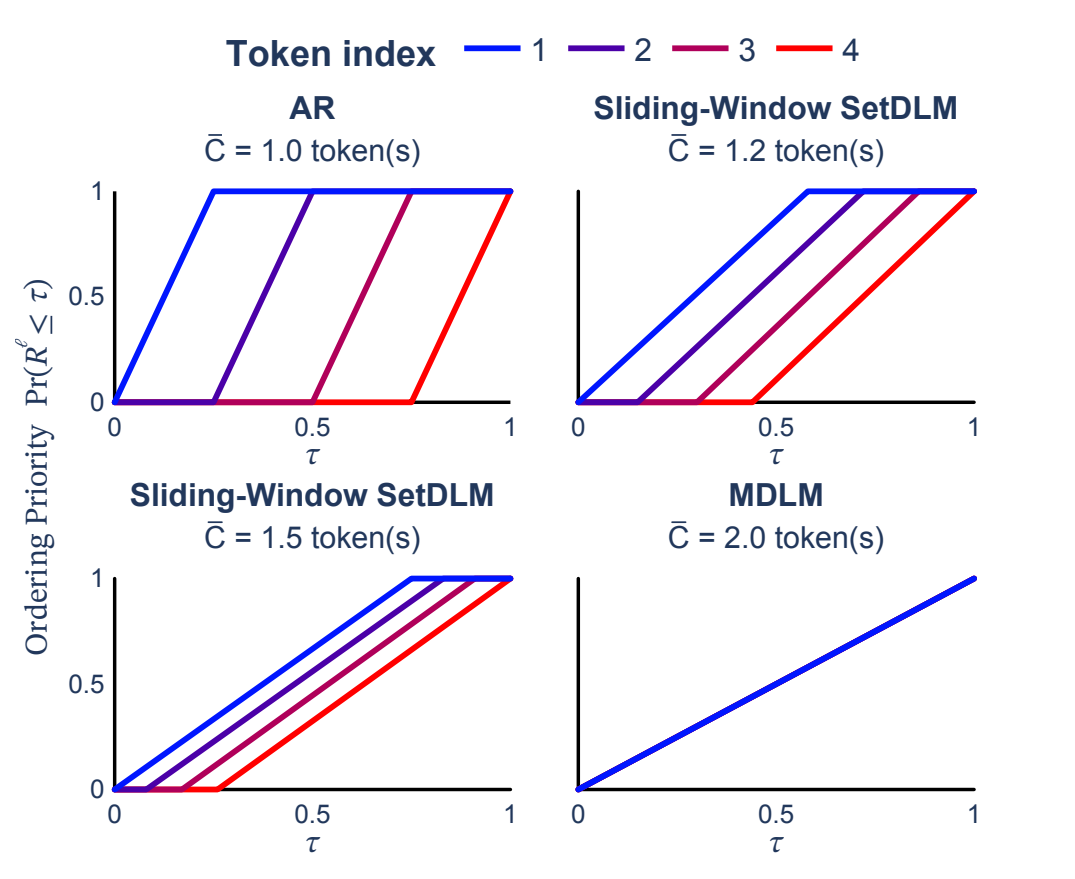
Method Set diffusion factorizes the sequence likelihood over token sets drawn from an ordering distribution π, marginalizing over generation orders with a variational bound; each set-conditional is modeled by masked diffusion, and a set-causal transformer keeps committed KV valid regardless of which set comes next. Orders are induced by position-offset reveal-time schedules: each position ℓ draws a random reveal time from its own interval [aℓ, aℓ+w], and sorting the sampled times yields the generation order — like a lottery where every token position is issued a ticket window for when it may be revealed, so narrow staggered windows produce near left-to-right order while one fully shared window produces fully random order. The practical instantiation, SW-SetDLM, trains on singleton sets so the sequence can be permuted into generation order and processed under one standard causal mask in a single forward pass (clean and noisy views concatenated), yielding a token-efficient, low-variance estimator.
방법 Set diffusion은 시퀀스 우도를 ordering 분포 π에서 뽑힌 token 집합들로 인수분해하고 생성 순서에 대해 variational bound로 marginalize하며, 각 집합-조건부는 masked diffusion으로, 전체는 확정된 KV가 다음에 어떤 집합이 오든 유효하게 유지되는 set-causal transformer로 모델링한다. 순서는 position-offset reveal-time schedule로 유도된다: 위치 ℓ마다 자기 구간 [aℓ, aℓ+w]에서 무작위 공개 시각을 뽑고 이를 정렬하면 생성 순서가 된다 — 각 token 위치가 자신이 공개될 수 있는 시간대 티켓을 추첨받는 복권과 같아서, 좁게 엇갈린 티켓 창은 좌→우 순서를, 전원이 공유하는 하나의 창은 완전 무작위 순서를 만든다. 실용 버전인 SW-SetDLM은 singleton 집합으로 학습해 시퀀스를 생성 순서로 permute하면 표준 causal mask 하나로 한 번의 forward pass(clean·noisy view를 concat)에서 모든 조건부 우도를 계산하는 token-efficient·저분산 estimator를 얻는다.
Key idea Causality is defined over the sampled generation order rather than over contiguous positions, so committing one token set never invalidates the KV entries of anything already committed — the cache behaves like an append-only ledger, growing exactly (no approximation) after every single inference step and never being recomputed. On top of this, a single window-width parameter w interpolates the whole model family: w=1 recovers order-agnostic MDLM, and as w→1/L the ELBO tightens to the exact AR objective (Prop. 4.1), with block diffusion and any-order AR also arising as special cases of the same likelihood.
핵심 아이디어 인과성이 연속된 위치가 아니라 샘플링된 생성 순서 위에 정의되므로, 한 token 집합을 확정해도 이미 확정된 것들의 KV가 절대 무효화되지 않는다 — 캐시는 append-only 장부처럼 매 추론 step마다 정확하게(근사 없이) 자라기만 하고 다시 계산되지 않는다. 그 위에서 window 폭 w 하나가 모델 패밀리 전체를 interpolate한다: w=1이면 order-agnostic MDLM이 되고, w→1/L이면 ELBO가 정확한 AR objective로 수렴하며(Prop. 4.1), block diffusion과 any-order AR도 같은 우도의 특수 사례로 복원된다.
Validation Four task families, all trained by the authors at small scale: GSM8K math reasoning with a student initialized from Qwen3-1.7B-Base and distilled on Qwen3-32B-Base teacher responses; CNN/DailyMail summarization (80M params); ROCStories infilling over 1,871 five-sentence stories with OWT-trained 110M models; and likelihood plus unconditional generation on OpenWebText and LM1B (perplexity, MAUVE). Throughput is measured at batch size 1 on an H100 80GB (four RTX A6000 48GB for unconditional generation), and comparisons are matched on inference prediction budget (Def. 4.2) so SW-SetDLM window sizes S≤{8,16,32} align with BD3LM block sizes S={4,8,16}.
검증 네 과제군을 저자들이 소규모로 직접 학습해 평가했다: Qwen3-1.7B-Base에서 초기화해 Qwen3-32B-Base teacher 응답으로 distill한 GSM8K 수학 추론, 80M 파라미터 CNN/DailyMail 요약, OWT로 학습한 110M 모델의 ROCStories infilling(5문장 스토리 1,871개), 그리고 OpenWebText·LM1B 우도 및 무조건부 생성(perplexity, MAUVE). 처리량은 H100 80GB에서 batch size 1로 측정하고(무조건부 생성은 RTX A6000 48GB 4장), inference prediction budget을 맞춰(Def. 4.2) SW-SetDLM window S≤{8,16,32}를 BD3LM block S={4,8,16}과 정렬해 비교한다.
Results On GSM8K, SW-SetDLM (S≤8) reaches 66.41% zero-shot pass@1 at ≥60.4 tok/s versus block diffusion's 63.53% at ≥55.4 tok/s — a strictly better speed-accuracy Pareto frontier, though the AR baseline still leads raw accuracy at 75.74%. On ROCStories infilling it beats BD3LM on ROUGE (R-1 11.6 vs 9.2 on infill 1/5) while decoding ~25% faster; on CNN/DailyMail it decodes up to 10% faster at competitive ROUGE (and beats the overfitting AR baseline); on unconditional OWT generation MAUVE improves 64.91 → 71.98 over BD3LM at higher throughput. On LM1B it posts the best diffusion test perplexity (≤27.83, S≤8) together with the highest diffusion throughput (≥98.5 tok/s), and the token-efficient objective cuts gradient variance by ~3×.
결과 GSM8K에서 SW-SetDLM(S≤8)은 66.41% zero-shot pass@1을 ≥60.4 tok/s로 달성해 block diffusion의 63.53%·≥55.4 tok/s를 속도-정확도 양면에서 이기며 Pareto frontier가 전 구간에서 우위다(단 AR 베이스라인은 75.74%로 정확도 자체는 여전히 앞선다). ROCStories infilling에서는 BD3LM 대비 ROUGE-1 11.6 vs 9.2(infill 1/5)에 ~25% 빠른 디코딩, CNN/DailyMail에서는 최대 10% 빠른 디코딩에 대등한 ROUGE(overfitting하는 AR 베이스라인은 능가), 무조건부 OWT 생성에서는 MAUVE가 BD3LM 대비 64.91→71.98로 오르면서 처리량도 높다. LM1B에서는 diffusion 계열 최고 test perplexity(≤27.83, S≤8)를 최고 처리량(≥98.5 tok/s)과 함께 기록했고, token-efficient objective는 gradient variance를 ~3× 줄인다.
Comparison Baselines span the retraining lane broadly: AR transformers, masked diffusion (MDLM, SEDD, D3PM, UDLM, Duo), DiffuGPT and ASSD on infilling, and BD3LM as the main hybrid rival; Eso-LM, FlexMDM, WeDLM, and AO-ARMs are distinguished at the mechanism level rather than in head-to-head tables. Training-free dLLM cache approximations (dKV-Cache, Fast-dLLM) appear only as motivation and as a component — Fast-dLLM's confidence-aware parallel decoding is reused as the sampler — not as baselines (reviewer judgment: a fair boundary, since set diffusion changes the training recipe rather than adding a post-hoc inference trick).
비교 베이스라인은 재학습 계열을 폭넓게 덮는다: AR transformer, MDLM·SEDD·D3PM·UDLM·Duo 등 masked diffusion, infilling에서는 DiffuGPT·ASSD, 그리고 핵심 라이벌인 BD3LM. Eso-LM·FlexMDM·WeDLM·AO-ARM과는 수치 표가 아니라 메커니즘 수준에서 구분 짓는다. training-free dLLM 캐시 근사(dKV-Cache, Fast-dLLM 등)는 베이스라인이 아니라 motivation과 부품으로만 등장한다 — Fast-dLLM의 confidence-aware parallel decoding은 sampler로 재사용된다 (리뷰어 판단: set diffusion은 사후 추론 트릭이 아니라 학습 레시피를 바꾸는 계열이므로 타당한 경계 설정이다).
Significance It generalizes the "exact KV cache via retraining" lane from fixed blocks to arbitrary sets, so that AR, MDLM, block diffusion, and any-order AR all become different settings of one dial — the reveal-window width w — on a single likelihood. For efficient dLLM serving this matters because the cache is an *exact* object refreshed every step: AR-side KV machinery (paging, quantization, eviction) has a well-defined target to act on, in contrast to approximate-cache dLLMs where cached states silently go stale. Accepted at ICML 2026.
의의 "재학습으로 정확한 KV 캐시를 얻는" 계열을 고정 block에서 임의 집합으로 일반화한 것으로, AR·MDLM·block diffusion·any-order AR이 전부 하나의 다이얼(reveal-window 폭 w)의 서로 다른 눈금이 된다. 효율적 dLLM 서빙 관점에서 중요한 이유는 캐시가 매 step 갱신되는 *정확한* 객체라는 점이다: paging·quantization·eviction 같은 AR 쪽 KV 인프라가 작동할 대상이 잘 정의되며, 캐시된 상태가 조용히 낡아가는 근사-캐시 dLLM과 대비된다. ICML 2026 채택작이다.
Limitations The paper's own limitations section concedes that an accuracy-parallelism tradeoff persists in tuning the position-offset schedules, which are currently hand-designed rather than learned. Scale is modest — 110M/80M-parameter models plus one distilled 1.7B GSM8K student — and the AR baseline still wins GSM8K accuracy outright (75.74% vs 66.41%). SW-SetDLM's one-shot factorized denoising also assumes conditional independence among tokens within a set, the same approximation parallel-decoding heuristics make (reviewer judgment: the most likely failure point as set sizes grow).
한계 논문 스스로 한계로 명시하듯, position-offset schedule 튜닝에는 여전히 정확도-병렬성 tradeoff가 남아 있고 schedule은 학습되는 것이 아니라 손으로 설계된다. 규모도 작다 — 110M/80M 모델과 distill된 1.7B GSM8K student가 전부이며, GSM8K 정확도는 AR 베이스라인이 75.74% vs 66.41%로 확실히 앞선다. 또한 SW-SetDLM의 one-shot 인수분해 denoising은 집합 내 token들의 조건부 독립을 가정하는데, 이는 parallel-decoding 휴리스틱들과 같은 근사다 (리뷰어 판단: 집합 크기를 키울 때 가장 먼저 깨질 지점이다).
Future work Explicitly deferred: learned ordering distributions, which are compatible with the framework but require propagating gradients through discrete sampling — the authors leave this to future work and point to progressive-unmasking and learned-order approaches as candidates. The limitations section also suggests tuning schedules to the parallelization profile of the inference hardware, effectively treating the ordering distribution as a serving-time knob.
향후 과제 명시적으로 미룬 것은 학습된 ordering 분포다: 프레임워크와 호환되지만 이산 샘플링을 통과하는 gradient 전파가 필요해 future work로 남기며, progressive-unmasking·learned-order 계열 연구를 후보로 지목한다. Limitations 절에서는 추론 하드웨어의 병렬화 특성에 맞춰 schedule을 조정하는 방향도 제안하는데, 사실상 ordering 분포를 serving-time knob으로 취급하는 셈이다.
Released resources Code is public at kuleshov-group/setdlms on GitHub, with model weights and an explanatory blog post on the authors' project page. Supplement L documents training configurations down to optimizer, batch sizes, and tokenizers, making it a sufficient starting point for reproduction.
자원 공개 코드는 GitHub kuleshov-group/setdlms에, 모델 가중치와 해설 블로그 포스트는 저자 운영 프로젝트 페이지에 공개되어 있다. 부록 L에 optimizer·batch size·tokenizer까지 학습 설정이 상세히 기록되어 있어 재현 출발점으로 충분하다.
The research thread
Where this paper sits 연구의 흐름
Set diffusion is the third act of a very legible Cornell lineage. MDLM (Sahoo et al., 2024) distilled masked discrete diffusion — descended from D3PM (Austin et al., 2021) and SEDD (Lou et al., 2023) — into a simple, scalable recipe, but inherited fixed-length generation and no KV cache. Block Diffusion (BD3LM; Arriola et al., ICLR 2025), by the same first author, made the first interpolation move: run diffusion inside contiguous left-to-right blocks, regaining variable-length generation and per-block caching. A small cluster formed around that axis — Esoteric LMs bought caching at the price of sparse supervision, FlexMDM bought any-order flexibility at the price of caching, and the older any-order AR line (ARDM-style AO-ARMs) had order flexibility but trained with high-variance estimators. Each held two corners of the caching / any-order / training-efficiency triangle; set diffusion is the same group's answer for holding all three.
The conceptual move is what the interpolation dial measures. Block diffusion interpolates by size: shrink blocks toward one token for AR, grow them for full diffusion. Set diffusion interpolates by order: the causal unit becomes an arbitrary token set drawn from an ordering distribution π, and causality is defined over the sampled generation order rather than over contiguous positions. The moment ordering becomes a first-class random variable you marginalize over — instead of a structural constant baked into the attention mask — the cache question decouples from the ordering question. Committed KV stays exactly valid no matter which set is revealed next, so the cache is an append-only ledger, growing each step, and a single reveal-window width w sweeps AR, MDLM, block diffusion, and any-order AR as different settings of one likelihood.
The most explicit opening is the one the authors defer themselves: π is still hand-designed. The paper proves the family contains AR at one end and order-agnostic diffusion at the other, but the interesting region is the middle, and nothing yet learns where a given task should sit — that requires gradients through discrete sampling, and the authors point to learned-order and progressive-unmasking work. The limitations section carries a subtler suggestion too: tune schedules to the parallelization profile of the inference hardware — effectively turning generation order into a serving-time knob, a layer of scheduling AR models never had.
The tension that remains is the classic one for this lane: the cache's exactness is proven, quality at scale is not. AR still wins GSM8K outright (75.74% vs 66.41%), the largest model is a distilled 1.7B, and within-set denoising still assumes conditional independence — the same approximation parallel-decoding heuristics make, and the first thing likely to strain as sets grow. Expect the field to push on three fronts: scaling the recipe, learning π, and testing whether "AR vs diffusion" survives as a distinction once both are merely orderings of one set-causal likelihood.
Set diffusion은 매우 뚜렷한 Cornell 계보의 3막이다. MDLM(Sahoo et al., 2024)은 D3PM(Austin et al., 2021)과 SEDD(Lou et al., 2023)에서 내려온 masked discrete diffusion을 단순하고 스케일 가능한 레시피로 정제했지만, 고정 길이 생성과 KV cache 부재를 그대로 물려받았다. 같은 1저자의 Block Diffusion(BD3LM, Arriola et al., ICLR 2025)이 첫 interpolation 수를 뒀다: 연속된 좌→우 block 안에서 diffusion을 돌려 가변 길이 생성과 block 단위 caching을 되찾은 것이다. 그 축 주변에 작은 군집이 형성됐다 — Esoteric LM은 희소한 supervision을 대가로 caching을 샀고, FlexMDM은 caching을 포기하고 any-order 유연성을 샀으며, 더 오래된 any-order AR 계열(ARDM류 AO-ARM)은 순서 유연성은 있었지만 고분산 estimator로 학습됐다. 각자 caching·any-order·학습 효율이라는 삼각형의 두 꼭짓점만 쥐고 있었고, set diffusion은 셋 다 쥐겠다는 같은 그룹의 답이다.
개념적 이동은 interpolation 다이얼이 무엇을 재는가에 있다. Block diffusion은 크기로 보간한다: block을 token 하나로 줄이면 AR에, 키우면 full diffusion에 가까워진다. Set diffusion은 순서로 보간한다: 인과 단위가 ordering 분포 π에서 뽑힌 임의의 token 집합이 되고, 인과성은 연속된 위치가 아니라 샘플링된 생성 순서 위에 정의된다. Ordering을 attention mask에 박힌 구조적 상수가 아니라 marginalize하는 일급 확률변수로 만드는 순간, cache 질문이 ordering 질문에서 분리된다. 다음에 어떤 집합이 공개되든 확정된 KV는 정확히 유효하므로 cache는 매 step 자라기만 하는 append-only 장부가 되고, reveal-window 폭 w 하나가 AR·MDLM·block diffusion·any-order AR을 하나의 우도 위 서로 다른 눈금으로 쓸어 담는다.
가장 명시적인 개구부는 저자들이 스스로 미룬 것이다: π가 아직 손으로 설계된다. 논문은 이 패밀리가 한쪽 끝에 AR을, 반대쪽 끝에 order-agnostic diffusion을 담는다는 것을 증명했지만, 흥미로운 영역은 그 중간이고 주어진 과제가 어디에 앉아야 하는지 배우는 장치는 아직 없다 — discrete sampling을 통과하는 gradient 전파가 필요하며, 저자들은 learned-order·progressive-unmasking 계열을 후보로 지목한다. Limitations 절에는 더 미묘한 제안도 있다: schedule을 추론 hardware의 병렬화 특성에 맞추라는 것 — 생성 순서를 serving-time knob으로 바꾸는 셈이고, AR 모델에는 존재한 적 없는 층위의 스케줄링이다.
남은 긴장은 이 계열의 고전적 긴장이다: cache의 정확성은 증명됐지만 규모에서의 품질은 아니다. AR은 GSM8K에서 여전히 확실하게 앞서고(75.74% vs 66.41%), 최대 모델은 distill된 1.7B이며, 집합 내 denoising은 여전히 conditional independence를 가정한다 — parallel-decoding 휴리스틱들과 같은 근사이고, 집합이 커질수록 가장 먼저 삐걱일 지점이다. 필드는 세 방향으로 밀고 나갈 가능성이 높다: 레시피의 스케일업, π의 학습, 그리고 둘 다 하나의 set-causal 우도 위 ordering일 뿐이라면 "AR vs diffusion"이라는 구분 자체가 살아남는지에 대한 검증.
Sparks — where one could take this 아이디어의 씨앗
-
One could parameterize the ordering distribution π and learn it end-to-end with gradient estimators through discrete sampling (score-function or relaxation based), letting each task discover where it should sit between AR and any-order decoding. Ordering 분포 π를 parameterize하고 discrete sampling을 통과하는 gradient estimator(score-function·relaxation 계열)로 end-to-end 학습해, 과제마다 AR과 any-order 사이의 최적 지점을 스스로 찾게 해볼 수 있다.
-
One could co-tune reveal-time schedules with the parallelization profile of the target inference hardware, treating generation order as a serving-time knob benchmarked across batch sizes and accelerators. Reveal-time schedule을 목표 추론 hardware의 병렬화 특성과 함께 co-tune해, 생성 순서를 batch 크기·accelerator별로 벤치마크되는 serving-time knob으로 다뤄볼 수 있다.
-
One could measure how the within-set conditional-independence approximation degrades as committed set size grows across task families, and turn that curve into a principled rule for choosing set sizes. 확정되는 집합 크기를 키울 때 집합 내 conditional-independence 근사가 과제군별로 얼마나 깨지는지 측정하고, 그 곡선을 set 크기 선택의 원칙적 규칙으로 바꿔볼 수 있다.
Seeds grounded in the paper's own stated limitations and open questions. 논문이 스스로 밝힌 limitations와 open questions에 뿌리를 둔 씨앗입니다.
Notes
Notes
The headline architectural move is genuinely novel within the “exact KV cache via retraining” lane: prior entries (BD3LM, Eso-LM, WeDLM) all keep the causal unit contiguous, while set diffusion makes the causal unit an arbitrary set, which is what unlocks sliding-window and other non-contiguous commit orders without losing exact caching. Numbers in this review are verified against the arXiv v1 PDF (no arXiv HTML rendering exists for this paper; the two figures were extracted from the PDF).
Linked reviews
LLaDA: Large Language Diffusion Models
An 8B masked-diffusion language model trained from scratch on 2.3T tokens that matches LLaMA3-8B-class autoregressive baselines, showing next-token prediction is not the only recipe for LLM capabilities.
dllmNemotron-Labs-Diffusion: A Tri-Mode Language Model Unifying Autoregressive, Diffusion, and Self-Speculation Decoding
A single NVIDIA model switches between autoregressive, block-wise diffusion, and self-speculative decoding from one set of weights, with self-speculation (diffusion drafts, the same model's AR pass verifies) beating multi-token prediction and the 8B model decoding 6x more tokens per forward than Qwen3-8B at comparable accuracy.
diffusion-llmConditional Total Correlation and the Serial Depth of Adaptive Parallel Sampling
Proves an exact information-theoretic identity showing that a parallel-decoding policy approximation error equals the conditional total correlation it discards each round, then uses it to show the confidence-based heuristics deployed in real masked diffusion language models are information-theoretically worse than decoding in random order.